



The most persistent bottlenecks in freight logistics are often found far from the highway. They sit inside the yards and loading docks operated by thousands of shippers and receivers, where utilization losses accumulate and trucks can spend valuable time waiting behind a warehouse gate.
At many facilities, that still means drivers lining up with as many as 10 other trucks, waiting to speak with a single employee behind a pane of glass.
YardFlow is now taking its yard automation platform across the entire network of a major beverage company after completing an initial deployment at 26 facilities. According to an analysis by YardFlow, the shipper was able to move nearly 5% more freight without increasing its headcount.
“That’s tens of millions of dollars of incremental profit,” YardFlow founder Jake Koppinger told FreightWaves.
The rollout is now expanding from the customer’s largest facilities to its smallest. Koppinger said the beverage company wants to establish the same operating standards across more than 200 locations.
“They’re pushing us into all of their 200+ facilities, including their smallest, so biggest to smallest, because they want to see that standardization,” he said.
Across the initial 26 sites, YardFlow has already processed close to 2 million shipments. The platform is operating at three-nines availability, or 99.9% uptime.
The Paper Trail Hidden Inside the Warehouse
YardFlow’s original challenge was remarkably basic: paperwork.
More specifically, the company targeted the traditional handoff of the bill of lading, a process that at thousands of U.S. distribution centers still depends on a printer, a stapler and a small slot in a window.
Koppinger described the process through a hypothetical example. A dock coordinator prints three copies of the document, organizes them, passes them through the window, receives a signature and then stores the shipper’s copy.
The result is an ever-growing archive of paper.
“They build up this big pile of paper, rubber band it, put a date on it, and put the pile in the box,” Koppinger said.
When the box is full, it can be moved into storage for seven years to meet the applicable statute of limitations.
The operational cost of that paperwork can emerge weeks later when invoice discrepancies arise. If a shipper invoices a retailer for 24 pallets but the retailer says only 23 were received, the discrepancy may only become visible after multiple invoices have already been bundled into a single payment.
“You have like 50 invoices that get paid at once and it comes back in a lump sum of like $1.2 million. Well, I was expecting through those invoices $1.3 million. Now I’ve got to figure out why a hundred thousand’s missing,” Koppinger said.
“That’s a cash attribution issue.”
Resolving the discrepancy can require a dock coordinator to return to the warehouse, locate the correct storage box and retrieve a signature from two months earlier.
The same employee may also be coordinating forklift drivers, assigning yard spotters, handling truck drivers and changing printer ink.
Koppinger compares the experience to the airport check-in process before digitalization.
Drivers waiting in those lines are not simply losing time. They can also accumulate detention costs and face the risk of on-time, in-full penalties associated with the delivery they are trying to complete.
Why the Driver Journey Comes Before Robotics
YardFlow’s core platform is centered on what Koppinger calls the “driver journey.”
The digital process takes a driver from gate check-in through dock assignment, then to check-out and digitally managed documentation. The platform has processed nearly 2 million shipments and maintains 99.9% uptime.
Drivers do not have to download an application, while QR-code check-in remains an optional feature.
That decision is intentional.
Koppinger argues that requiring drivers to install an app can create an operational obstacle when connectivity is poor or when a driver simply does not have the application.
“If you have any issues where truck drivers are asked to download an app to get a digital bill of lading or something, they don’t have it and then they’re stuck there trying to download this app, they don’t have connectivity,” he said. “That causes problems with your operations.”
Technology, however, is only one part of the challenge. The organizational structure of warehouses can be just as difficult to standardize.
Many facilities rely heavily on institutional knowledge accumulated over decades. Employees who have worked at the same site for 20 or 30 years often understand the operation better than anyone else and are central to keeping it running.
“You have people that have worked there for 20, 30 years and they’re the ones that keep the lights on,” Koppinger said.
Because large warehouse operations can be highly autonomous, individual facilities frequently develop their own procedures and operate in silos.
At major retailers and consumer packaged goods companies, a single facility can generate hundreds of millions of dollars in revenue. That scale can give individual sites substantial freedom to determine how they operate.
The consequence is a reporting problem. Warehouses may be measured against identical key performance indicators while collecting and organizing their underlying data in completely different ways.
For executives, that can make direct comparisons difficult because the data is effectively comparing operational “apples to oranges.”
YardFlow’s approach is to identify the common elements shared by virtually every yard.
Drivers arrive. They check in. They move through the facility. They sign documentation. Then they leave.
“There’s one common theme, one lowest common denominator that exists from an operational perspective that is sort of the heartbeat for how they ship products and generate revenue,” Koppinger said.
Machine Vision Adds Another Layer to Yard Control
Once the driver journey had been implemented, the beverage company asked YardFlow to address another part of the operation: yard management.
The company built the requested yard management system and is now deploying it, extending the same effort to the operations of yard spotters, jockeys and trailer inventory.
The newer layer incorporates machine vision, with cameras positioned at gates as well as on the spotters themselves.
The goal is to verify that physical yard movements actually match what the system instructed.
“If I tell a yard spotter to go take something from dock three and put it in spot four, the system has to trust that that’s what they did,” Koppinger said.
“But if you can have an eye in the sky to actually validate the fact that they took it from dock three and put it in spot four, now we have something to cross-check that.”
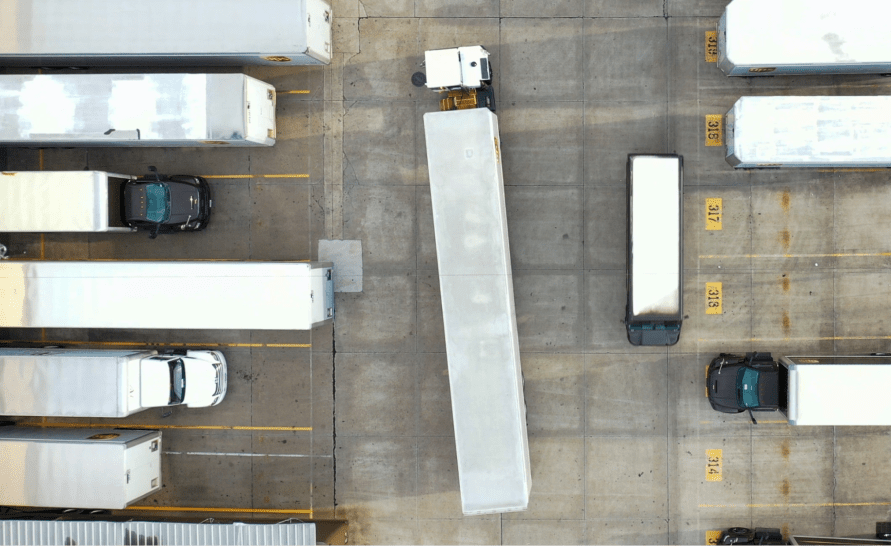
Cameras mounted on moving spotters are used to create what Koppinger describes as a digital twin of the yard.
At the gate, cameras can identify arriving and departing trucks and trailers, while the system can validate carrier identities against DOT and MC numbers.
That capability also has implications for cargo theft and identity fraud, two issues that have encouraged shippers to introduce stricter controls around who is allowed to enter and leave their facilities.
Fix the Foundation Before Adding the Flash
Koppinger’s message to shippers is intentionally practical.
He argues that companies should first solve the basic operational problems before introducing more advanced automation.
“There’s a lot of AI pilot fatigue. You pilot something, it never goes anywhere. It’s hard to scale,” he said.
For him, digitizing driver check-in and documentation represents the essential foundation — the “steak” rather than the “sizzle.”
Koppinger describes this as a deliberate order of operations.
“Let’s get the operations fixed. Let’s standardize your processes and protocols across your yards. Let’s get everything digitized so that you can then be in a position to start layering in these other layers of automation,” he said.
That means establishing a standardized digital workflow before introducing an autonomous yard jockey into a facility where drivers still arrive carrying paper and checking in on clipboards.
Deployment speed is another element of the strategy. YardFlow says the driver journey and yard management system can be activated remotely in about 30 minutes.
Machine vision takes longer because it requires hardware to be installed on site.
Koppinger said the company has watched other yard modernization projects spend years optimizing a single facility, only to encounter difficulties when attempting to extend the model across the rest of a network.
“We’ve seen companies take on yard modernization projects that take years to optimize one facility and then they struggle to get the next one on and scale across the pilot network, because there’s a gap between theory and operational reality or just require too much change management at once,” he said.
The Long-Term Goal: A Yard Ready for Autonomous Operations
YardFlow’s longer-term objective goes beyond digitizing paperwork.
The vision is a yard capable of dispatching machines with the same ease that it currently coordinates human workers.
Koppinger sees documentation as one of the barriers that must be removed before autonomous equipment can operate at scale.
“You’re not going to be handing paperwork to an autonomous truck, right? You’ve got to be able to orchestrate an autonomous truck in through the gate, through the yard, tell them where to go in whatever the language that autonomous truck speaks,” he said.
He also expects human and autonomous yard spotters to coexist for years.
“You’ve got to deal with both human spotters and autonomous spotters probably for the next 15 years,” Koppinger said.
In that model, YardFlow aims to serve as the central layer connecting the different elements of the operation.
“And so our system is kind of the brain that sits in the middle and orchestrates all of these different things to facilitate that autonomous yard,” he said.