



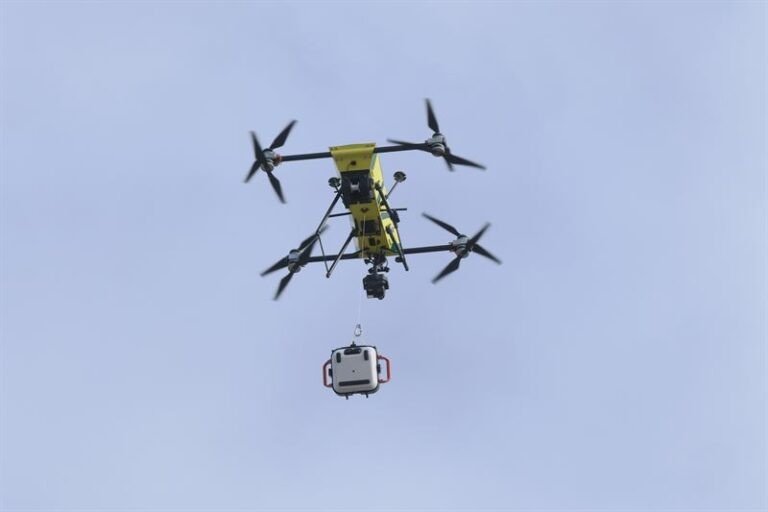
An emergency response with an automated external defibrillator (AED) provided by Everdrone’s autonomous drone system was meaningful in a confirmed out-of-hospital cardiac arrest involving a man in his 60s in Borås, Sweden, on 19 July 2026.
The drone was used as part of the standard emergency response program of the Västra Götaland Region (VGR) and meant that the AED arrived at the scene before the ambulance. After treatment, the patient was able to regain a pulse on scene and was transported to the hospital for further medical care.
The drone was automatically sent out from its operational base in Borås after an emergency call was received by SOS Alarm. It flew autonomously to the site and dropped the defibrillator, lowering it from a height of some 30 metres by a winch system.
Bystanders immediately began cardiopulmonary resuscitation (CPR) on the victim while waiting for the emergency crews, guided by the emergency dispatcher. The AED arrived and analyzed the patient’s heart rhythm and delivered a defibrillation shock prior to ambulance personnel and other emergency personnel assuming medical care.
“The first few minutes after an out-of-hospital cardiac arrest are critical for survival. So it is critical to be able to provide rapid access to an AED,” says Mats Sällström, CEO of Everdrone.
The first few minutes are crucial in out-of-hospital cardiac arrest. “Everdrone’s drone system helps healthcare providers get an AED to the scene as quickly as possible to give the patient the best chance of survival,” he said.
Every actual deployment shows the value of integrating drone technology into emergency medical services, said Sällström. The drones are not meant to substitute for ambulances, but to supplement existing emergency resources by getting life-saving equipment to the most critical moments before medical teams can arrive.
The operation was part of the Västra Götaland Region’s emergency drone programme where drones are automatically dispatched with ambulances when a suspected cardiac arrest is reported.
Everdrone’s Drone Emergency Medical Services (DEMS) platform is already operational in Sweden and France. The company said the latest intervention further highlights the potential of drone-assisted emergency response to improve patient outcomes, while raising awareness of drones as a valuable addition to conventional emergency medical services.
The service is operated in collaboration with Everdrone and Västra Götaland Region. Six drone bases are operational and providing coverage for over 300,000 residents as part of a long-term plan to cut response times and boost survival rates for those experiencing out-of-hospital cardiac arrest. The successful intervention in Borås is yet another example of how drone technology is becoming an integrated part of everyday emergency healthcare operations.