



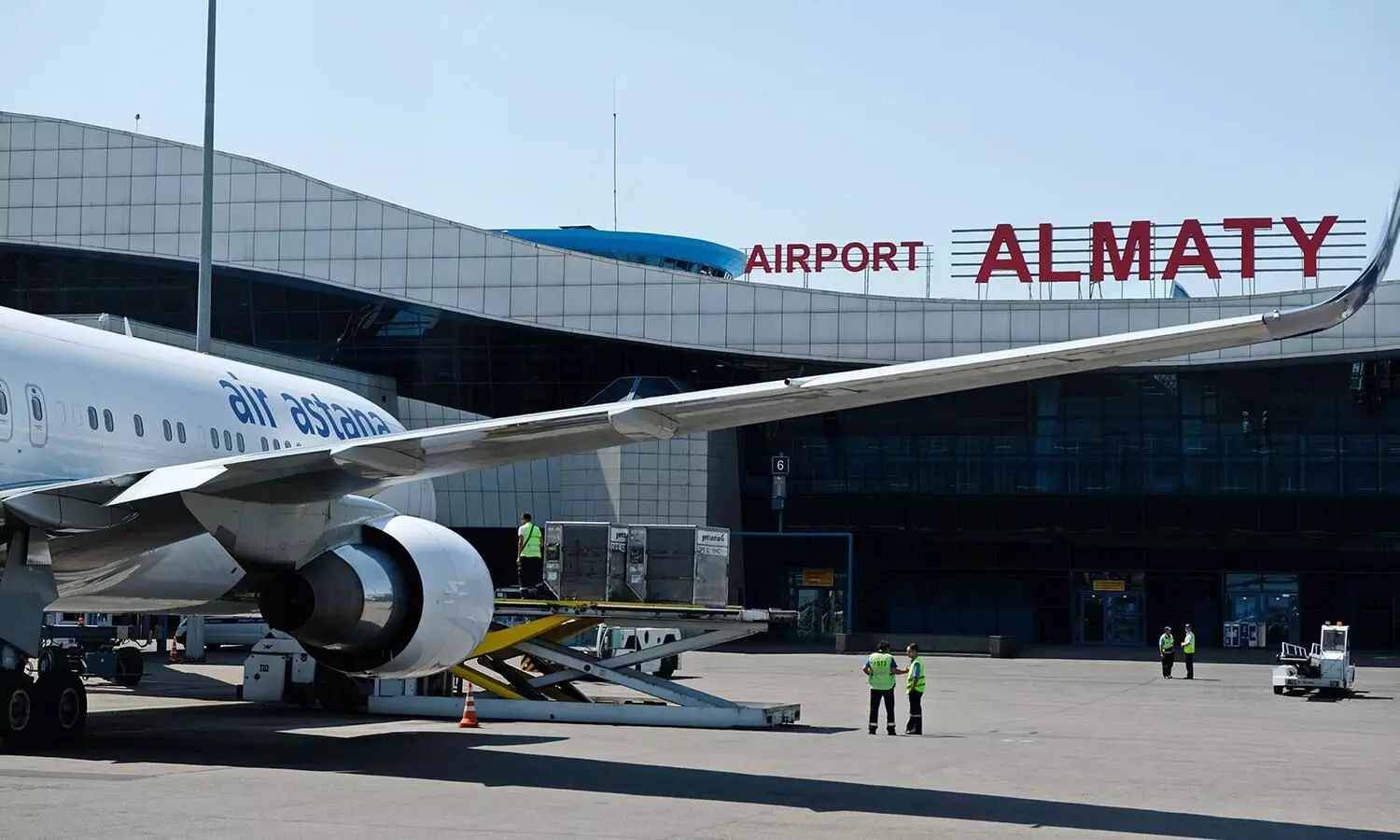
CargoPoint is taking a bigger position in Central Asia with the opening of a new office in Almaty, Kazakhstan, a move that gives the freight forwarder a stronger presence along its China-Europe trade corridor.
The new location is not simply another office on the company’s map. It puts a CargoPoint team directly on the ground in Kazakhstan, allowing the company to manage a growing share of the China-Europe route locally and strengthen its Truck+Air multimodal service.
The timing comes as shippers continue to search for alternatives to traditional transport routes affected by congestion and geopolitical uncertainty.
From China to Europe through Central Asia
CargoPoint’s model combines road and air transport rather than relying entirely on one mode.
Cargo consolidated in Shenzhen and Xi’an first moves by road through Khorgos and into Kazakhstan. From there, shipments are transferred to air services operating from Almaty and Astana, connecting them with destinations across Europe, the Middle East, Africa and the Americas.
Until now, the corridor was coordinated from CargoPoint’s headquarters in Tashkent. The company says its Truck+Air solution can cut China-Europe transit times by at least two days.
The service is positioned as a “deferred” air freight option, combining the relatively low cost of road transportation with the faster transit offered by air freight.
For shippers, CargoPoint sees this as another option alongside established routes such as Russian rail and Red Sea ocean services, particularly when those corridors face operational or geopolitical challenges.
More control along the route
The arrival of the Almaty office will split operational responsibility between Kazakhstan and Uzbekistan.
Shipments travelling through Kazakhstan will be handled by the Almaty team, while movements through Uzbekistan will remain under the responsibility of the Tashkent operation.
For CargoPoint CEO Bahtiyar Nomozbaev, the new gateway strengthens a strategically important link between East and West.
“By strategically integrating the Almaty gateway into our China-Europe network, we are unlocking a critical artery for global commerce,” Nomozbaev said.
He said the company’s objective is to give shippers a resilient and high-speed alternative capable of operating beyond traditional maritime and geopolitical constraints, helping keep East-West trade moving in an increasingly unpredictable environment.
CargoPoint Business Development Director Mirzali Mirusmonov stressed that the investment should not be viewed as an attempt to enter an entirely new market.
Instead, he said, Almaty is intended to complete CargoPoint’s existing network.
Having a team on the ground in Kazakhstan gives the company greater operational control across the corridor, while also improving execution and scalability. According to Mirusmonov, the office will also provide a platform for longer-term growth as global trade flows continue to evolve.
Demand for alternative routes is growing
CargoPoint expects traffic through Almaty to build as more shippers reconsider congested maritime routes and airspace affected by geopolitical disruptions.
The new office will work with both existing customers and new clients, while CargoPoint develops additional routing possibilities through Central Asian gateways.
The broader goal is to make the China-Europe Truck+Air service more flexible, allowing cargo owners to adapt their transport choices according to changing conditions rather than depending on a single trade lane.
CargoPoint currently operates hubs in Tashkent, Almaty, Dubai and Singapore. Its portfolio covers air freight, road and rail transport, multimodal solutions, last-mile delivery and customs brokerage.
With the Almaty operation now directly integrated into the network, CargoPoint is betting on Central Asia’s growing role as a bridge between Chinese production centres and European and international markets.