



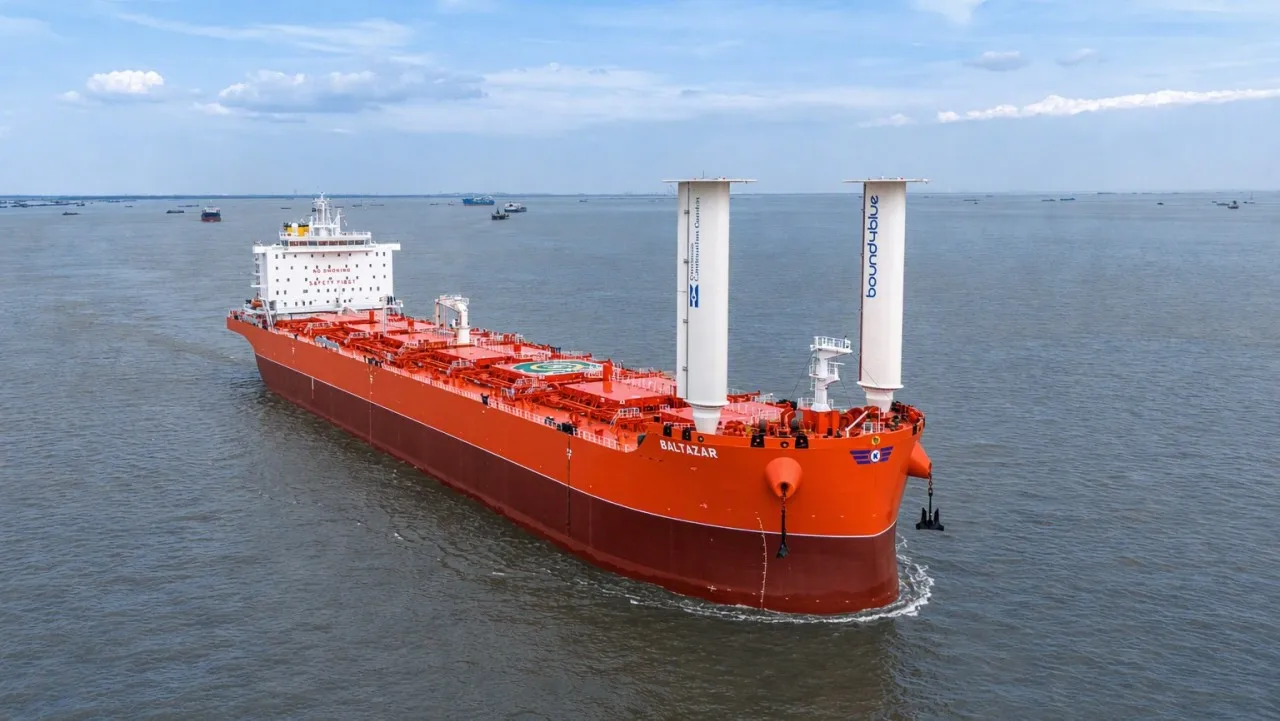
Klaveness Combination Carriers (KCC) has added another vessel to its growing fleet of combination carriers with the delivery of the 83,000-dwt Baltazar.
Delivered last Thursday, the new vessel is now sailing towards Fremantle, Australia, where KCC will hold its naming ceremony with invited guests.
The Baltazar is the third and final contracted vessel in the CABU III series, bringing KCC’s CABU fleet to 11 vessels and its total number of combination carriers to 19.
But the latest addition is notable for more than its capacity. The ship introduces wind-assisted propulsion to the CABU III series, adding another technology to KCC’s efforts to reduce emissions and improve the commercial performance of its fleet.
A ship designed for two very different cargoes
The Baltazar has been designed around a trading model that allows it to move between liquid and dry bulk cargoes without the extended ballast periods typically associated with conventional vessels.
On its outbound voyage, the vessel is designed to carry caustic soda solution from Asia, mainly China, to Australia, where the chemical is used in the production of aluminium.
Rather than returning empty, the vessel can then switch to dry bulk cargoes for the return journey. These can include aluminium, bauxite, iron ore and grain.
According to KCC, this operating model gives the Baltazar a 35% lower carbon footprint than first-generation CABU vessels while providing 20% higher earnings potential.
Wind power joins the efficiency package
Like its two sister vessels, Balder and Bastion, the Baltazar has been equipped with a series of technologies aimed at reducing fuel consumption.
These include an air lubrication system, a shaft generator, an EcoEGR fuel-optimised engine and a Mewis Duct supplied by Germany’s Becker Marine Systems.
The Baltazar, however, takes the concept one step further.
It is the first vessel in the series to use wind power, with two bound4blue eSAIL suction sails installed to harness wind energy and help reduce the ship’s fuel requirements.
The vessel has also been prepared for a future transition to zero- or near-zero-carbon fuels, allowing it to be retrofitted as suitable technologies and fuels become available.
Why combination carriers remain attractive
Combination carriers come with higher construction costs than conventional bulk carriers or tankers because they are designed to handle both dry and liquid bulk cargoes.
Their commercial advantage comes from the flexibility that this additional capability provides.
By being able to carry different types of cargo on different legs of a voyage, combination carriers can maintain high load factors and spend less time sailing in ballast.
That translates into greater earning potential, while also allowing operators to make more efficient use of each voyage.
KCC, which describes itself as the world’s largest owner of combination carriers, currently operates eight CLEANBU vessels in addition to its CABU fleet.
The CLEANBU vessels are designed to transport clean petroleum products and dry bulk cargoes, further extending the company’s strategy of combining cargo flexibility with improved operational efficiency.
With the arrival of Baltazar, KCC now has another vessel capable of combining multiple cargo streams with a growing package of energy-saving and wind-assisted technologies.