



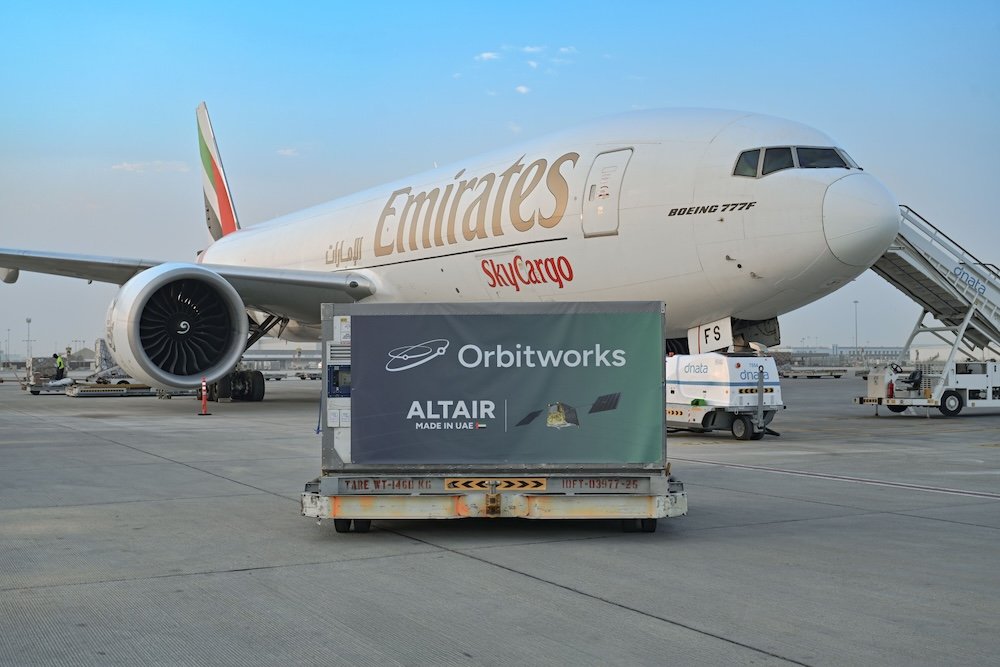
Emirates SkyCargo has completed the transportation of Altair-1, the United Arab Emirates’ first commercial AI-enabled Earth observation satellite, marking another milestone for the country’s growing space and advanced technology sector.
The satellite was transported from Dubai World Central (DWC) to Los Angeles International Airport (LAX) aboard an Emirates SkyCargo Boeing 777 freighter. The shipment took place ahead of Altair-1’s scheduled launch in October 2026.
Developed and manufactured in the UAE by Orbitworks, Altair-1 is the first of 10 satellites planned for the Altair constellation. The multi-sensor system combines optical, infrared, thermal and radio-frequency (RF) sensing with onboard artificial intelligence processing.
The constellation is designed to deliver analysis-ready intelligence across a range of applications, including environmental monitoring, disaster response, land and coastal-use analysis, maritime domain awareness, resource monitoring and infrastructure assessment.
Its advanced imaging payloads, optimized orbital design, frequent revisit rates and consistent data collection are intended to provide detailed information for organizations requiring timely Earth observation data.
Specialized logistics for a sensitive payload
The movement of Altair-1 also highlights Emirates SkyCargo’s capabilities in handling highly sensitive and specialized aerospace cargo.
A dedicated team managed the satellite’s end-to-end transportation, applying strict environmental and safety controls throughout the journey and ensuring the shipment arrived according to schedule.
Badr Abbas, Divisional Senior Vice President of Emirates SkyCargo, said the carrier was proud to support Orbitworks during what he described as a significant moment for the UAE.
He highlighted the specialist expertise required to transport technologically advanced and highly sensitive cargo and said the movement from the UAE to the United States demonstrates the importance of specialized air freight solutions to the global aerospace industry.
For Orbitworks, the shipment represents another important step toward the company’s first satellite launch.
Schahan Sediqi, General Manager of Orbitworks, described Altair-1 as the result of extensive work by the company’s team and said its transportation would not have been possible without UAE-based partners such as Emirates SkyCargo.
The company is now preparing for the planned October launch, when Altair-1 is expected to enter orbit and begin its mission.
Growing aerospace cargo expertise
Emirates SkyCargo has built significant experience in transporting satellites and other specialized aerospace equipment around the world.
Most recently, the carrier transported Arab Satellite 813 from Dubai to its launch site near Shanghai, China.
In 2018, Emirates SkyCargo also made history by transporting Khalifasat, the first satellite developed and built by UAE engineers, from Dubai to South Korea.
The carrier’s Aerospace and Engineering service has become one of the fastest-growing specialized verticals in its portfolio. During 2026, Emirates SkyCargo has transported more than 6,000 tonnes of aerospace and advanced engineering cargo worldwide.
Freighter expansion strengthens global network
The Altair-1 shipment comes as Emirates SkyCargo continues a major expansion of its freighter fleet and global network.
Since March 2026, the carrier has received six Boeing 777-F production freighters as well as one Boeing 777-300ERSF converted from an Emirates passenger aircraft.
A further four Boeing 777-F production freighters and one additional converted freighter are scheduled to join the fleet later this year.
The expanded fleet has enabled Emirates SkyCargo to increase its dedicated freighter network to more than 60 destinations.
The additional capacity gives customers greater access to main-deck cargo space while providing increased flexibility to manage changing international supply chain requirements.
With Altair-1 now safely transported to Los Angeles, Emirates SkyCargo is once again demonstrating the role of specialized air cargo in supporting the rapidly developing global aerospace and space technology industries.