



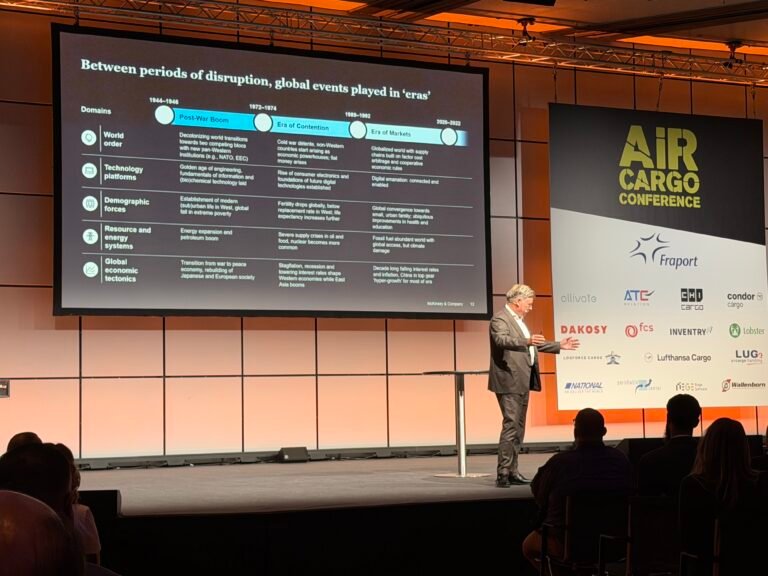
More than 400 professionals from across the international air cargo and logistics sector have gathered in Frankfurt for the 11th Air Cargo Conference, taking place on 2 and 3 September at the Congress Center of Messe Frankfurt and hosted by Air Cargo Community Frankfurt e.V.
The conference has grown considerably since its beginnings more than a decade ago, when it was launched as a relatively small initiative bringing together industry professionals, academics and students. Following years of expansion, including last year’s anniversary edition held at Frankfurt’s football stadium, the event has established itself as a significant fixture on the European air cargo calendar.
The diversity of the participants reflects the complexity of the air cargo ecosystem itself. Airlines, freight forwarders, handling agents, suppliers, technology providers and representatives from numerous other areas of the supply chain are all represented at the event.
“We have airlines, we have freight forwarders. We have handling agents. We have suppliers, technology providers, and we do have a lot more from our supply chain representatives of all the different kinds of services we have in our very long, long supply chain here in cargo, in the air as well as on the ground,” said Michael Hope, Member of the Board of Air Cargo Community Frankfurt, while opening the conference.
Hope pointed to the complexity created by such a broad ecosystem, but argued that this diversity is also one of the sector’s greatest strengths.
“But this diversity makes our business very complex, but at the same time, it’s our strength because we do have many, many sets of things that we know very well, and we do very good jobs everywhere. Otherwise, the whole system wouldn’t work.”
An increasingly international gathering
The conference is no longer a primarily local Frankfurt event. Its audience has become increasingly international, with delegates travelling from across Europe as well as China, Ethiopia, India, the United States and other parts of the world.
For the organisers, that international presence underlines both Frankfurt’s role as a major logistics gateway and the global nature of air cargo itself.
“Our guests are not from Frankfurt local and not Frankfurt Downtown. No, this conference developed into an international conference in the meantime. We have people from across Europe. We also have participants here from China, from Ethiopia, from India, United States, and also other parts of the world. So that makes it a really international event,” Hope said.
The international character of the event comes as the industry faces a particularly complex operating environment. Geopolitical tensions, trade disputes, conflicts, economic uncertainty and regulatory changes are all reshaping global supply chains and influencing the way cargo operators and their customers manage international trade.
Resilience at the centre of the discussion
Against this backdrop, resilience has emerged as a central theme of the conference.
The experience of the pandemic, as well as earlier crises, has demonstrated that periods of disruption can also create opportunities for innovation and change. According to Hope, these moments can force the industry to reconsider established approaches and find new ways of maintaining connectivity.
“We have learned not only in the pandemic but also before that always crises bear a lot of potential for new ideas and new opportunities, and crises make us think differently. So that helps to develop and that helps to reshape the industry again,” he explained.
Airfreight’s speed and flexibility become particularly important when traditional transport routes are disrupted.
“When common sea transport routes don’t work properly, aircraft keeps goods moving. That means that we are able to be flexible and to be very speedy in global connectivity,” Hope added.
For shippers and logistics providers dealing with an increasingly unpredictable trading environment, that flexibility is becoming an important part of supply chain resilience. The cargo business also represents an important source of revenue for airlines while contributing to the wider resilience of their operations.
However, the role of air cargo extends well beyond the movement of goods and its commercial contribution.
Connecting industries, people and countries
Airfreight supports a wide range of critical industries, including pharmaceuticals, healthcare, technology and manufacturing. It also links different parts of the global economy, bringing together companies, people and markets across borders.
“Cargo is about much, much more than only the transportation of goods. Cargo connects industries, people, and connects also countries and cultures. It brings together aviation and brings together the air and the ground. So our business is everywhere,” Hope said.
That broader role is reflected in the programme prepared for the two-day event. Alongside keynote presentations and panel discussions, delegates are being given opportunities to discover emerging technologies, meet innovative companies and explore new approaches to challenges facing the industry.
Startups, technology and new business opportunities
For the second consecutive year, the conference is also putting the spotlight on startups. Eight companies will present their innovative solutions during the afternoon, with their ideas assessed by a jury.
“For the second time, we will have eight startups in the afternoon presenting their innovative solutions to us and to a jury,” said Felix Toepsch, Executive Director of Air Cargo Community Frankfurt.
The exhibition area has also been expanded, giving companies from across the cargo ecosystem a dedicated space to showcase their services and technologies.
“This year, once again, we have an exhibition area right in front here. So during the break, I encourage you to have good coffee and chats, but also check out the exhibition booths and exchange with their colleagues there,” Toepsch said.
In addition to the exhibition, private meeting rooms are available for more focused commercial discussions. Delegates can also use the event app to connect with other participants and submit questions directly during conference sessions.
A community-driven event
The organisers emphasised that the conference is the result of a collective effort involving numerous partners from across the industry.
“This is, as always, a community effort, and all that you have seen, that you have experienced already, and that we will see in the next upcoming days, would not have been possible without the tremendous support of our partners,” Toepsch said.
Those partners have contributed to the conference programme, provided services and supported keynote presentations and other elements required to bring the event together.
The conference is also designed to create opportunities for less formal exchanges. At the end of the first day, delegates will have the opportunity to continue their conversations during a sunset cruise on the Main River.
Building stronger connections for the future
Ultimately, the organisers see the Air Cargo Conference as more than a platform for presentations and industry discussions. At a time when global supply chains are under pressure from geopolitical and economic developments, the event is intended to encourage collaboration, share expertise and identify practical responses to a rapidly changing market.
“These conferences like today are very important. They allow us to learn from each other. They allow us to meet new people, to get new ideas, discuss challenges, identify new opportunities and strengthen partnerships to shape the future for our industry,” Hope said.
He also wished delegates a productive conference across both days before concluding with a message that captures the broader purpose of the event and the industry it represents:
“Cargo connects the world and cargo connects all of us.”