



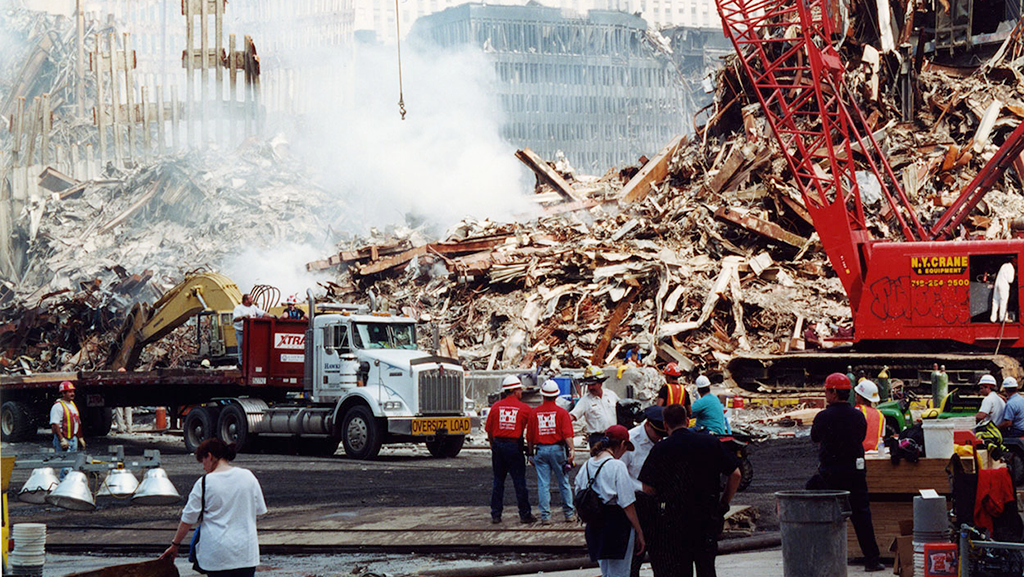
In the aftermath of the devastating events of Sept. 11, 2001, the American Society of Civil Engineers (ASCE) and organizations such as the National Institute of Standards and Technology (NIST) launched extensive investigations into the factors that led to the progressive collapse of the World Trade Center towers.
Those investigations not only helped engineers understand what happened to the buildings, but also changed the way structural risks are assessed and addressed.
A recent article recounts the experiences of engineers who played a role in examining the World Trade Center and the Pentagon. Their accounts combine technical findings with personal memories of the attacks and highlight the lessons that have influenced structural engineering over the past 25 years.
The Daily Commercial News has highlighted several key elements from that article. The full version is available through ASCE.
The need for a blast standard
On the morning of Sept. 11, 2001, Paul Mlakar, an engineer emeritus with the U.S. Army Corps of Engineers, was preparing for a telephone discussion with colleagues about the need for a standard covering blast-resistant design.
A news program was playing silently in the background when the first aircraft struck the North Tower at 8:46 a.m. EDT.
For Mlakar, the attacks demonstrated the importance of developing what would eventually become the ASCE/Structural Engineering Institute 59-22 Blast Protection of Buildings standard.
“Not all buildings need to be blast-resistant,” he said. “But for public buildings, we now have the ASCE standard to provide a basis for that. It could help designers better protect those structures in the future.”
The standard has since provided structural designers with a framework for considering blast protection in buildings where such risks are relevant.
Designing against progressive collapse
Gerard Schwartz, who became president of ASCE the month following the attacks, visited Ground Zero for the first time in late October 2001.
According to the article, he said the public often does not realize the extent of the contribution made by structural engineers, particularly members of SEAoNY, to the rescue and cleanup operations following the attacks.
As the new head of ASCE, Schwartz helped coordinate civilian forensic teams responsible for assessing and analyzing building performance at both the World Trade Center and the Pentagon.
The work provided engineers with a better understanding of the factors that contributed to the collapses and offered information that could be incorporated into the design of future structures.
“The planes hit the World Trade Center tower at an angle, cutting through several floors,” Schwartz explained. “The building was actually strong enough structurally to withstand that hit. But it wasn’t strong enough to withstand the fire that resulted from all the jet fuel. That lit everything inside the building on fire, buckling important joists that provided important vertical and horizontal support.”
The Pentagon’s older structural design also played a role in limiting the extent of a potential progressive collapse.
“There was a lot about the way the Pentagon was designed and built (beginning) in 1941 that made it more resistant to the progression of collapse,” Mlakar said in the article.
“There was a relatively small area of the building that collapsed 20 minutes after impact, but the extent of it was fairly minimal, thanks to the continuity of the structural system and the way the columns were reinforced. We can learn from that.”
The contrast between the two structures provided engineers with valuable information about how structural continuity and reinforcement can influence the progression of a collapse.
A broader view of structural risk
Vicki Arbitrio, an associate partner at Manhattan-based Gilsanz Murray Steficek, was serving as secretary of SEAoNY when the twin towers collapsed.
Looking back on the aftermath, she said in the article that “strong engineering judgment” helped ensure that no one suffered fatal physical injuries during the removal process.
Twenty-five years after the attacks, Arbitrio believes that the investigations conducted by ASCE and NIST have contributed to broader improvements in building safety.
She also points to a significant cultural change within structural engineering. The experience of 9/11 encouraged greater collaboration between different engineering disciplines and reinforced the importance of considering a wider range of potential risks during the design process.
Arbitrio also notes that the World Trade Center had, in fact, been designed with the possibility of an aircraft impact in mind.
“Planes have gotten so much bigger since the building went up (in 1973), and no one thought any impact would be intentional,” she said.
The evolution of aircraft, combined with the intentional nature of the 9/11 attacks, demonstrated that engineers must consider how changing technologies and threats can affect structures.
“We understand now there are other technologies we need to learn more about so we can understand their potential impact on a structure, depending on where a building is and what’s around it,” Arbitrio added.
“There are a lot of possibilities that you want to consider as you work through a design.”
Lessons that continue to shape the profession
The structural engineering lessons from Sept. 11 extend far beyond the investigation of the World Trade Center towers and the Pentagon.
The work carried out by ASCE, NIST and the engineers involved in the forensic investigations helped deepen the profession’s understanding of blast protection, progressive collapse, structural continuity, fire resistance and broader risk assessment.
Twenty-five years later, the experiences of those engineers continue to influence how structural risks are evaluated and how buildings are designed to respond to threats that may not have been fully anticipated when earlier structures were conceived.







