



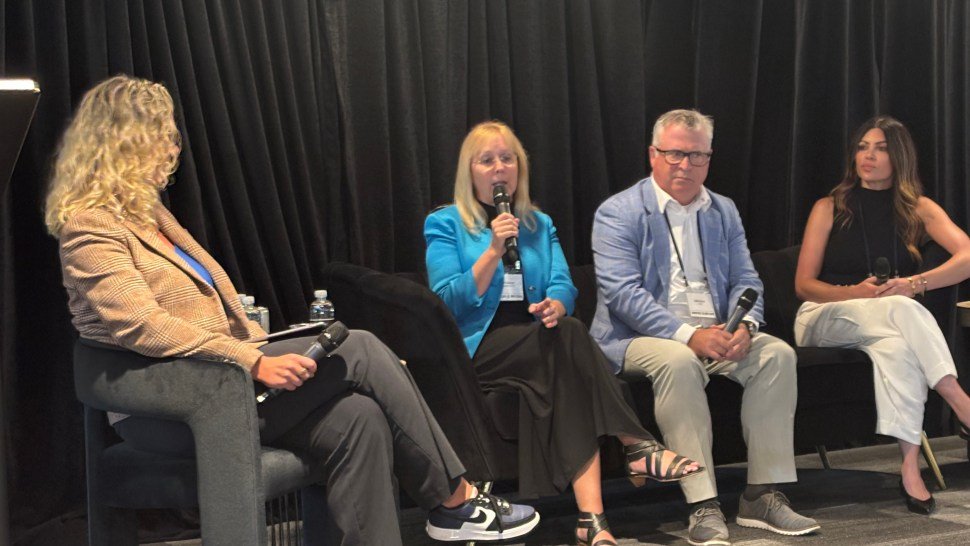
NAPERVILLE, Illinois – A U.S. Supreme Court ruling that could reshape broker liability unexpectedly became part of the conversation at a conference focused on logistics mergers and acquisitions — and, according to Prosperio Group CEO Beth Carroll, it may also strengthen the case for keeping humans firmly involved in brokerage decisions.
The unexpected guest at the Logisyn Advisors M&A Club conference was Montgomery vs. Caribe Transport II, a recent Supreme Court decision that opened the door to greater liability exposure for freight brokers.
The ruling has already been viewed as a potential catalyst for mergers and acquisitions across the third-party logistics sector. Smaller brokers facing higher insurance premiums and other costs in an increasingly uncertain legal environment could seek the protection and resources of larger parent companies.
But that was not the main argument made at the conference.
Instead, Carroll raised Montgomery during a panel on developing and retaining talent. Her point was particularly relevant to brokers concerned that artificial intelligence could eventually eliminate traditional brokerage jobs.
The concern is not theoretical. The financial results of C.H. Robinson (NASDAQ: CHRW) have for several years shown a steady reduction in head count even as the company’s freight volumes and profits have increased, a trend that is still ongoing.
Carroll, whose book “Taming the Compensation Monster” on freight-broker compensation was distributed to attendees at the Logisyn conference, described the implications of Montgomery as “another whole layer on top of everything.”
The unanimous Supreme Court decision in May removed a key defense that brokers had relied on for years when facing negligence and liability claims.
That change, Carroll said, affects the way companies need to think about AI as well as the people making day-to-day brokerage decisions.
When AI meets broker liability
Carroll said her work studying artificial intelligence had led her to question the long-term future of the traditional, hands-on carrier sales role.
“I thought, is there really going to be a future for the traditional carrier sales type role?” she said. “Is that something that’s going to be completely automated?”
Montgomery changed her thinking.
Her conclusion now is straightforward: “I don’t think so.”
The reason, she explained, comes down to accountability when a brokerage decision is challenged in court.
“You’re not going to stand up in court and say, well, how did this truck get booked that you know ended up killing people?” Carroll said, describing the type of testimony that could emerge in litigation.
The answer brokers will not want to provide, she argued, is: “Well, AI made the choice.”
Instead, Carroll said, companies will need people behind those decisions, along with controls and compliance procedures governing how automated systems are used.
“No, you’re going to need to have human beings that are behind that decision, and lots of controls and compliance around the rules that are being used to make that decision,” Carroll said.
She also connected the issue to employee compensation.
“Do you want to have that same conversation in front of a jury and tell them that your carrier sales rep is on a 100% commission plan?” Carroll asked.
Although she did not elaborate extensively on the point, the implication was that compensation structures built entirely around volume may fail to encourage the safest possible behavior.
With Montgomery now established as a legal precedent, that incentive structure could become an important issue in litigation following a crash or another serious incident.
AI could also disrupt broker compensation
Carroll said the combination of AI and Montgomery could ultimately create a more “pro-human” environment inside 3PLs, but she also warned that technology-driven productivity gains could produce significant complications for compensation plans.
Most brokers, she said, think in terms of loads moved per day.
“That’s a common metric that is used,” Carroll said.
But if AI allows brokers to dramatically increase the number of loads they handle, conventional commission plans could become difficult to sustain.
Carroll described the issue as “a problem that is coming fast for them.”
“Productivity is going to increase, and on straight commission plans, that means pay is going to increase at the exact same rate, unless something is done to change it,” she said.
Her proposed answer is an “adjustment factor.”
Companies may eventually have to explain to brokers working under straight-commission arrangements that they cannot continue paying commissions solely on gross margin when technology allows those employees to produce significantly more output without a proportional increase in effort.
Carroll framed the challenge in practical terms.
“Look, we’re going to have to cut your commission rate.”
“How many of you have had that conversation?” she asked. “It doesn’t go well, does it?”
AI is not yet part of executive searches
The discussion also moved beyond frontline brokerage positions to the leadership ranks.
Mike Knox, senior managing partner at recruiting firm GESG and a fellow panelist, said he has not yet conducted an executive search in which AI knowledge or experience has been a formal part of the process.
Knox nevertheless pointed to a shift in expectations for 3PL executives that is increasingly being driven by technology.
For companies that award equity, a traditional structure might involve three- or five-year vesting periods, he said.
Now, however, performance pressure can arrive much sooner.
“If you’re not performing in 18 months, there’s pressure with what your competitors are doing, all driven by technology,” Knox said.
Sarah Barnes-Humphrey, owner of Let’s Talk Supply Chain and moderator of the panel, raised another concern: what happens to the next generation of C-suite leaders if AI eliminates large numbers of entry-level and lower-level positions?
“What does that mean for leadership in the future when we don’t really have the critical thinking skills that we develop from having that experience, and how do we have a human in the loop that doesn’t have the knowledge and experience that we get from an entry-level job?” Barnes-Humphrey said.
The concern adds another dimension to the AI debate: automation may improve productivity, but reducing the number of traditional entry points into the industry could also affect how future executives gain experience.
So, has 2026 been the M&A year many expected?
The Logisyn conference shares several themes with the annual Benesch law firm conference on private equity in logistics, held each December in New York.
At the end of 2025, expectations were high for logistics M&A in 2026. Among those forecasting a strong year was Ron Lentz, managing director at Logisyn, who discussed the outlook at the Benesch conference.
That raises a basic question: how is the market actually performing?
Logisyn publishes a monthly report tracking logistics transactions globally during the previous month. Until recently, those reports had not shown a major increase in deal activity.
The picture changed sharply with the August figures, although methodology played a significant role.
Logisyn and transportation research firm Ti-Insight said they had implemented “an improved tracking system that will provide a more comprehensive logistics M&A transaction database month over month.”
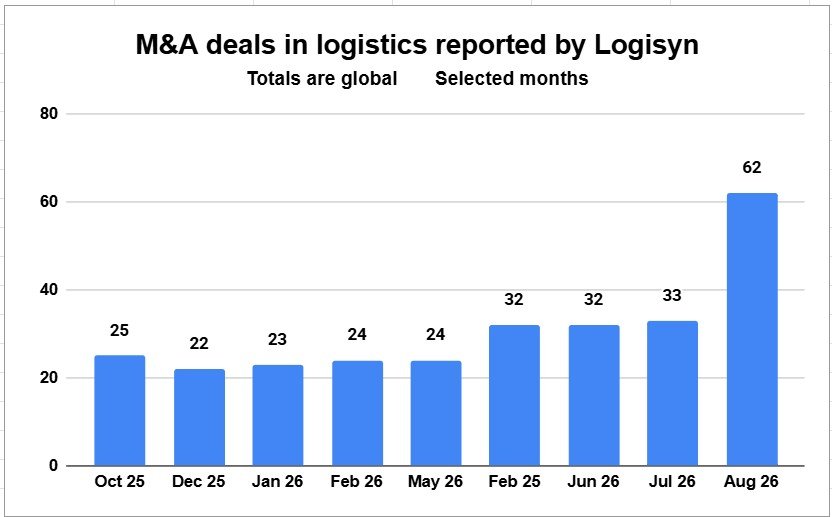
Under the new methodology, the number of logistics deals recorded worldwide in August was more than twice the level reported in recent months. Because the methodology has changed, however, the figures are not directly comparable on an apples-to-apples basis.
Even so, Logisyn characterized the August environment as strong.
“Rapid investment across data centers, energy, renewables and infrastructure is creating a new growth cycle for project logistics and specialized transportation,” the report said.
“These capital-intensive industries require moving increasingly large, heavy, and complex components, driving demand for heavy-haul transportation, specialized lifting equipment, project forwarding, and engineering expertise.”
Other highlights from the Logisyn M&A Club
The conference also produced several notable developments and observations.
A transaction was announced directly from the conference stage. As the first session was coming to an end, Kendra Tanner, president and CEO of AllStates World Cargo, announced that the company was being acquired by Eve Partners.
The announcement was immediately confirmed by the presence of J.J. Schickel, a partner at Eve, who was seated next to Tanner as the deal was revealed.
Elsewhere, Cameron Roberts, managing partner at Roberts & Kehagiaras LLP, offered a perspective on U.S. Customs and Border Protection during a panel titled “Resilience in the face of global geopolitical crises.”
Roberts said the resources CBP is bringing to its enforcement efforts are “at an all-time high.”
At a recent trade summit, he said, CBP officials told attendees that their message to businesses was essentially: “Prove to me that you’re a good broker. Prove to me that you’re a good importer.”
Roberts said the earlier idea of “facilitation,” in which CBP would primarily seek to help an importer navigate the process, has disappeared.
“The concept is enforcement and the presumption of people doing things the wrong way,” he said.
Why it matters
AI continues to raise questions about the future of brokerage employment, particularly as some large 3PLs have reduced head counts while increasing productivity and profitability.
But the discussion at Logisyn highlighted a different possibility.
As broker liability evolves following Montgomery vs. Caribe Transport II, the presence of human decision-makers, supported by clearly defined controls and compliance procedures, could become increasingly important when a brokerage decision is examined in litigation after a crash or other incident.
At the same time, the rise of AI is creating new challenges around compensation, performance expectations and the development of future logistics executives issues that may become increasingly difficult for 3PLs to separate from their broader business and M&A strategies.