




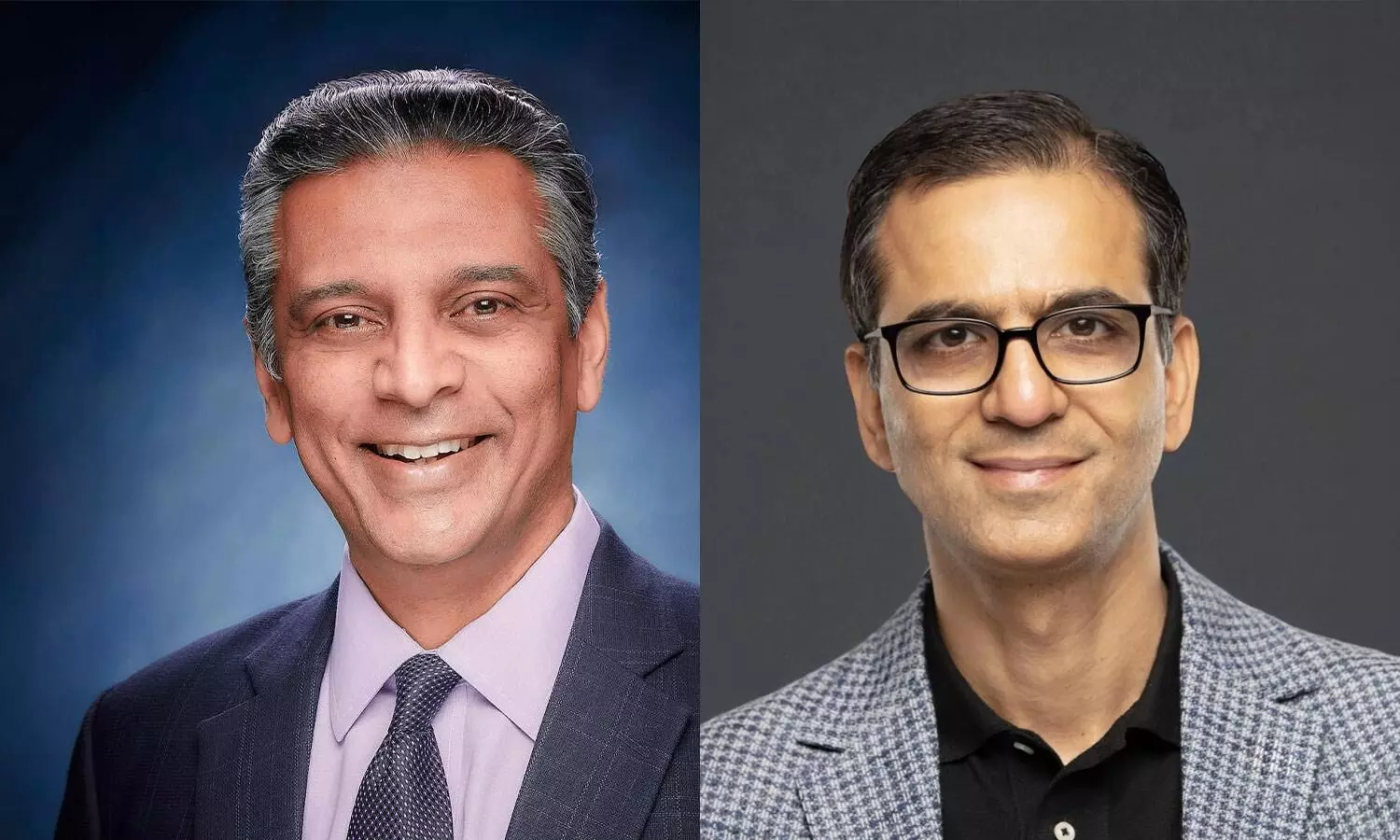
FedEx CEO Raj Subramaniam and Vishal Talwar, Executive Vice President and Chief Digital and Information Officer (CDIO) at FedEx and President of FedEx Dataworks, see artificial intelligence as a company-wide transformation that must be led directly from the top.
Speaking to the WSJ Leadership Institute Technology Council in New York on September 14, the two executives told Alan Murray, founding president of the WSJ Leadership Institute, that the defining challenge for logistics is no longer simply moving shipments faster. The larger problem, they argued, is the time freight spends standing still.
AI has to be driven by the CEO
Asked who ultimately owns AI at FedEx, Subramaniam put the responsibility firmly with himself.
“I don’t think any company today can succeed in AI without the CEO taking active leadership role in AI,” he said, arguing that technology and business strategy can no longer be treated as separate disciplines.
“The gap between business and technology is fast moving away. We can’t have a business strategy without technology and the reverse is also the case.”
Subramaniam described AI as “the defining technology of the era” and said its strategy must be driven from the top down. Talwar fully backed that approach, responding: “I’m 100% cool with anything Raj says here.”
Two petabytes of data every day
FedEx’s AI ambitions are built around the enormous volume of data generated by its global network, which Subramaniam said handles roughly $2 trillion of commerce every year.
“The fuel for AI is data, and two petabytes of data every single day represents the movement of the world’s most premium supply chain,” he said.
The pandemic also changed the way supply chains are viewed, according to Subramaniam. Once largely treated as an operational issue, supply chains became “a cool thing” and a “boardroom conversation,” pushing FedEx to look beyond internal efficiency.
One area where that shift is already producing results is healthcare transportation. Subramaniam said the business has grown 30% over the past couple of years, helped by AI-powered forecasting that allows healthcare customers to “schedule their workflow significantly better.”
Talwar described FedEx’s AI strategy through three broad layers: efficiency, customer differentiation and what he called the “true transformative” opportunity of developing new business models.
On efficiency, he pointed to several measurable results. Research time for air-maintenance work has been reduced from 30 minutes to three minutes, a 90% improvement that allows aircraft to return to service more quickly. AI has also helped FedEx identify mis-tracked and non-standard packages that should have generated a surcharge, recovering tens of millions of dollars in annual revenue.
For customers, Talwar said certainty is increasingly more important than sheer speed.
“The one thing our customers care most about is don’t surprise us. They want certainty,” he said, pointing to FedEx’s ability to offer delivery guarantees within a two-hour window for shipments travelling thousands of miles between Asia and the United States.
The biggest friction point comes when shipments stop moving
Subramaniam believes FedEx is already operating close to the physical limits of aviation when it comes to speed.
“We are leaving China and delivering to every zip code in America overnight,” he said. “Now we are at the speed of aviation technology and that’s kind of it at this point.”
When the discussion turned jokingly toward whether teleportation might be the next step, Talwar shifted the focus away from the time a shipment spends moving and toward the time it spends waiting.
“The focus that we have is not about the speed while an object is in motion,” he said. “I can put anything from China to US in 13 hours, 14-hour flight time. Then it sits in customs for clearance for another four days.”
For Talwar, those periods when shipments are stationary represent a much greater opportunity to improve the supply chain.
“The amount of time that’s spent in something waiting when it’s not in motion, that’s where the friction in supply chain is.”
Both executives stressed that the problem extends far beyond FedEx itself.
“This is a problem in industry at large. It’s not a problem that’s just for FedEx,” Talwar said.
He estimated that approximately $1.9 trillion in annual value is lost because of inefficiencies and friction points across global supply chains.
Subramaniam also described FedEx’s AI transformation as being at an early stage.
“I would say we are early innings,” he said. “We have been building infrastructure… but there is a long way to go.”
He added that FedEx wants to address the estimated $1.9 trillion in global supply-chain inefficiency by applying its technology and infrastructure at scale.
Robots in the hubs and autonomous trucks on the road
FedEx is also applying AI to the physical side of logistics.
Subramaniam described the company’s large sortation hubs as an “inventory in motion system” that is already highly automated, with loading and unloading trucks remaining two of the most difficult tasks to automate.
“Packages of different sizes, shapes, weights coming through. You don’t know what’s coming exactly. And then it has to figure out how to actually play Tetris on the truck,” he said.
FedEx has already deployed 60 robots at one facility to test physical-AI solutions ahead of the peak season.
The company is also working with Aurora on autonomous trucking for highway middle-mile routes, connecting facilities while keeping unmanned trucks away from interior roads.
Talwar said the robotics strategy is closely linked to the company’s enormous data advantage. He argued that FedEx may be in a position to develop something that does not currently exist in logistics: a real-world model of the supply chain.
“A real-world model for supply chain or logistics does not exist today. And who’s going to create it? It has to be one of the physical operators of that network, which is us,” he said.
Even FedEx’s shipping labels, however, remain “passive” rather than functioning as smart devices.
[IMAGE] Physical AI deployment at the FedEx Hagerstown hub in Maryland
FedEx sees AI driving growth rather than cutting jobs
The prospect of increased automation inevitably raises questions about employment, but Subramaniam rejected the idea that AI is simply a headcount-reduction strategy.
FedEx added 25,000 new employees in the United States last year, he noted.
“I think you’re not going to see AI delivering packages anytime soon,” Subramaniam said, pointing to the complexity of the last mile and, particularly, “the last 10 feet.”
“These robots are going to work hand-in-hand with our team members,” he added.
He summarized FedEx’s approach in three stages: “AI as a driver of growth. Growth drives packages. Packages drive people.”
Geopolitics has become part of the daily equation
With operations spanning 220 countries, FedEx also has to account for geopolitical disruption in its day-to-day network planning.
Subramaniam cited the need to reroute operations around Russian and Ukrainian airspace and the decision to suspend the company’s Dubai hub in favour of a more southerly route through the Middle East.
“Every twitch and turn that happens anywhere in the world has an impact on FedEx,” he said.
He described the growing complexity of the operating environment with a mathematical analogy.
“As the world has got more complex, before basic math would have done. Now we need advanced calculus, and there are very few people who do advanced calculus, and we are one of them.”
Talwar acknowledged that AI has not yet been applied directly to geopolitical risk at FedEx, but said FedEx Dataworks is increasingly working with customer CEOs on sourcing decisions, tariff scenario modelling and lane strategy.
Both executives take an optimistic view of AI’s risks
Asked about the broader debate over whether AI will ultimately drive prosperity or create catastrophic risks, Talwar said there was no meaningful disagreement between himself and Subramaniam.
“We both think that it’s in our hands and it’s up to us to apply it for good,” he said.
Subramaniam was similarly direct, saying: “We’re on the optimistic side, let’s call it that.”
Talwar also highlighted FedEx’s participation in the newly formed “AI for Good” commission, which brings together public figures and industry leaders to address equitable access to AI and promote responsible deployment of the technology.