

• Latest
  • Trending
Union Pacific begins battery-electric locomotive testing in Southern California

Union Pacific begins battery-electric locomotive testing in Southern California

September 25, 2026
6 Food Manufacturers Reveal Their Supply Chain Tactics

6 Food Manufacturers Reveal Their Supply Chain Tactics

September 25, 2026
Shippers turn to port-to-inland routes to reduce supply chain risk

Shippers turn to port-to-inland routes to reduce supply chain risk

September 25, 2026
ADVERTISEMENT
Trafigura moves into tanker ownership as VLCC charter rates approach $1 million a day

Trafigura moves into tanker ownership as VLCC charter rates approach $1 million a day

September 25, 2026
Coretura selects Vector-QNX software for commercial vehicle platform

Coretura selects Vector-QNX software for commercial vehicle platform

September 25, 2026
Tesla Opens Dedicated Semi Factory as Engineering Focus Shifts to Efficiency and Uptime

Tesla Opens Dedicated Semi Factory as Engineering Focus Shifts to Efficiency and Uptime

September 25, 2026
Former Sembcorp Marine chief acquitted of corruption charges

Former Sembcorp Marine chief acquitted of corruption charges

September 25, 2026
UK Prime Minister Andy Burnham ‘has always opposed’ Heathrow third runway, FT reports

UK Prime Minister Andy Burnham ‘has always opposed’ Heathrow third runway, FT reports

September 25, 2026
LATAM’s Miami–Confins freighter route moves 800 tonnes in first year

LATAM’s Miami–Confins freighter route moves 800 tonnes in first year

September 25, 2026
DHL Trend Radar: AI takes action as people remain central to logistics

DHL Trend Radar: AI takes action as people remain central to logistics

September 25, 2026
IATA urges supply-chain-wide response to undeclared dangerous goods

IATA urges supply-chain-wide response to undeclared dangerous goods

September 25, 2026
FMCSA’s “virtual” trucking inspections began under Trump, not Biden

FMCSA’s “virtual” trucking inspections began under Trump, not Biden

September 25, 2026
Hapag-Lloyd revises Zim offer as Israeli approval concerns persist

Hapag-Lloyd revises Zim offer as Israeli approval concerns persist

September 25, 2026
  • Home
  • About Us
  • Press Room
  • Podcasts
  • Media Kit
  • Contact Us
  • Careers
Friday, September 25, 2026
  • Login
  • Register
The Logistic News
  • Logistic
  • Air
  • Maritime
  • Land
  • World
  • Business
  • Tech
  • Events
  • Advertise
No Result
View All Result
  • Logistic
  • Air
  • Maritime
  • Land
  • World
  • Business
  • Tech
  • Events
  • Advertise
No Result
View All Result
The Logistic News
No Result
View All Result
Home Business

Union Pacific begins battery-electric locomotive testing in Southern California

Class 1 railroad puts battery power into local and switching operations as it evaluates reliability, performance and the potential for wider freight applications

The Logistic News by The Logistic News
September 25, 2026
in Business, Land, Logistic, Tech
Reading Time: 3 mins read
0
Union Pacific begins battery-electric locomotive testing in Southern California
ADVERTISEMENT

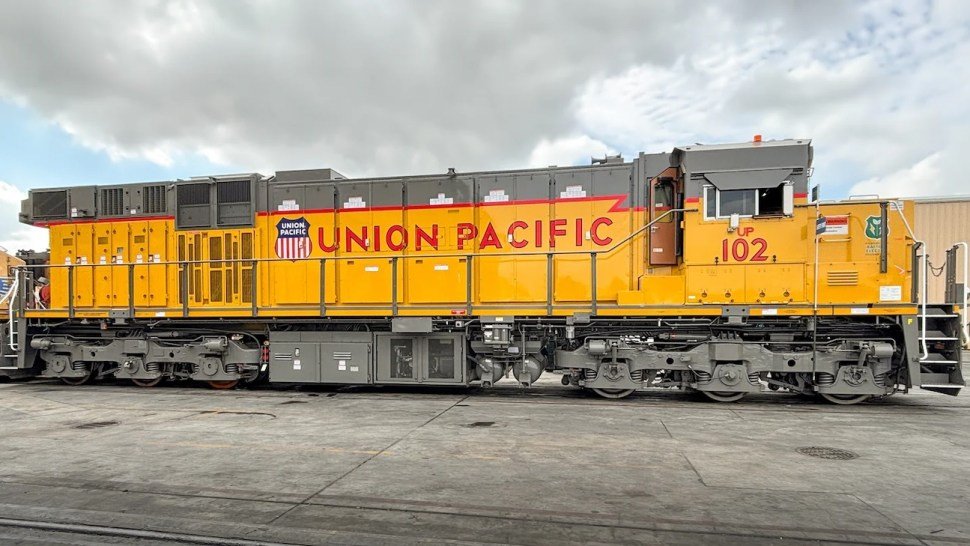
Union Pacific has put its first two battery-electric locomotives into service in Southern California, launching a field-testing program designed to assess how the technology performs under the demands of daily freight railroad operations.

The two Wabtec FLXdrive locomotives represent the first half of a four-unit order placed by Union Pacific (NYSE: UNP). The railroad said the remaining two battery-electric locomotives are expected to arrive in October, completing a four-unit fleet that will operate across the greater Los Angeles area.

Union Pacific plans to deploy the locomotives primarily in switching and local-customer operations, exposing the battery-powered units to the repeated demands of a busy rail yard and short-haul freight assignments. The testing program is intended to generate operational data covering performance, reliability and overall capabilities.

ADVERTISEMENT

According to Union Pacific, each FLXdrive locomotive stores approximately 2.7 megawatt-hours of energy, with the system powered by roughly 7,000 battery cells.

“Testing technologies like battery-electric locomotives help us to better understand what’s possible by putting these emerging technologies to work in actual railroad operations,” said Union Pacific Chief Executive Jim Vena in the announcement.

A demanding test environment in Southern California

Once all four units are in operation, Union Pacific will have a dedicated battery-electric locomotive fleet operating in one of the United States’ most emissions-sensitive freight regions.

Southern California provides a particularly demanding environment for the technology. Its extensive rail yards, local freight movements and port-linked supply chains require locomotives to manage frequent acceleration and braking cycles, along with extended periods of idling and repeated terminal movements.

Those operating patterns will allow Union Pacific to examine whether battery-electric propulsion can consistently meet the requirements of switching and local service in a real-world freight environment.

Wabtec Chairman and CEO Rafael Santana said putting FLXdrive locomotives into daily Union Pacific operations would provide the real-world data needed to improve the technology and assess opportunities for scaling it further.

Exploring alternatives to diesel

Union Pacific described the battery-electric deployment as part of its broader effort to modernize railroad operations, improve efficiency and investigate technologies that could help reduce greenhouse-gas emissions.

The railroad operates across 23 western states and serves nearly 7,300 communities, giving its technology decisions implications across a large freight network.

At the same time, alternatives to conventional diesel propulsion remain relatively limited in commercial use across the U.S. freight rail system. Battery-electric technology is therefore being tested in an industry where locomotives must deliver high levels of power and flexibility over demanding operating cycles.

A key issue will be the charging infrastructure required to support battery-powered locomotives.

Josh Raglin, chief sustainability officer at Norfolk Southern, raised the issue on LinkedIn, saying battery power will prove viable “only if the local grid has the capacity to charge them.” He added that each locomotive charger requires energy equivalent to 83 Tesla fast chargers, and suggested that hybrid technology could be a more practical option because hybrid locomotives can operate both with and without charging.

For Union Pacific, the Southern California deployment will provide an opportunity to gather operational evidence on where battery-electric locomotives can fit within freight rail operations and what infrastructure requirements would need to be addressed for broader adoption.


Previous Post

Coretura selects Vector-QNX software for commercial vehicle platform

Next Post

Trafigura moves into tanker ownership as VLCC charter rates approach $1 million a day

Next Post
Trafigura moves into tanker ownership as VLCC charter rates approach $1 million a day

Trafigura moves into tanker ownership as VLCC charter rates approach $1 million a day

Leave a Reply Cancel reply

Your email address will not be published. Required fields are marked *

A D V E R T I S E M E N T

Popular News

  • Drone Delivery Takes Flight: Amazon Partners with UPS for Trial Program

    Drone Delivery Takes Flight: Amazon Partners with UPS for Trial Program

    0 shares
    Share 0 Tweet 0
  • Rail Cargo Group Strengthens European Network with Captrain Netherlands Acquisition

    0 shares
    Share 0 Tweet 0
  • Automotive Inbound Logistics Market: Navigating Future Challenges

    0 shares
    Share 0 Tweet 0
  • Global Inflation Cools to Target After Three Years, Central Banks Face Policy Dilemma

    0 shares
    Share 0 Tweet 0
  • Dubai Mercantile Exchange Rebrands as Gulf Mercantile Exchange Following Saudi Tadawul Group Acquisition

    0 shares
    Share 0 Tweet 0

Recent News

6 Food Manufacturers Reveal Their Supply Chain Tactics

6 Food Manufacturers Reveal Their Supply Chain Tactics

September 25, 2026
Shippers turn to port-to-inland routes to reduce supply chain risk

Shippers turn to port-to-inland routes to reduce supply chain risk

September 25, 2026
Trafigura moves into tanker ownership as VLCC charter rates approach $1 million a day

Trafigura moves into tanker ownership as VLCC charter rates approach $1 million a day

September 25, 2026

Discover a new era of logistics reporting with The Logistic News, your go-to platform for breaking news, insightful features, and exclusive interviews shaping the global logistics and freight landscape. Trust us to deliver accurate, timely, and relevant information that empowers professionals and enthusiasts alike in navigating the intricacies of this vital sector.

Navigation

  • Home
  • About Us
  • Press Room
  • Podcasts
  • Media Kit
  • Contact Us
  • Careers
  • Privacy Policy
  • Terms of Use

© 2024 - thelogisticnews.com

Welcome Back!

Login to your account below

Forgotten Password? Sign Up

Create New Account!

Fill the forms below to register

All fields are required. Log In

Retrieve your password

Please enter your username or email address to reset your password.

Log In

SIgn Up Newsletter

This will close in 20 seconds

Manage Cookie Consent
We use technologies like cookies to store and/or access device information. We do this to improve browsing experience and to show (non-) personalized ads. Consenting to these technologies will allow us to process data such as browsing behavior or unique IDs on this site. Not consenting or withdrawing consent, may adversely affect certain features and functions.
Functional Always active
The technical storage or access is strictly necessary for the legitimate purpose of enabling the use of a specific service explicitly requested by the subscriber or user, or for the sole purpose of carrying out the transmission of a communication over an electronic communications network.
Preferences
The technical storage or access is necessary for the legitimate purpose of storing preferences that are not requested by the subscriber or user.
Statistics
The technical storage or access that is used exclusively for statistical purposes. The technical storage or access that is used exclusively for anonymous statistical purposes. Without a subpoena, voluntary compliance on the part of your Internet Service Provider, or additional records from a third party, information stored or retrieved for this purpose alone cannot usually be used to identify you.
Marketing
The technical storage or access is required to create user profiles to send advertising, or to track the user on a website or across several websites for similar marketing purposes.
Manage options Manage services Manage {vendor_count} vendors Read more about these purposes
View preferences
{title} {title} {title}
No Result
View All Result
  • Logistic
  • Air
  • Maritime
  • Land
  • World
  • Business
  • Tech
  • Events
  • Advertise

© 2024 - thelogisticnews.com