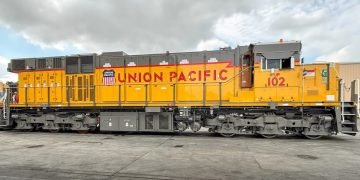




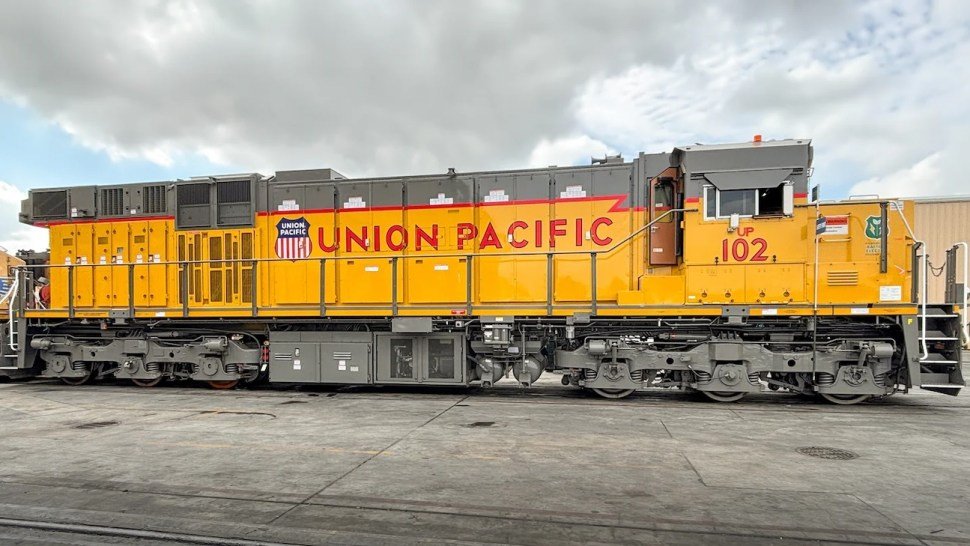
Union Pacific has put its first two battery-electric locomotives into service in Southern California, launching a field-testing program designed to assess how the technology performs under the demands of daily freight railroad operations.
The two Wabtec FLXdrive locomotives represent the first half of a four-unit order placed by Union Pacific (NYSE: UNP). The railroad said the remaining two battery-electric locomotives are expected to arrive in October, completing a four-unit fleet that will operate across the greater Los Angeles area.
Union Pacific plans to deploy the locomotives primarily in switching and local-customer operations, exposing the battery-powered units to the repeated demands of a busy rail yard and short-haul freight assignments. The testing program is intended to generate operational data covering performance, reliability and overall capabilities.
According to Union Pacific, each FLXdrive locomotive stores approximately 2.7 megawatt-hours of energy, with the system powered by roughly 7,000 battery cells.
“Testing technologies like battery-electric locomotives help us to better understand what’s possible by putting these emerging technologies to work in actual railroad operations,” said Union Pacific Chief Executive Jim Vena in the announcement.
A demanding test environment in Southern California
Once all four units are in operation, Union Pacific will have a dedicated battery-electric locomotive fleet operating in one of the United States’ most emissions-sensitive freight regions.
Southern California provides a particularly demanding environment for the technology. Its extensive rail yards, local freight movements and port-linked supply chains require locomotives to manage frequent acceleration and braking cycles, along with extended periods of idling and repeated terminal movements.
Those operating patterns will allow Union Pacific to examine whether battery-electric propulsion can consistently meet the requirements of switching and local service in a real-world freight environment.
Wabtec Chairman and CEO Rafael Santana said putting FLXdrive locomotives into daily Union Pacific operations would provide the real-world data needed to improve the technology and assess opportunities for scaling it further.
Exploring alternatives to diesel
Union Pacific described the battery-electric deployment as part of its broader effort to modernize railroad operations, improve efficiency and investigate technologies that could help reduce greenhouse-gas emissions.
The railroad operates across 23 western states and serves nearly 7,300 communities, giving its technology decisions implications across a large freight network.
At the same time, alternatives to conventional diesel propulsion remain relatively limited in commercial use across the U.S. freight rail system. Battery-electric technology is therefore being tested in an industry where locomotives must deliver high levels of power and flexibility over demanding operating cycles.
A key issue will be the charging infrastructure required to support battery-powered locomotives.
Josh Raglin, chief sustainability officer at Norfolk Southern, raised the issue on LinkedIn, saying battery power will prove viable “only if the local grid has the capacity to charge them.” He added that each locomotive charger requires energy equivalent to 83 Tesla fast chargers, and suggested that hybrid technology could be a more practical option because hybrid locomotives can operate both with and without charging.
For Union Pacific, the Southern California deployment will provide an opportunity to gather operational evidence on where battery-electric locomotives can fit within freight rail operations and what infrastructure requirements would need to be addressed for broader adoption.