



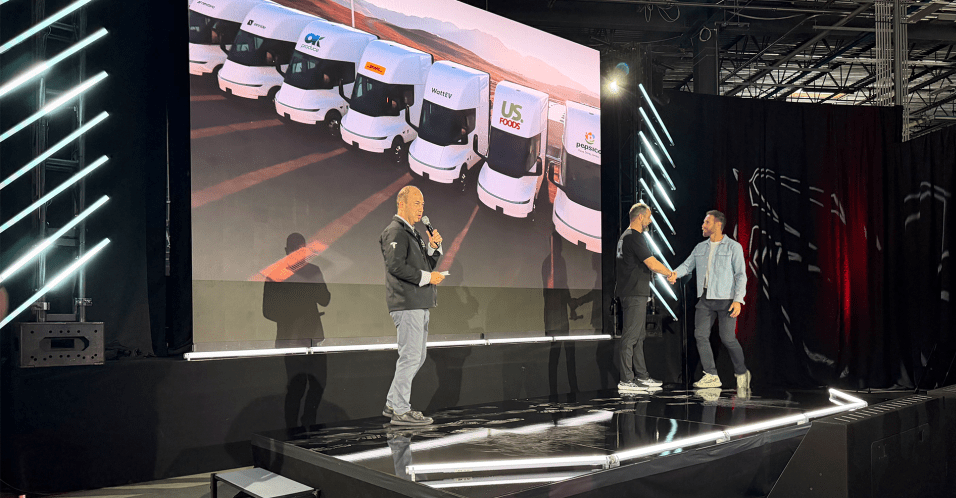
Tesla formally inaugurated its dedicated Semi factory in Sparks, Nevada, on September 24, unveiling a 1.7 million-square-foot facility built alongside Gigafactory Nevada. Tesla presented the event as the beginning of high-volume Semi production, although the first truck actually rolled off the line in April. In that sense, the ceremony was less about opening a factory than publicly introducing a production program that has been moving toward this point since 2017.
Among the companies receiving early deliveries are DHL, PepsiCo and US Foods. The facility has been designed with annual capacity for 50,000 trucks. Tesla, however, has not disclosed how many Semis it is currently producing, an important distinction as the company moves from development into industrial-scale manufacturing.
After driving a fully loaded Semi with tractor and trailer, three elements stood out: power, acceleration and ride quality. The acceleration is naturally the most dramatic feature, particularly because of how unexpected it feels in a heavy truck. But ride quality is arguably more consequential for fleets, especially when a truck is expected to operate with a driver behind the wheel every day.
There is another detail from the driver’s seat that changes the operating experience: the service brake is used very little. Regenerative braking handles a substantial share of deceleration, changing the rhythm of driving. For anyone familiar with mountain grades, the implications are immediate, particularly when it comes to brake wear and the maintenance costs associated with it.
Nine Years of Development, Told Through the Engineering
Dan Priestley, who leads Tesla’s Semi program, outlined a development timeline that began earlier than many might expect.
The initial idea emerged in 2014 from a contradiction within Tesla’s own operations. The company was building its battery and powertrain plant in Nevada while simultaneously using diesel trucks to move components from Nevada to Fremont, California. Moving electric-vehicle components by diesel-powered trucks did not align with Tesla’s broader mission.
Design work moved from modeling into hardware in early 2016. Two alpha trucks were publicly unveiled in 2017, and Priestley said those vehicles accumulated more miles than any other alpha program Tesla had previously undertaken. Much of the design identity established at that stage survived, including the central driving position and dual-screen cockpit.
The pilot fleet arrived in 2022. It consisted of just under 200 trucks and accumulated approximately 17.5 million miles collectively. Priestley described the architectural shift between the original alpha vehicles and the pilot fleet as a massive step forward. The current production truck, he explained, takes the lessons gathered from fleet operations and direct customer feedback and incorporates them into the final design.
Priestley was also explicit about Tesla’s position in the heavy-truck market. The company, he said, is not yet a heavy-truck company, while emphasizing respect for the people who operate trucks every day. The objective is therefore to build a vehicle capable of serving the majority of fleets and drivers rather than designing around a single customer.
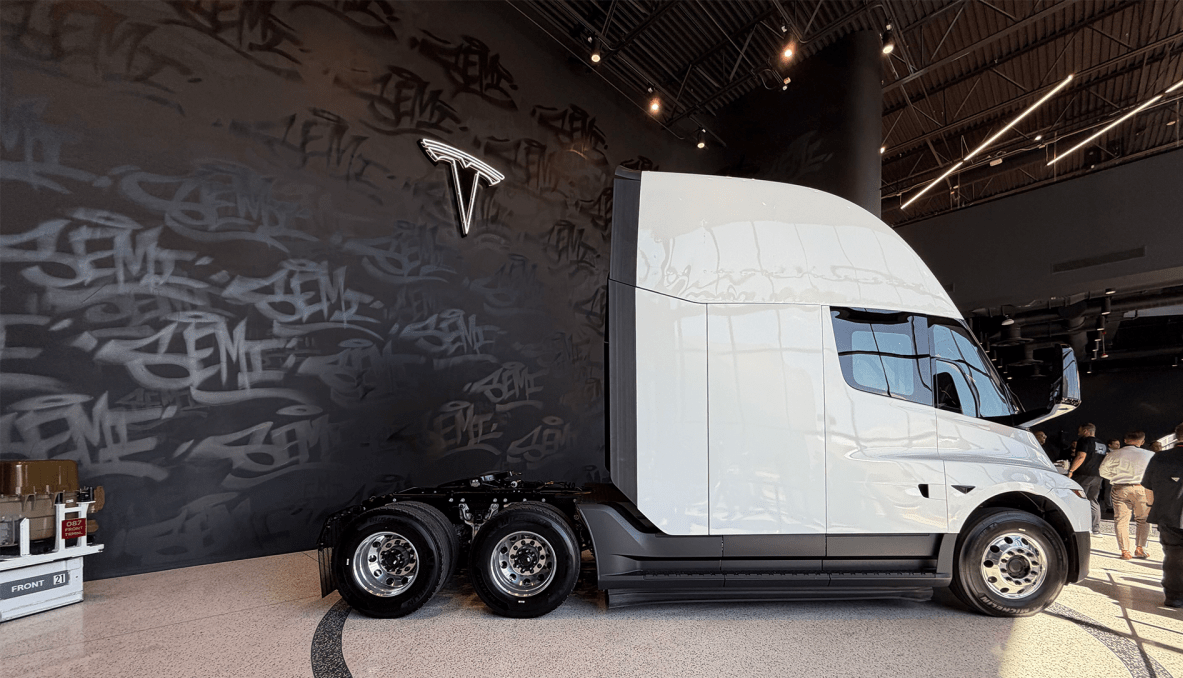
One of the clearest examples of that feedback loop can be seen in the truck’s side window. The original design used a small pop-out window. Customers strongly objected, prompting Tesla to replace it with a roll-down version. The reason was simple: badge readers, toll booths and call boxes are generally positioned at approximately that height. Priestley and the engineering team acknowledged that the original design decision was wrong.
The Engineering Philosophy: The Best Part Is No Part
The factory tour provides perhaps the clearest illustration of Tesla’s engineering philosophy. The phrase repeatedly used by the team was simple: the best part is no part.
The battery architecture has changed from purchased 2170 cells to Tesla’s in-house 4680 cells, manufactured within the same complex next door. That shift has allowed Tesla to reduce both battery weight and total kilowatt-hours while maintaining range, with improvements in efficiency making up the difference.
For fleet operators, the efficiency figure may be more important than any headline about acceleration. Tesla’s original internal target was approximately 2,000 watt-hours per mile, a figure the company said outside voices considered impossible. The Semi is now operating at around 1.6 to 1.7, representing an improvement of roughly 25 percent over that original target.
The drivetrain has also been redesigned. The previous rotor relied on a carbon-fiber sleeve borrowed from the Plaid powertrain. While it performed well, Tesla determined that it was not the right solution for mass production. The new steel-cage rotor is less expensive, generates more torque and is more reliable.
A bar-round stator shared with Cybertruck has also been incorporated into the Semi. According to the engineering team, that change removed roughly 80 kilograms from the drive axle while allowing Tesla to reuse an existing production line.
Then come the eliminations, which may matter most to maintenance managers.
The original truck used three separate oils: one for the motor, one for the gearbox and one for the hub. The hub is now fully integrated and requires no oil, which also reduces rolling resistance. The motor and gearbox share a single common oil designed to last more than a quarter-million miles.
Tesla has also eliminated hydraulic power steering. In its place is a fully redundant electric steer-by-wire system developed for Cybertruck.
Priestley framed that decision in operational terms. A hydraulic steering leak may not be catastrophic, but it can still leave a truck out of service until a technician arrives. Removing the hydraulic loop therefore eliminates both the failure mode and the associated pre-trip inspection requirement.
There is an additional benefit: Tesla says the truck’s turning radius is close to that of a Model Y, something that becomes particularly noticeable during dock maneuvering.
The thermal system uses the same indirect architecture found in Cybercab. It relies on the same compressor and coolant pumps already used across tens of millions of Tesla vehicles. There are no refrigerant lines running toward the front of the vehicle, eliminating another set of components that could be damaged or require servicing.
Range, Charging and the Economics of a Shift
Tesla is bringing two Semi configurations out of Sparks: a 325-mile standard-range version and a 500-mile long-range version. Tesla says the 500-mile figure represents real-world performance at a fully loaded 82,000 pounds rather than a range calculation based on a reduced payload.
The standard-range truck has a curb weight below 20,000 pounds and a payload capability of 45,000 pounds.
Priestley was candid about why Tesla has not simply pushed the Semi’s range higher. It is technically possible to build a truck capable of crossing the country on a single charge, but doing so would require additional batteries, increasing both weight and cost while reducing the cargo the truck can carry.
Tesla’s position is that range only has meaning when it is considered alongside charging.
The shift calculation Priestley described illustrates that point. A truck can begin a shift at 450 miles of available range, travel 400 miles and arrive with approximately 10 percent remaining. During the driver’s scheduled break, 60 percent of the battery can be restored in 30 minutes. The truck can then continue for another 300 miles.
Under that scenario, the Semi could cover roughly 700 miles during a shift without requiring a dedicated stop solely for charging.
Tesla is using the Megawatt Charging System and says the platform is intended to be fully interoperable in both directions. That means the Semi can charge using other providers’ equipment, while MCS-equipped trucks from other manufacturers will also be able to use Tesla’s network.
By the end of the year, Tesla expects to have more than 30 stations and more than 200 megawatt-capable charging posts, including deployments at Pilot Flying J locations. The charging hardware is also available for purchase.
The Semi currently has no sleeper configuration. Priestley said a sleeper depends on an over-the-road charging network that does not yet exist at the required scale. The chassis has been designed to accommodate a sleeper, but Tesla’s planned sequence begins with regional operations, followed by connections between regions and eventually over-the-road service.
Tesla has not disclosed pricing. Outside estimates have placed the truck at around $290,000, which would be below published estimates for a Freightliner eCascadia or Volvo VNR Electric, but Tesla has not publicly confirmed that figure.
Uptime Is the Argument Fleets May Watch Closely
The pilot fleet is reporting 98 percent uptime, although Priestley did not portray the development process as trouble-free.
He cited early problems involving drivetrain components, as well as issues with routing, airlines and hoses.
Tesla is approaching Semi service in a way that borrows heavily from its passenger-car business. The model includes a dedicated Semi service network, mobile technicians dispatched directly to trucks, over-the-air diagnostics and software updates, and shared parts distribution with Tesla’s automotive fleet.
That last element could become particularly important. Tesla has far more passenger vehicles operating on the road than Class 8 trucks, meaning the same distribution centers and high-voltage technician training pipeline can support both sides of the business. Failures identified in passenger vehicles can therefore potentially feed engineering and service improvements into the truck program.
The team said it was struck by the vehicle-off-road figures seen across the wider trucking industry and designed the Semi specifically to improve on them.
The guiding principle was blunt: planned maintenance is acceptable, while unscheduled maintenance is a tragedy.
The Market Tesla Is Entering
The broader market context remains critical because Tesla has made a major manufacturing commitment to a segment that has yet to fully embrace battery-electric trucks.
Battery-electric vehicles currently represent less than one percent of new Class 6 through 8 truck sales in North America. ACT Research does not expect widespread long-haul Class 8 adoption until sometime between 2035 and 2040.
Volvo Trucks executives have also publicly said they expect electric truck sales to remain modest through 2026 and into 2027. At the same time, federal incentives and emissions regulations that helped support some of the earliest deployments are receding, placing greater emphasis on total cost of ownership in fleet purchasing decisions.
ACT forecasts approximately 224,800 Class 8 retail sales in the United States in 2026. A factory with an annual capacity of 50,000 trucks is therefore sized for more than one-fifth of the entire U.S. Class 8 market.
The competitive landscape is also more developed than headlines sometimes suggest.
Volvo has more than 750 VNR Electric trucks operating, with more than 30 million zero-tailpipe miles accumulated. Its electric-truck service footprint includes 84 certified EV dealerships across 33 states and four Canadian provinces.
Freightliner’s eCascadia has more than 55 fleets operating the model and has accumulated more than six million miles.
Tesla’s pilot fleet has generated approximately 17.5 million miles from fewer than 200 trucks, representing substantially higher utilization per vehicle. Volvo, however, already has an established dealer network, while Tesla is building that support infrastructure for the Semi from the ground up.
Why the Tesla Semi Matters
The most significant feature of the Semi may not be its acceleration, even though that is the element most likely to dominate public attention.
The larger engineering story is the systematic removal of potential failure points: the hydraulic steering loop, two of the three oil systems and the refrigerant lines are all gone.
For a fleet, those decisions matter because these are precisely the kinds of components that can take a truck out of service on an ordinary working day and create costs that were never part of the operating plan.
The central question now is whether that engineering discipline can overcome the limited charging infrastructure available outside a relatively small number of corridors.
The answer will emerge over the next three years through fleets moving real freight, not through factory demonstrations.