




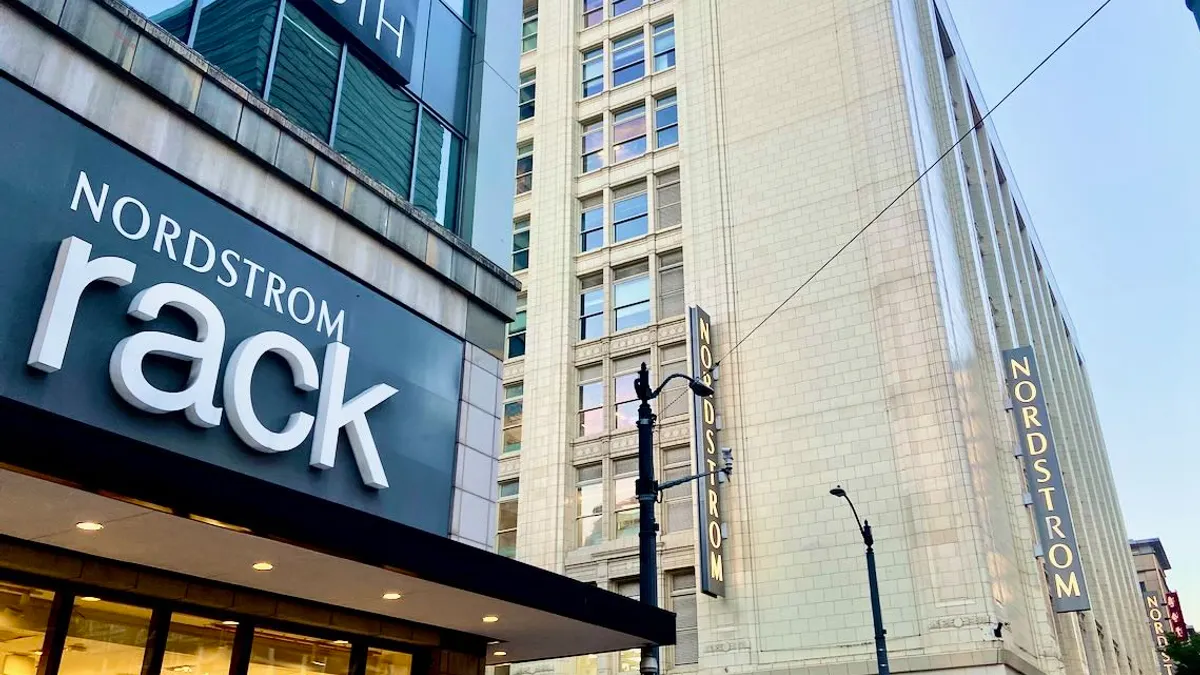
Weekend delivery has become one of Nordstrom’s next priorities as the retailer looks to provide customers with faster and more consistent shipping throughout the week.
Kevin Breedlove, Nordstrom’s director of customer delivery and returns, said at Parcel Forum ’26 in Orlando, Florida, earlier this month that the company is evaluating ways to provide delivery seven days a week through its mix of parcel carriers.
Nordstrom already offers faster alternatives to its standard shipping services, including next-business-day and two-business-day delivery, according to the retailer’s website. The company is now examining how it can extend that speed across all seven days, including by working with “new entrant options” capable of delivering that level of service at scale, Breedlove said during a session focused on building an effective parcel carrier strategy.
The retailer believes consistent delivery speeds throughout the week could strengthen the customer experience and encourage shoppers to return, Breedlove said, according to a recording of the session shared with Supply Chain Dive.
The move comes as more parcel carriers expand their delivery schedules beyond traditional business days in an effort to respond to consumer expectations and differentiate themselves in an increasingly competitive market.
OnTrac introduced Saturday and Sunday delivery across most of its network in 2024. FedEx expanded its Sunday home delivery coverage in 2025, a capability that helped persuade Best Buy to select FedEx as its primary parcel carrier. Amazon Shipping, meanwhile, offers both pickup and delivery seven days a week.
Nordstrom also accelerates same-day and next-day delivery
Weekend availability is only part of Nordstrom’s shipping strategy. Breedlove said the retailer is also working to increase the speed of its delivery services, with particular attention on expanding next-day and two-day coverage.
Nordstrom has already tested same-day delivery in Los Angeles, and the pilot has produced positive results.
Breedlove did not provide additional details about the test. However, Farah Akoum, Nordstrom’s senior director of product management and digital shopping experience, said in a LinkedIn post earlier this month that the retailer had launched same-day delivery for beauty products in Los Angeles.
Under the service, customers placing orders by 3 p.m. receive their packages at their doorstep by 9 p.m. Nordstrom plans to extend the offering to additional markets nationwide in the fall, Akoum said.
The retailer is also working on another element of delivery performance: improving the accuracy of the arrival windows communicated to customers.
Other retailers have recently made delivery reliability a priority as well, highlighting the growing importance of precision alongside speed. Breedlove said Nordstrom faces a balance between making highly cautious delivery promises and offering tighter estimates that could carry a greater risk of late deliveries.
A conservative approach could produce a very high on-time delivery rate, but tighter promised windows could increase the likelihood of missing the commitment. Breedlove noted that customers generally view a late delivery more negatively than an early one, while increasingly expecting precise arrival estimates so they can be available when their packages arrive.
How Nordstrom manages its parcel carrier network
Nordstrom also provided insight during the Parcel Forum session into how it structures relationships with parcel carriers and approaches contract negotiations.
The retailer relies on national parcel carriers to handle pickup and delivery requirements across the United States. At the same time, regional carriers are used in higher-volume markets and to provide coverage tailored to specific states, Breedlove said.
Nordstrom also holds an annual summit with its delivery providers to better understand carrier priorities and capabilities.
On the first day, all carriers participate together in the same room, a setup Breedlove described as potentially “dicey,” but one that generates substantial discussion. The second day consists of individual meetings with each carrier, allowing Nordstrom to examine their strengths and understand how they plan to achieve their objectives over the following year.
For shippers considering the addition of new carriers, Parker Bushaw, Nordstrom’s strategic sourcing manager, said each new provider should have a clearly defined role within the supply chain.
Adding carriers simply to increase the size of the network is not necessarily useful. Instead, companies should be able to explain precisely why a new carrier is needed, whether the objective is to improve delivery speed, lower shipping costs or address another specific requirement.
“Diversification for diversification’s sake really isn’t going to accomplish anything,” Bushaw said.
The same focus applies to contract negotiations. Before entering discussions with a carrier, a shipper’s procurement team should first consult the other relevant departments across the organization to determine what the next contract needs to achieve.
At Nordstrom, teams establish a priority list distinguishing between requirements that are considered essential and those that would be desirable but are not critical. The ultimate objective is to meet customer expectations rather than simply pursue the lowest possible transportation rates.
Bushaw illustrated the point with a straightforward example: if a retailer is promising customers delivery within two days, obtaining an attractive carrier rate tied to a three-day delivery commitment would not represent a successful deal.
For Nordstrom, the broader strategy is therefore built around matching carrier capabilities, delivery speed, reliability and contract terms with the service promises made to customers.