



The global air cargo market recorded a clear rebound in mid-September, with worldwide tonnages recovering ahead of China’s upcoming holiday period. At the same time, average rates remained well above their levels a year earlier, according to the latest weekly figures from WorldACD Market Data.
While international capacity continues to expand on a global basis, the picture remains uneven. Capacity to and from the Gulf is still significantly below its levels before the start of the US-Iran conflict, even as other regions have recorded substantial increases.
Asia Pacific continues to post solid growth overall, although traffic to Europe remains a notable exception. In particular, air cargo tonnages from Hong Kong to Europe are down 29 percent year on year.
Worldwide tonnages rebound after the annual Labor Day dip
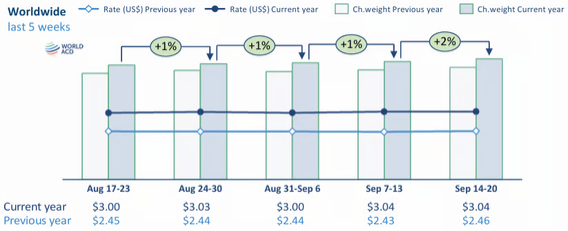
Worldwide air cargo tonnages increased in mid-September following the usual annual decline linked to Labor Day in the US and Canada on September 7.
Chargeable weight rose for the fourth consecutive week, with global tonnages, rates and capacity all higher than at the same time last year across all major regions.
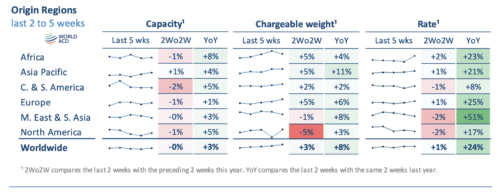
According to WorldACD Market Data, worldwide tonnages increased by 2 percent week on week in week 38, covering September 14 to 20. The recovery was largely driven by a 14 percent rebound in volumes originating in North America, bringing traffic from the region back to the levels recorded during the previous few weeks.
The gains were partially offset by declines from Middle East & South Asia (MESA), where volumes fell 4 percent week on week, and from Africa, which also recorded a 4 percent decline.
Compared with the equivalent period in 2025, worldwide tonnages were 8 percent higher in week 38. Asia Pacific led the growth with an 11 percent year-on-year increase. North America followed with an 8 percent rise, while Europe recorded 6 percent growth. MESA and Central & South America (CSA) each registered a 2 percent increase.
Stable rates remain significantly above last year
Pricing remained broadly stable in week 38 when measured across a full-market mix of spot and contract rates.
The largest percentage increase came from Africa, where average rates climbed 6 percent week on week to US$2.47 per kilo.
Worldwide full-market average rates were 24 percent higher year on year. MESA recorded the strongest increase, at 49 percent, followed by Europe and Africa, both up 26 percent, while rates from Asia Pacific origins were 21 percent higher.
Average worldwide spot rates were also unchanged week on week at US$3.45 per kilo, despite another increase in jet fuel prices.
Africa posted the largest weekly increase in spot rates, rising 7 percent. Rates from Asia Pacific and Europe each edged up 1 percent. Those increases were offset by declines from North America, down 4 percent; MESA, down 2 percent; and CSA, down 1 percent.
At US$3.45 per kilo, the worldwide average spot rate was 33 percent higher than a year earlier. Every major region recorded a year-on-year increase, with most gains reaching at least 25 percent.
CSA was the only exception, with spot rates up 5 percent year on year. MESA recorded the strongest increase at 52 percent, followed by North America at 34 percent, Africa at 31 percent, Asia Pacific at 30 percent and Europe at 29 percent.
MESA traffic remains volatile
The decline in MESA tonnages is particularly visible on the US trade lane.
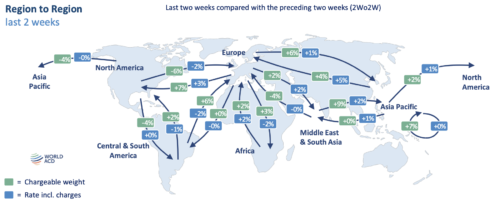
Traffic from MESA to the US fell 5 percent week on week. Within that decline, India dropped 5 percent, Bangladesh fell 17 percent and Sri Lanka declined 10 percent. Traffic from several Gulf markets also remains volatile.
By comparison, traffic from MESA to Europe was more stable and increased slightly, by 1 percent week on week. Higher volumes from Bangladesh offset a significant 14 percent week-on-week decline from Sri Lanka.
Worldwide capacity broadly stable, but Gulf capacity remains significantly lower
Global air cargo capacity was broadly stable in week 38, increasing by around 1 percent week on week. Freighter capacity rose by almost 2 percent, while passenger capacity declined slightly.
Compared with last year, total international capacity continued to expand, increasing 4 percent year on year. Freighter capacity led the growth, rising 5 percent.
Looking back to week 7, just before the start of the US-Iran conflict, worldwide capacity in week 38 was 4 percent higher on average.
The regional differences, however, remain substantial. Capacity to and from Europe was 19 percent higher than in week 7, while capacity to and from MESA was 9 percent lower. Capacity to and from Asia Pacific was around 2 percent below its week 7 level.
Within the 9 percent decline affecting MESA, capacity to and from South Asia was actually around 3 percent higher. The Gulf region tells a different story, with capacity to and from the area still almost 17 percent below its level at the beginning of the Iran conflict.
Capacity from the Gulf also declined by around 1 percent in week 38 compared with the previous week.
Asia Pacific growth continues, except on the Europe trade lane
After a gradual recovery in traffic from China and Hong Kong to Europe over the previous four weeks, volumes weakened again in week 38.
The earlier recovery had followed two months of steep declines after the removal of the European Union’s “de minimis” exemptions on July 1. During week 38, volumes from Hong Kong and mainland China slipped backwards, with Hong Kong recording a 5 percent week-on-week decline.
The year-on-year comparison is particularly striking for Hong Kong. Air cargo tonnages from Hong Kong to Europe were down 29 percent compared with the same period last year.
Mainland China volumes, meanwhile, remained broadly stable, recording a 2 percent year-on-year increase.
Despite the weaker volumes, spot rates from China and Hong Kong to Europe, as well as from Asia Pacific origins overall, remained firm.
Mainland China recorded a further 4 percent week-on-week increase in spot rates, Hong Kong rose 1 percent, Japan increased 3 percent and South Korea gained 2 percent.
Vietnam recorded its second consecutive weekly increase of 8 percent, bringing its spot rate to US$4.89 per kilo.
Across all Asia Pacific origins, average spot rates to Europe rose 2 percent week on week to US$4.72 per kilo in week 38.
Strong Asia Pacific demand to the US keeps the market supported
Demand from Asia Pacific origins to the US remained strong, increasing 13 percent year on year.
South Korea recorded the largest increase at 54 percent, followed by Japan at 47 percent and China at 14 percent.
Several major Southeast Asian markets also posted significant gains, including Thailand at 12 percent, Singapore at 10 percent and Indonesia at 19 percent.
Average spot rates from Asia Pacific to the US were broadly stable in week 38 at US$6.75 per kilo. However, that level was around 40 percent higher than during the corresponding week last year.
Singapore recorded a 62 percent year-on-year increase in spot rates, while Japan was up 50 percent.
China’s Golden Week and Mid-Autumn Festival create a tighter freight window
China’s Mid-Autumn Festival, taking place from September 25 to 27, is followed closely by the National Day Golden Week holiday from October 1 to 7.
The close succession of the two holiday periods is compressing production, export handovers and freight planning into a particularly narrow window before October, freight forwarders report.
Air freight can become a pressure-release option when ocean freight schedules are missed. As a result, urgent shipments, high-value goods and e-commerce traffic are expected to compete for limited air cargo capacity both before and immediately after Golden Week.
Forwarders report that general cargo demand from North China is increasing as shippers accelerate shipments ahead of the holidays. E-commerce volumes, however, remain relatively soft.
New charter capacity entering the market is reportedly absorbing much of the rate pressure that stronger general cargo demand might otherwise create, helping rates remain relatively stable.
In Southern China, transpacific demand is also increasing, but sufficient capacity is keeping rates broadly stable. E-commerce demand from the region remains relatively low.
Even so, the upcoming Chinese holidays could raise pressure on transpacific markets over the coming days.
Westbound demand from Asia Pacific to Europe, by contrast, remains soft for the time being, helping keep rates on that trade lane relatively subdued.
The latest WorldACD Market Data report therefore points to a worldwide air cargo market that has regained momentum ahead of the Chinese holiday period. Volumes are recovering, global rates remain significantly above last year’s levels, and capacity continues to expand overall.
The main pressure point remains the Gulf, where capacity is still almost 17 percent below its level at the beginning of the Iran conflict, while the Asia Pacific market continues to grow except on the Europe lane, where Hong Kong volumes remain 29 percent below last year.