



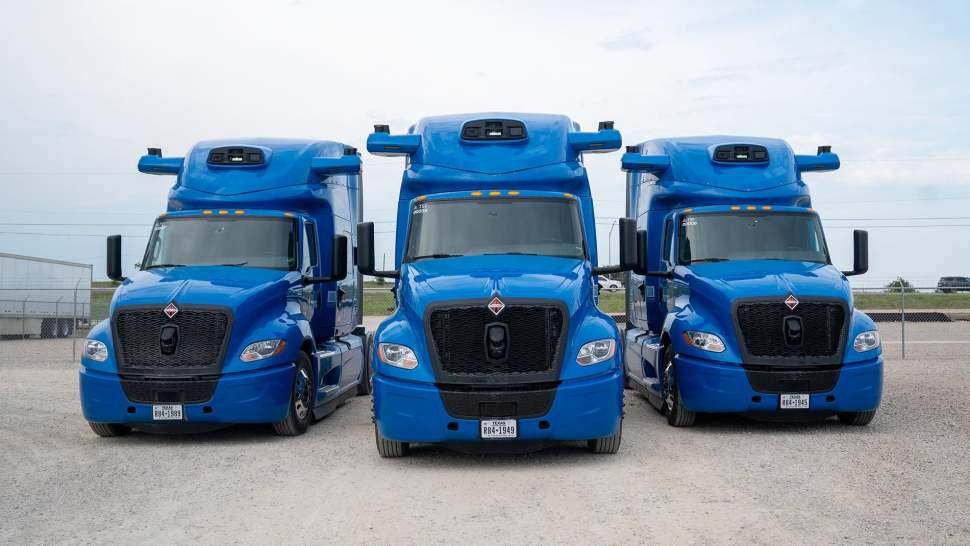
Aurora Innovation is planning to scale its autonomous trucking operation to more than 30,000 driverless trucks by 2030, setting an ambitious target for a business that is still working through the economics of large-scale deployment.
The company outlined the plan during its Analyst and Investor Day in Dallas on Sept. 23. Aurora expects the fleet to generate more than $5 billion in revenue in 2030 and is targeting a gross margin of approximately 60% that year, according to its investor presentation.
Aurora is fully allocated to exit 2026 with 200 driverless trucks in commercial operation. CFO David Maday said that fleet would represent an $80 million annualized revenue run rate. Since its commercial launch, the Aurora Driver has accumulated more than 500,000 driverless miles.
The pace of expansion, however, will depend not only on technology and production capacity but also on whether carriers can make the numbers work.
Daragh Mahon, executive vice president and chief information officer at Werner Enterprises, said Werner remains in discussions with Aurora as the companies work through legal, contractual and economic issues.
Mahon said the economics still contain a gap that must be resolved, but added that the model should become viable once autonomous fleets reach sufficient scale. He expects the two sides to reach a point within the next few months where the economics can support the deployment.
Gross margin breakeven pushed into 2027
Aurora now expects to end 2027 with more than 1,000 trucks in operation and approximately $200 million in revenue. The company is targeting gross-margin breakeven on a run-rate basis during the first half of 2027, when the fleet reaches around 500 trucks.
That represents a change from Aurora’s fourth-quarter 2025 shareholder letter, which had targeted gross-margin breakeven by the end of 2026. Maday said the revised timeline reflects a slightly slower fleet ramp.
The next major financial milestone is expected in 2028. Aurora expects to reach positive free cash flow on a run-rate basis by the end of that year, with approximately 7,500 trucks on the road.
Maday expects capital expenditures to reach about $185 million in 2027, with most of that spending going toward trucks operated directly by Aurora and the final units of its second-generation hardware kits. In 2028, he expects annual capital spending to fall below $50 million.
Aurora’s margin ambitions have also been adjusted. Its 2024 investor day presentation had targeted a gross margin of approximately 70% by 2028. Asked about the change, Craig-Hallum analyst Ryan Sigdahl was told that 70% remains the company’s objective, although Maday indicated that reaching that level could take another year.
Maday also pointed to supply chain headwinds as one of the factors Aurora is currently accounting for and addressing.
The carrier, not Aurora, will increasingly own the truck
A key part of Aurora’s long-term strategy involves changing who owns and operates autonomous equipment.
Today, Aurora owns and operates the trucks it provides to customers under its Transport as a Service, or TaaS, model. Those trucks are expected to average roughly 200,000 miles annually at around $2 per mile, including a fuel surcharge.
Maday described the model as capital-intensive and said Aurora intends to limit its TaaS fleet to roughly 500 trucks.
The larger opportunity comes through Driver as a Service, or DaaS. Under that structure, the carrier owns and operates the truck while paying Aurora for the autonomous driving capability.
As carriers incorporate the trucks into their own networks, Aurora expects annual mileage per truck to increase toward 250,000 miles. Revenue for Aurora would decline to 85 cents or more per mile.
The underlying strategy is to focus the economic value proposition on replacing driver costs rather than attempting to replace the full cost of operating a truck.
Hirschbach is expected to own and operate 500 trucks under a DaaS agreement, with deliveries scheduled to begin in 2027. Aurora described the commitment in its April announcement as a nonbinding memorandum of understanding.
Detmar Logistics is also examining the ownership equation. CEO Matt Detmar operates frac-sand trucks in the Permian Basin and said between 10% and 15% of the fleet’s miles can sometimes be off-road. That makes maintenance a particularly important consideration when deciding who should own the equipment.
Detmar said the company prefers to bring maintenance in-house when it buys the asset because doing so can help improve uptime.
Higher utilization is central to Aurora’s pitch
Aurora says one of the strongest arguments for autonomous trucking is the potential to keep equipment moving for substantially longer periods.
Driverless trucks operating for McLane, Werner and other customers are averaging more than 225,000 miles per year on an annualized basis, according to Aurora. The company says that level of utilization is more than twice that of a traditional truck.
Aurora co-founder and CEO Chris Urmson said the technology is effectively doubling the number of trips Detmar can complete each day.
Detmar’s drivers typically work three weeks followed by one week off, drive approximately 11 hours per day and take a 34-hour reset. As a result, tractor utilization remains below 40%.
On a 60-mile loop, Detmar said conventional drivers generally complete between two and 2.5 loads per day. Driverless trucks are reaching approximately five to six loads.
That takes utilization from about 40% to more than 90%, according to Detmar.
Aurora President Ossa Fisher said the company’s total-cost-of-ownership analysis, based on data from the American Transportation Research Institute, indicates savings of more than 20%, or roughly 50 cents per mile, compared with a solo-driven truck.
On the company’s Phoenix-to-Fort Worth lane, Fisher said Aurora’s model for a single truck over a one-year period showed an additional $340,000 in revenue and $160,000 in margin.
Mahon said the amount of value a carrier can capture depends heavily on length of haul. Werner sees the strongest fit in long-haul, middle-mile operations covering 500 miles or more.
Longer routes allow carriers to increase utilization and improve fuel economy, Mahon said. He pointed to the ability to keep a truck moving for 20 to 22 hours out of a 24-hour period as an important part of the equation, something shorter hauls do not support to the same extent.
Insurance remains one of the unresolved costs
Aurora’s cost argument extends beyond driver expenses and fuel to insurance, but that category remains more difficult to predict.
Fisher included insurance among the expenses the autonomous model could eventually reduce. Chris Moore of Apollo, the Lloyd’s of London syndicate that insures Aurora, said autonomous trucks are currently priced slightly above human-driven trucks.
Moore said pricing differs by state and remains higher primarily because of uncertainty around severity.
Aurora’s insurer now has enough data to account for fewer crashes, Moore said. However, relatively few autonomous-vehicle claims have reached court, leaving uncertainty around the severity of incidents.
That question is particularly significant in a trucking insurance market that has experienced major jury awards, often referred to as nuclear verdicts.
Moore expects insurance rates for autonomous trucks to decline by between 15% and 25% annually as more data becomes available.
He also described a different risk relationship for autonomous vehicles: while the risk associated with a human driver is relatively linear, each additional autonomous mile can provide more information and improve the overall risk profile.
Hardware production expands across multiple suppliers
Aurora is also preparing for the manufacturing scale required to support its long-term fleet ambitions.
The company’s second-generation hardware kit is manufactured by contract manufacturer Fabrinet in Thailand. Aurora says the system is designed for a one-million-mile operating life while reducing hardware costs by more than half.
Roush installs the kits on International LT Series trucks at a dedicated facility in Livonia, Michigan. The company is targeting production of 20 trucks per week in October.
Roush added a second shift the week before Aurora’s investor event and is now building trucks 16 hours a day, according to Brad Rzetelny of Roush. Sandor Barna, Aurora’s senior vice president of hardware, said a 20-truck weekly rate equates to approximately 1,000 trucks per year.
Volvo Autonomous Solutions is preparing another production channel. The company said in June that it plans to begin driverless operations during the first quarter of 2027 using Volvo VNL Autonomous trucks equipped with the Aurora Driver directly on the assembly line at Volvo’s New River Valley plant in Virginia.
Sasko Cuklev of Volvo Autonomous Solutions said the company expects more than 300 of those trucks to be operating by the end of 2027.
Cuklev also said one large fleet told Volvo it was being forced to turn down business because it did not have enough drivers. Another major customer, he said, wanted half of the 300 autonomous trucks planned for the program.
Aurora is already preparing the next stage of its hardware roadmap.
Third-generation hardware moves toward a per-mile model
The third-generation hardware system, developed with AUMOVIO, will shift toward a hardware-as-a-service model.
Under the new structure, customers would pay for the hardware on a per-mile basis rather than taking on a new upfront capital expense.
Barna said production is expected to begin in the second half of 2027, with material economic benefits expected to appear in 2028 and beyond.
Jeremy McClain of AUMOVIO said the company is ramping up a manufacturing plant in New Braunfels, Texas, to produce the system. PACCAR and Aurora are also working on how the technology will be integrated into PACCAR’s assembly lines.
For Werner’s Mahon, that industrial scale-up is one of the most important factors in the economics of autonomous trucking.
He expects the cost of the truck, its hardware, the autonomous technology and the broader Aurora service to decline as production volumes increase.
A 30,000-truck target built around scale
Aurora’s target of more than 30,000 driverless trucks by 2030 is based on a combination of market size, expected customer demand and the production capacity Aurora and its partners believe they can achieve.
Maday said Aurora estimates the U.S. trucking market at approximately $1 trillion, representing around 200 billion vehicle miles traveled. By 2030, the company expects its autonomous technology to be capable of operating across 150 billion of those miles.
The scale of the ambition can appear significant, but Aurora argues that the broader trucking market provides room for a fleet of that size.
More than 2 million trucks are currently operating on U.S. roads, according to Maday, while manufacturers build more than 250,000 trucks each year.
The 30,000-truck objective is therefore intended as a large production milestone within a much larger existing trucking ecosystem rather than a standalone market transformation overnight.
For Aurora, the next stage of the autonomous trucking business will depend on bringing together fleet growth, manufacturing capacity, higher vehicle utilization and lower per-mile costs.
For carriers, the central question remains the same: whether those gains can translate into an operating model that works economically at scale.