



The return of selected container services to the Suez Canal is accelerating cargo flows from India to the Port of Savannah by 10 to 14 days, providing importers with faster inventory replenishment and potentially reducing inventory-carrying costs, according to officials from the Georgia Ports Authority.
Maersk (OTC: AMKBY) has moved its MECL service back through the Suez Canal after previously operating via the longer Cape of Good Hope route. The change brings the transit time between Nhava Sheva, India, and Savannah down to 28 days, based on the carrier’s service information.
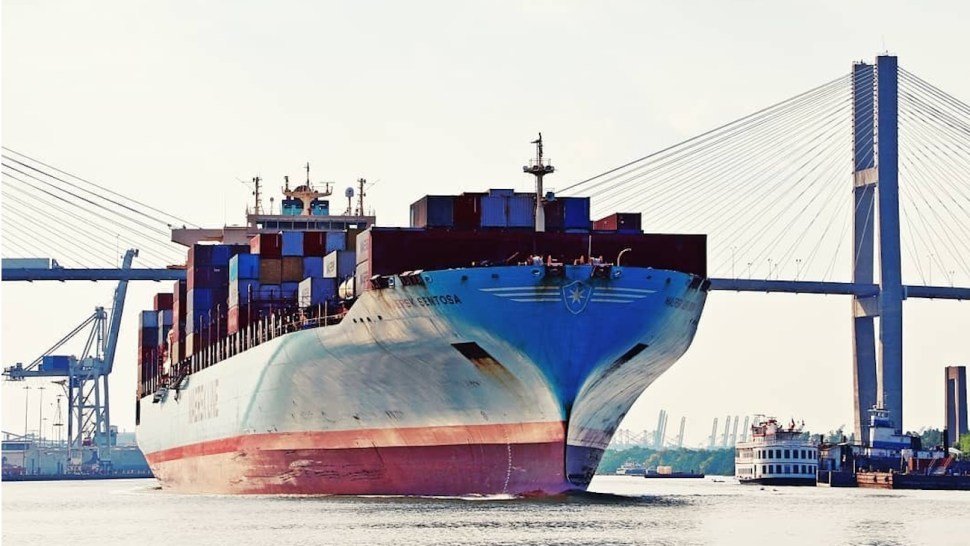
The Maersk Denver marked Maersk’s first new westbound sailing through the Suez Canal when the vessel called at Savannah on Aug. 9.
As part of the service’s return to Red Sea transits, the Copenhagen-based carrier has also added an eastbound call at Jeddah, Saudi Arabia, to the MECL rotation.
CMA CGM is also restoring its Indamex service to the Suez Canal. The French carrier’s routing change is expected to cut five days from the Nhava Sheva-to-Savannah transit while allowing the service to retain a weekly frequency with two fewer vessels.
“Georgia Ports welcomes the transit time improvements as several major carriers return to Suez routings linking Georgia to world markets,” Georgia Ports President Kevin Price said.
The changes are part of a broader, gradual resumption of Red Sea and Suez Canal operations by container carriers. Many services had previously been rerouted around Africa because of security risks in the region.
The Cape of Good Hope diversion significantly increased sailing distances and transit times while also requiring additional vessel capacity across major trade lanes, including Asia-Europe and India-U.S. East Coast services.
Mediterranean Shipping Co. has also announced plans to restore Suez Canal routings in both directions on four Asia-Europe and Mediterranean services: Tiger, Albatross, Himalaya Express and Jade.
MSC said eliminating the Africa detour would enable each of those services to operate with two fewer vessels. The change would consequently increase the amount of global container ship capacity available to the market.
For cargo owners sourcing products from India, South Asia and Southeast Asia, shorter ocean voyages could provide more accurate forecasting and reduce the inventory levels needed to protect against longer and less predictable lead times.
According to port officials, the improvement is particularly relevant for companies that have invested in diversifying manufacturing away from China and into India and other production locations across the Indian subcontinent and Southeast Asia.
“We are glad to see ocean carriers resuming Red Sea transits using the Suez Canal, the fastest and most economical way to link Asia, South and Southeast Asia and the Middle East to the U.S. market,” said Flavio Batista, chief commercial officer at the Georgia Ports Authority.
“Cargo owners have made significant investments to diversify manufacturing to countries in Southeast Asia and the Indian subcontinent. Now they will be able to enjoy the full benefit of that manufacturing shift with shorter lead times and a more predictable supply chain.”
The Port of Savannah currently handles 40 weekly vessel calls, 42 weekly double-stack rail departures and nearly 15,000 daily truck moves, highlighting the scale of the port’s multimodal connections and its role in supporting cargo flows into and out of the U.S. market.