



San Diego – After more than two decades covering logistics and transportation technology, Lee Klaskow has watched one technology trend after another capture the industry’s attention before eventually fading away.
But the senior logistics analyst at Bloomberg believes artificial intelligence is different.
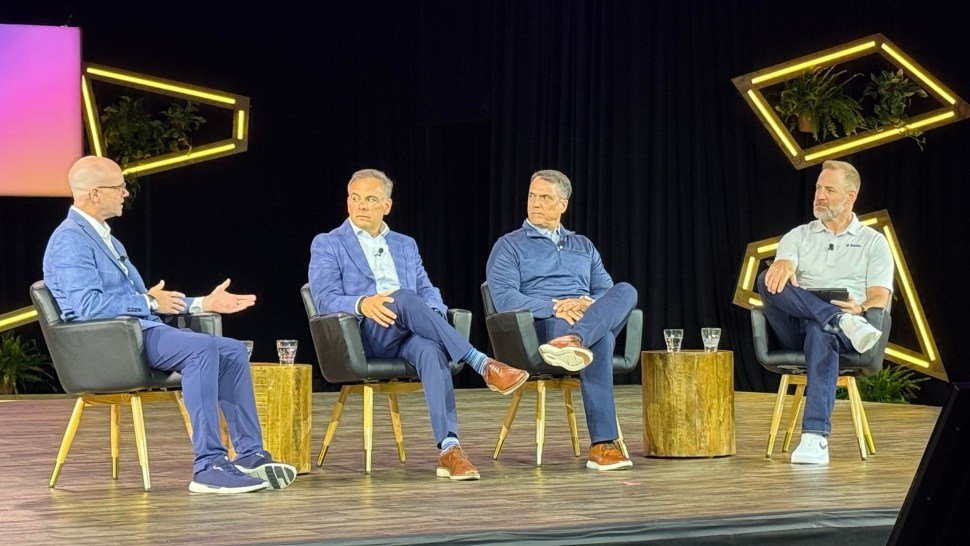
Speaking during a morning session at the Trimble Insight conference in San Diego, where Trimble executives had spent much of the morning discussing AI, Klaskow joined Craig Fuller, CEO of FreightWaves, and Alex Formoso, executive vice president for procurement and supply chain at Polyglass U.S.A., a manufacturer of roofing products.
“I’ve been covering this space for some 20-odd years,” Klaskow said. “It’s the first technology hype that’s actually worth the hype.”
From autonomous vehicles to blockchain
Klaskow pointed to several technologies that have previously dominated conversations across the freight and logistics industry.
Autonomous vehicles, he noted, have been discussed for roughly 25 years, while blockchain also generated significant attention before failing to deliver the transformative impact many had anticipated.
“There’s all these other things that came and went,” Klaskow said.
AI, however, is already producing tangible benefits, according to the Bloomberg analyst.
“With AI, we’re definitely seeing the benefits,” Klaskow said, pointing to a wide range of applications across freight operations. Those include brokers using AI to identify missed pickups, determine when the next pickup should occur, improve customer service, support rate pricing and optimize routes.
Klaskow also cited C.H. Robinson (NASDAQ: CHRW) as an example of a company whose AI efforts are reflected in its business performance. The company has continued to increase revenue and profitability while also significantly reducing its headcount, he noted.
Brokers are more willing than carriers to embrace new technology
For Craig Fuller, the appetite for new technology is not evenly distributed across the trucking industry.
Brokers, he said, are often the most receptive customers because they function much like “the day traders of the industry.” They are generally more willing than asset-based carriers to adopt new technologies, according to Fuller.
Selling technology to carriers that own and operate physical assets tends to involve a much longer sales process, he said. Those companies can also be more skeptical about promised improvements.
Fuller said that caution is understandable in a business “where you have to pay attention to every penny.”
Brokers, by contrast, are constantly looking for tools that can help them gain an advantage and make purchasing decisions more efficiently.
“There’s only two ways to make money in brokerage,” Fuller said. “Either your margin expands on a per transaction basis, or you do more loads.”
He argued that increased regulatory scrutiny over the carriers brokers use is putting pressure on margins. As a result, brokers have fewer opportunities to improve profitability through higher margins.
“So the only way brokers are going to increase their profits is to do more volume, and AI is a way to help them optimize that solution,” Fuller said.
AI adoption also comes with risks
Despite the enthusiasm surrounding artificial intelligence, the panel also highlighted the importance of deploying the technology carefully.
Fuller recalled serving on the board of a company where AI had been introduced but produced limited results. The technology did not generate additional productivity, and it created a much more significant problem: drivers strongly disliked it.
“At the next board meeting, the management came back and said ‘we’ve gotten no more productivity. In fact we’ve upset our drivers.’”
For Fuller, the experience demonstrated a critical lesson about AI implementation.
The technology should not be inserted “between you and your most important resource,” he said.
Personalization matters to shippers
Formoso offered a similar perspective from the shipper side of the freight market.
At Polyglass, he said, the company receives a constant stream of emails and phone calls from brokers. The messages often follow the same formula: an offer to handle everything for the shipper because the broker claims to be able to provide a complete service.
Formoso’s typical response is straightforward: “delete, delete, delete.”
What catches his attention is a broker that demonstrates a real understanding of Polyglass’ freight activity.
For example, a broker that knows Polyglass regularly moves products from Texas to Florida — and can identify that the company makes eight or nine such shipments per week — immediately stands out.
That broker might then offer a potential backhaul opportunity.
Doing the homework changes the conversation
That level of detail signals to Formoso that the broker has invested time in understanding the shipper’s business.
That is a sign the broker has “done a little bit of homework,” Formoso said. “Now I’m not just an email.”
The difference illustrates one of the broader challenges facing freight technology: simply introducing an AI-powered tool is not enough. The technology has to produce useful, relevant outcomes for the people actually operating within the supply chain.
Regulation is reshaping the freight market
Fuller has also described the current freight environment in other forums as “the most interesting time since deregulation.”
One of the main reasons, he said, is actually the growing influence of regulation and government oversight.
“It’s the opposite of deregulation: regulatory pressure and oversight, and that’s creating a whole new playbook,” Fuller said.
Technology and artificial intelligence are certainly part of that changing environment, but Fuller believes another development may ultimately prove even more significant.
“Technology and AI are ‘part of the story,’” he said, “but I think what’s more interesting is how the government is actually interfering in some ways or impacting the freight market in ways that they haven’t done in frankly years.”
The discussion at Trimble Insight therefore pointed to two parallel forces reshaping trucking: the rapid expansion of AI capabilities and a freight market increasingly influenced by regulation and government oversight. For industry participants, the challenge will be determining where technology can create measurable operational value without disrupting the people and relationships that remain central to trucking.