



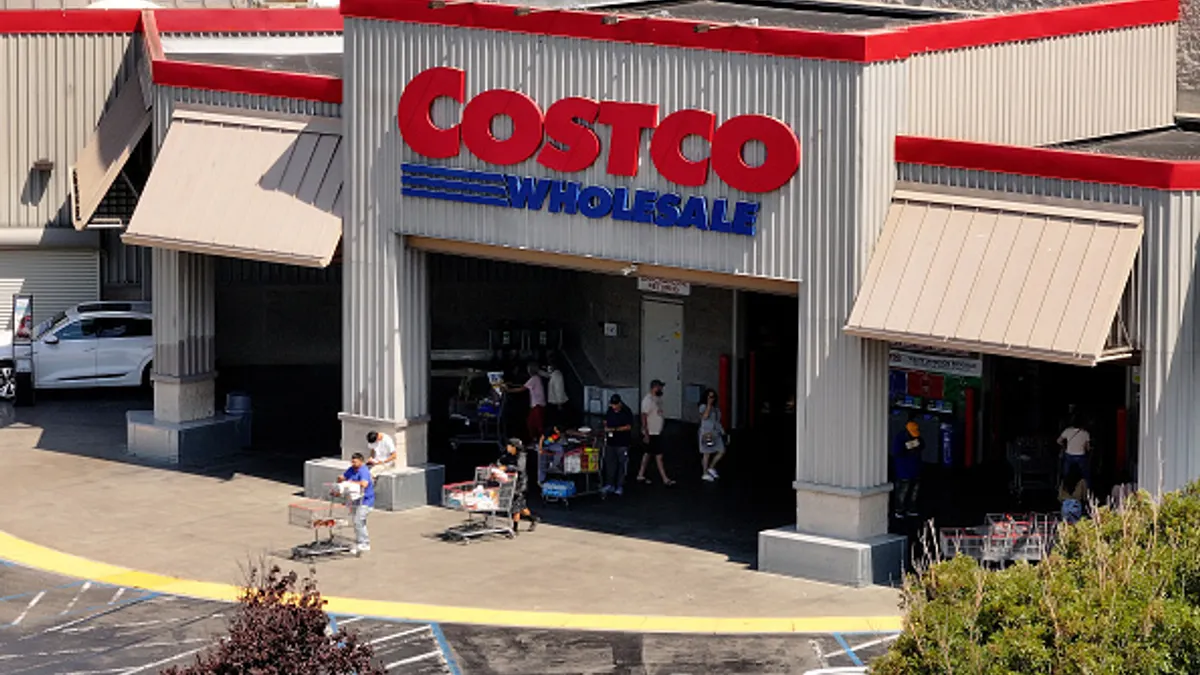
Costco Wholesale is using the first wave of tariff refunds it received during its fiscal fourth quarter largely to reduce prices for members, CEO Ron Vachris said during the company’s Sept. 24 earnings call.
The retailer has directed most of those refunds toward price reductions on produce, meat and beverages, along with selected home furnishing and hardware products, according to Vachris.
The company received $184 million in tariff refunds, including $10 million in interest, during the quarter that ended Aug. 30. CFO Gary Millerchip said that amount represents slightly more than one-third of the total refunds Costco expects to receive.
An analyst asked how Costco was assessing the decision to reinvest those refunds, particularly given the absence of what would be considered a “meaningful” increase in sales directly attributable to the move. Millerchip defended both the pricing strategy and the broader sales performance, describing sales as “robust” apart from gasoline.
He said Costco views the lower prices as a direct way of returning value to members who ultimately paid for goods affected by the tariffs.
“On the pricing investments, we view that as very much a giving value back to our members for the tariff refunds that we received,” Millerchip said. “Our goal was to make sure that we spread those as we could to items that would have the most impact for members.”
Dive Insight
The refunds stem from tariffs that were invalidated after the U.S. Supreme Court’s February decision struck down President Donald Trump’s use of the International Emergency Economic Powers Act (IEEPA) to impose them. U.S. Customs and Border Protection is now processing refunds tied to those tariffs.
The impact of the refunds will not end with fiscal 2026. Millerchip said tariff refunds, related reinvestments and other non-recurring items will continue to affect Costco’s financial results in fiscal 2027. The company therefore plans to provide comparable information about those items during future earnings calls.
Costco, headquartered in Issaquah, Washington, reported $2.99 billion in fourth-quarter net income, up from $2.6 billion in the same period a year earlier. Net sales increased 11.2% year over year to $93.9 billion.
The results drew a cautiously positive assessment from Citi analysts in a Sept. 25 client note. They said Costco’s fourth quarter delivered an “upside on sales and margins,” although that performance was partly overshadowed by slower membership growth.
Citi maintained its neutral rating on the retailer, while describing Costco as a “crown jewel in retail” and one of the “Big 3 market share gainers,” alongside Walmart and Amazon.
Refund strategy faces legal challenges
Costco’s decision to use tariff refunds primarily to support lower prices comes as retailers face legal challenges over how those funds should be distributed.
The warehouse club is among several retailers confronting proposed class-action lawsuits from customers seeking to recover part of the refunds. Costco executives did not address the litigation during the Sept. 24 earnings call.
One of the cases began in March, when an Illinois customer sued Costco, alleging that the company engaged in unfair and deceptive trade practices by planning to use potential tariff refunds to reduce prices rather than distribute some of the proceeds to customers who had already paid more for merchandise affected by IEEPA tariffs.
The lawsuit pointed to comments Millerchip made during a May 2025 earnings call, when he said Costco regarded price increases as a “last resort,” despite the company raising some prices at the time.
Costco moved to dismiss the case in May. Its attorneys argued that the consumer-fraud and deception allegations lacked merit.
The company’s legal filing stated:
“Plaintiff got what he paid for, and Costco never suggested that it would (or even might) later refund part of the purchase price.”
Earlier in September, Costco said it was still awaiting a ruling in the case, according to previous reporting from CFO Dive.
The churro is coming back
Tariffs were not the only topic to generate attention during Costco’s earnings call. Millerchip also continued the company’s tradition of mixing financial updates with lighthearted news about popular food-court products, including its long-running hot dog and soda offering.
This time, the spotlight was on the Costco food-court churro.
“I do want to address the speculation that’s been blowing up our social media feed and confirm that the rumors are true, for a limited time the food court churro will be returning to all our U.S. locations,” Millerchip said.
Costco also addressed the return of the churro in a recent Instagram post focused on the Twisted Churro move.
Inflation remains difficult to predict
Executives also provided an update on inflation, saying overall inflation remains in the low single digits and is “relatively stable” compared with previous quarters. The pressure, however, is not uniform across Costco’s product mix.
The company has seen some deflation in eggs, dairy and butter. At the same time, prices have risen for gasoline, motor oil and resins, with those categories affected by the war in the Middle East. Consumer electronics have also experienced inflation.
Millerchip cautioned that predicting the next phase of inflation remains difficult, particularly because of uncertainty surrounding the conflict in the Middle East and its potential effect on oil prices and other oil-related products.
“We think it’s difficult to predict what’s going to happen with inflation. I think especially because of the uncertainty around the situation with the Middle East and how long that might impact and what you might see in terms of volatility in prices on oil and oil-related items,” Millerchip said.
He added that uncertainty remains over the future direction of tariffs as well.
“And then, of course, there’s still uncertainty around potentially where exactly we land on the tariffs that exist today or could exist in the future.”