




German AI specialist Sereact, online fashion retailer Zalando and global logistics provider CEVA Logistics have launched AI-driven returns processing operations at fulfilment centres in Greven, Germany, and Świebodzin, Poland. The deployment introduces robotic systems designed to handle the unpredictable nature of returned fashion items, addressing one of the most demanding challenges in e-commerce logistics.
The systems use Sereact’s Cortex platform, which enables robots to recognise, grasp and sort objects they have not previously encountered. Unlike conventional automation, which often relies on predefined instructions and product-specific databases, the technology can adapt to items arriving in different conditions, including crumpled garments, poorly packaged products and dishevelled clothing.
The two facilities are now operating the dual-arm robotic systems in live production environments. This initial rollout marks the first phase of a broader programme through which the three companies intend to expand intelligent returns automation across their shared European logistics network.
A new approach to one of fashion logistics’ toughest challenges
Returns continue to be especially difficult to automate because of unpredictable volumes, variable product conditions and labor-intensive handling requirements. Unlike standard fulfillment operations, returns rarely arrive in the consistent state required by traditional robotic systems and are difficult to manage without extensive pre-programming.
Sereact’s Cortex technology is designed to overcome these limitations by dynamically identifying and manipulating unfamiliar items without the need for article-specific training or pre-defined product libraries. The approach is to improve the flexibility of automated handling to the operational realities of fashion e-commerce.
The deployment is under a Robotics-as-a-Service (RaaS) model, which means the technology can be delivered as an operational service that can be adjusted as required. It also marks the first commercial milestone of the strategic partnership between Sereact, Zalando and CEVA Logistics.
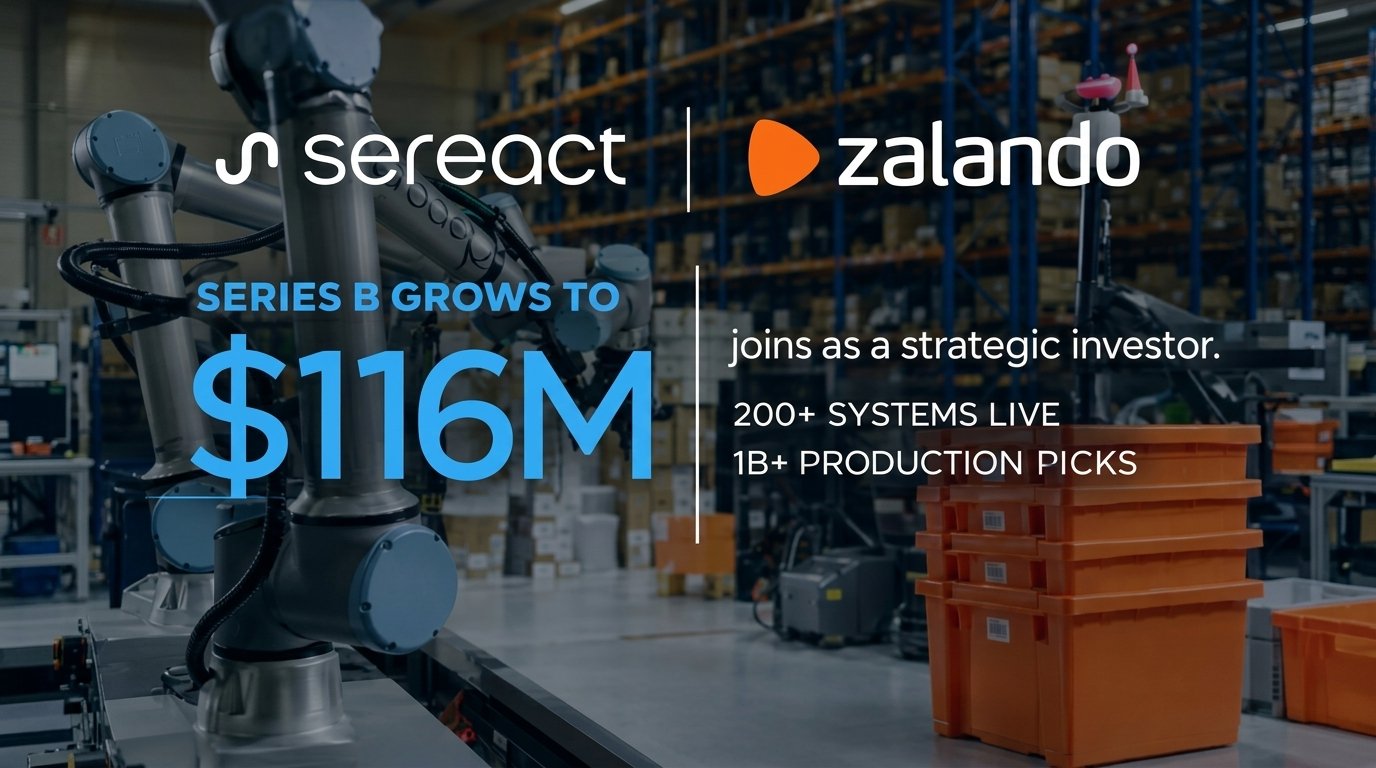
The partnership gained further momentum in July as Zalando invested in Sereact’s Series B funding round as a strategic investor. The funding round brought in $116 million in 2026, bolstering the foundation for the partners’ continued push to scale intelligent automation across their European logistics operations.
Automation designed to support warehouse employees
Beyond operational efficiency, the companies have positioned the technology as a means of improving working conditions in warehouses. Rather than replacing employees, the robotic systems are intended to take over repetitive manual handling and sorting tasks that can place considerable physical demands on personnel.
By reducing this workload, the deployment is expected to give warehouse employees greater opportunities to develop their skills and move towards higher-value responsibilities requiring human expertise, adaptability and sound judgment.
Masood Choudhry, SVP Logistics at Zalando, said the partnership reflects a broader vision for the future of fulfilment, in which technological progress and human capabilities advance together.
“At the heart of our collaboration with Sereact and CEVA is a fundamental belief: true innovation happens when technology and human potential advance together. By solving the most complex challenges in modern fulfilment today, we are actively shaping the future of e-commerce logistics for fashion and lifestyle.”
CEVA targets greater consistency and lower handling costs
At CEVA Logistics, returns processing is a mix of operational and financial pressures. Reverse logistics can be particularly expensive because of unpredictable volumes, seasonal fluctuations, manual quality inspections and the declining value of merchandise over time. It is even worse if each item is expensive to process.
Chris Walton, SVP Contract Logistics at CEVA Logistics, said the RaaS model has potential to improve performance across large scale returns operations.
“One of the most difficult challenges is returns handling, given its highly operational nature and scale, unpredictable volumes, manual quality checks, seasonality, value decay and disproportionately high cost per unit. Our Robotics-as-a-Service model provides consistent and predictable quality at scale by reducing manual touch points and sorting items faster. “This transforms returns from a cost driver to a controlled, high-performance service for our customers.”
The idea behind the system is to accelerate the classification of items, reduce the number of manual interventions and provide more consistent processing quality. For the logistics customer, these improvements could help turn returns management into a more controlled, scalable service, rather than a costly operational burden.
Live deployment puts Sereact’s physical AI to the test
The launch also provides a significant production-scale demonstration of Sereact’s physical AI technology. Fashion returns are particularly demanding because robots must manipulate items whose shapes, positions and conditions can vary considerably, often without having encountered them before.
Dr. Ralf Gulde, CEO and Co-Founder of Sereact, stressed that the ability to perform reliably in real-world operations is essential to making the technology viable for returns processing.
“Returns are the hardest manipulation problem in fashion logistics. If a system only works on articles it has seen before, it does not work in a returns operation at all. Running this in production with CEVA at Zalando volumes is the strongest proof point we have.”
With the systems now operating in Germany and Poland, Sereact, Zalando and CEVA Logistics are moving beyond the development and testing stages towards the practical application of AI-powered robotics in fashion reverse logistics. Their next objective is to build on this initial deployment and extend intelligent automation across their wider European fulfilment operations.