

• Latest
  • Trending
Alternative marine fuels face a reality check as vessel capability outpaces actual demand

Alternative marine fuels face a reality check as vessel capability outpaces actual demand

October 16, 2026
Asia Airfreight Terminal secures 15-year extension at Hong Kong International Airport

Asia Airfreight Terminal secures 15-year extension at Hong Kong International Airport

October 16, 2026
Edmonton Airport launches construction of a 50,000-square-foot air cargo facility

Edmonton Airport launches construction of a 50,000-square-foot air cargo facility

October 16, 2026
ADVERTISEMENT
Five trends reshaping consumer electronics supply chains amid the memory crunch

Five trends reshaping consumer electronics supply chains amid the memory crunch

October 16, 2026
Unilever ties digital twin expansion to measurable factory performance gains

Unilever ties digital twin expansion to measurable factory performance gains

October 16, 2026
J.B. Hunt Beats Reduced Q3 Forecasts as Operating Costs Weigh on Recovery

J.B. Hunt Beats Reduced Q3 Forecasts as Operating Costs Weigh on Recovery

October 16, 2026
US DOT Funding to Add 2,403 Truck Parking Spaces Across 14 Projects

US DOT Funding to Add 2,403 Truck Parking Spaces Across 14 Projects

October 16, 2026
Fleetworthy extends automated roadside inspections to four additional states

Fleetworthy extends automated roadside inspections to four additional states

October 16, 2026
Penske Automotive Moves Toward Private Ownership in $212-Per-Share Buyout

Penske Automotive Moves Toward Private Ownership in $212-Per-Share Buyout

October 16, 2026
A.P. Moller Capital to Acquire Portek International from Mitsui

A.P. Moller Capital to Acquire Portek International from Mitsui

October 16, 2026
LATAM Cargo brings immersive VR safety training to 550 employees in Miami

LATAM Cargo brings immersive VR safety training to 550 employees in Miami

October 16, 2026
Mark Colson to Lead American Trucking Associations as President and CEO

Mark Colson to Lead American Trucking Associations as President and CEO

October 15, 2026
UNFI turns to fuel hedging and AI to contain rising diesel costs

UNFI turns to fuel hedging and AI to contain rising diesel costs

October 15, 2026
  • Home
  • About Us
  • Press Room
  • Podcasts
  • Media Kit
  • Contact Us
  • Careers
Friday, October 16, 2026
  • Login
  • Register
The Logistic News
  • Logistic
  • Air
  • Maritime
  • Land
  • World
  • Business
  • Tech
  • Events
  • Advertise
No Result
View All Result
  • Logistic
  • Air
  • Maritime
  • Land
  • World
  • Business
  • Tech
  • Events
  • Advertise
No Result
View All Result
The Logistic News
No Result
View All Result
Home Business

Alternative marine fuels face a reality check as vessel capability outpaces actual demand

Despite the growing number of dual-fuel vessels entering service, LNG, methanol and ammonia consumption remains limited. Figures presented around SIBCON 2026 in Singapore highlight the decisive role of fuel prices, infrastructure and regulatory uncertainty in slowing the transition.

The Logistic News by The Logistic News
October 16, 2026
in Business, EchoChain, Logistic, Maritime
Reading Time: 4 mins read
0
Alternative marine fuels face a reality check as vessel capability outpaces actual demand
ADVERTISEMENT

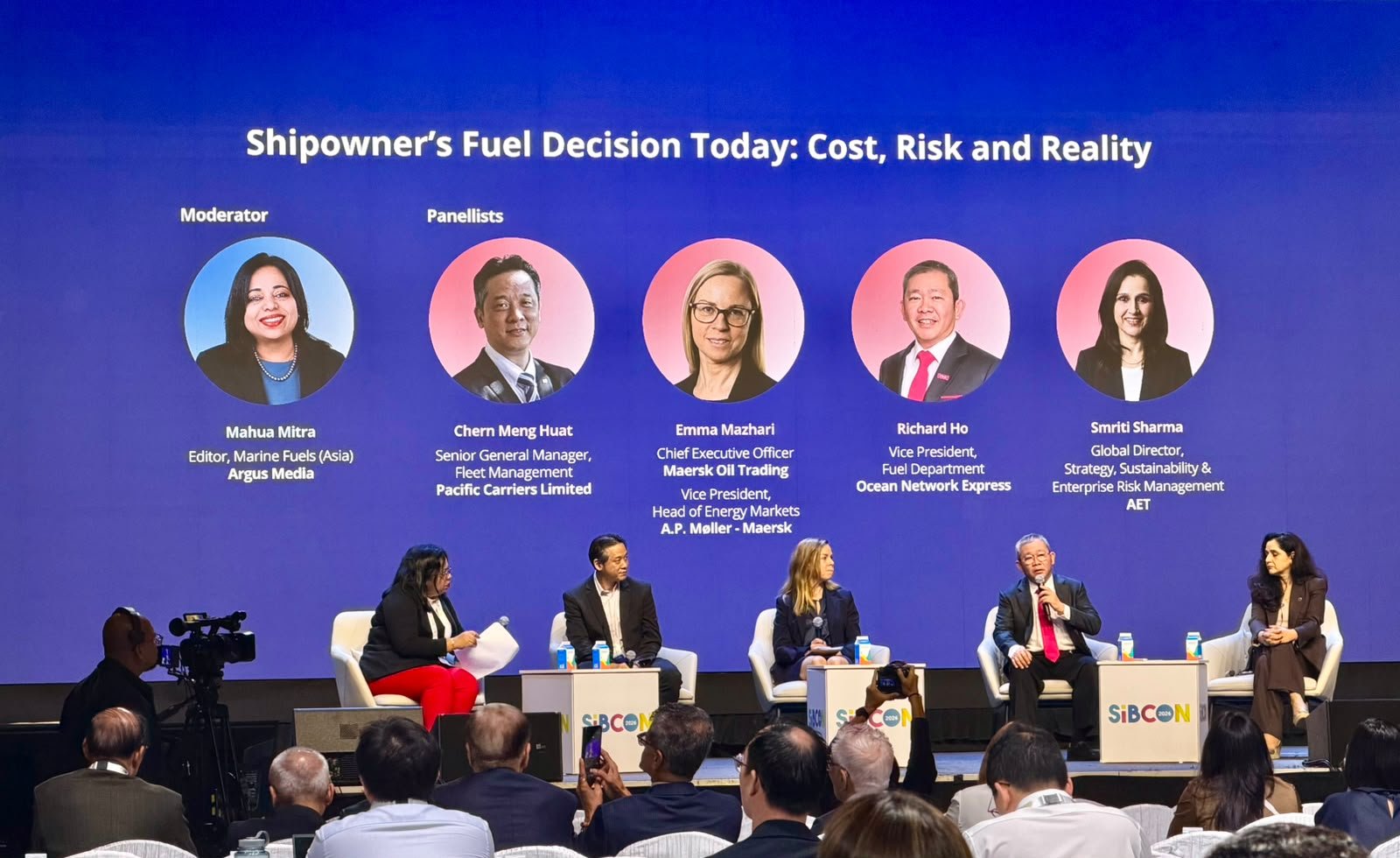
Dual-fuel vessels are becoming more common, but the use of lower-emission marine fuels is not keeping pace with the shipping industry’s technical capabilities. A key issue raised at the Singapore International Bunkering Conference and Exhibition (SIBCON) 2026 is that the gap between the alternative fuels that ships can use and the amount they actually do is still there.

As one speaker put it simply to lay out the issue: “capability does not equal consumption”.

More fleet means more fuel requirement

Alternative fuels are a regular theme at maritime conferences and more and more shipowners are investing in vessels that can run on fuels like LNG, methanol and ammonia. But the expansion of the fleet will not necessarily translate into an increase in demand for lower-emission energy sources.

ADVERTISEMENT

SIBCON, the world’s biggest marine fuels event, is an important forum for the sector to review developments. The conference is organized by Informa Markets on behalf of the Maritime & Port Authority of Singapore (MPA) and is under the Chatham House Rule. This limits the ability to attribute individual comments, but also helps to reduce the prominence of promotional statements that may not reflect actual market conditions.

Speakers at the event cited the increasing number of alternative-fuel vessels already in operation and on order as proof of potential future demand. But they said the technical ability of a ship to burn a fuel does not mean the owner or charterer of the ship will necessarily buy it.

Fleet stats show the gap between potential and consumption

Vessels that can operate on alternative fuels account for 5.48% of the fleet by tonnage, according to DNV platform Alternative Fuels Insights.

LNG has the highest percentage share of total fleet tonnage for LNG capable vessels at 4.03% Another 0.76% are methanol and ethanol-capable ships, and 0.68% are LPG-capable ships.

Depending on what proportion of the fleet is capable of running on LNG, this could be a big contribution to the total marine fuel demand. But the real numbers tell a different story, especially in Singapore, the world’s largest bunkering port by far.

According to MPA statistics, LNG made up just 1.15% of the port’s fuel sales in the first nine months of 2026. Total volume sold was 487,100 tons against total sales of marine fuels of 42.5 million tons.

Methanol sales were much lower, at 6,300 tons in Singapore over the same period. Ammonia, which is still in its infancy as a marine fuel, had no sales.

The numbers reflect the gap between the technical readiness of the fleet and the commercial adoption of alternative energy sources. Even with Singapore’s 4.03% share of the global LNG-capable vessel fleet tonnage, it is still relatively low at 1.15% when considering regional variations and the efficiency of current dual-fuel engines.

Fuel prices still a big problem

Economics of buying marine fuel drives decisions in the industry. LNG is getting expensive. The crisis concerning Iran has caused supply disruptions and security and transit concerns through the Strait of Hormuz have affected Qatari supplies.

Owners and charterers of alternative-fuel vessels still have the cheaper alternative available and can also run them on conventional marine fuels. As conventional fuels are obviously cheaper, the commercial incentive to switch to alternative fuels is reduced.

Many of the modern dual-fuel vessels are now scrubber fitted, adding another dimension to these purchase decisions. These systems enable vessels to operate on low cost high sulfur fuel oil (HSFO) and comply with the relevant sulphur-emissions regulations.

This option has become particularly attractive lately, with the price gap between HSFO and very low sulfur fuel oil (VLSFO). HSFO dominated the Singapore fuel market in September 2026 with 42.2% of all bunker fuel sales. The actual fuel consumption was greatly affected by the price spread.

regulatory uncertainty impedes transition

It is a tall order to turn the many trials of alternative fuels that ship owners have been conducting into recurring consumption and repeat orders. For most of the industry, economic factors will probably be the main driver of procurement decisions, as long as conventional fuels remain cheaper.

The International Maritime Organization (IMO) has proposed a Net-Zero Framework that could help bridge the cost gap between traditional fuels and lower-emission alternatives. Such a framework could help change the market conditions that drive investment and shape choice.

Confidence in the regulatory initiative in Singapore, however, remains weak and sentiment around the prospects for the delayed framework to come into force looks negative.

That uncertainty adds another element of complexity for shipowners who must weigh the cost of investment in alternative fuels against the likelihood of future regulatory requirements and the availability of economically competitive fuels.

Biofuels offer a more immediate route

Market activity is more balanced between alternative energy sources such as biofuels and biofuel blends. In September 2026 they accounted for 1.7% of total bunker fuel sales in Singapore, although the share fluctuated considerably over the year.

And the fact that they are available now is definitely a boon. Biofuels are now available at some 100 ports worldwide and used by around 100 shipowners.

Biofuels do not require costly retrofits to ships, unlike some of the other alternative fuels. The chemical composition is very different from conventional marine fuels but operational behavior is usually similar.

Shipowners have not faced more operational problems and problems with the quality of fuel from biofuels and biofuel blends than they have from conventional marine fuels, SIBCON speakers said.

These characteristics suggest biofuels could be easier for operators seeking to introduce lower-emission fuels to existing operations without major vessel modifications.

The SIBCON 2026 debate ultimately shone a light on a key dilemma in the decarbonization of shipping. On one side of the transition, it’s adding more ships that can run on alternative fuels. Competitive pricing, reliable supply, real-world availability and a more certain regulatory outlook will also be critical to future adoption.


Previous Post

A.P. Moller Capital to Acquire Portek International from Mitsui

Next Post

Penske Automotive Moves Toward Private Ownership in $212-Per-Share Buyout

Next Post
Penske Automotive Moves Toward Private Ownership in $212-Per-Share Buyout

Penske Automotive Moves Toward Private Ownership in $212-Per-Share Buyout

Leave a Reply Cancel reply

Your email address will not be published. Required fields are marked *

A D V E R T I S E M E N T

Popular News

  • Drone Delivery Takes Flight: Amazon Partners with UPS for Trial Program

    Drone Delivery Takes Flight: Amazon Partners with UPS for Trial Program

    0 shares
    Share 0 Tweet 0
  • Rail Cargo Group Strengthens European Network with Captrain Netherlands Acquisition

    0 shares
    Share 0 Tweet 0
  • Automotive Inbound Logistics Market: Navigating Future Challenges

    0 shares
    Share 0 Tweet 0
  • Global Inflation Cools to Target After Three Years, Central Banks Face Policy Dilemma

    0 shares
    Share 0 Tweet 0
  • Dubai Mercantile Exchange Rebrands as Gulf Mercantile Exchange Following Saudi Tadawul Group Acquisition

    0 shares
    Share 0 Tweet 0

Recent News

Asia Airfreight Terminal secures 15-year extension at Hong Kong International Airport

Asia Airfreight Terminal secures 15-year extension at Hong Kong International Airport

October 16, 2026
Edmonton Airport launches construction of a 50,000-square-foot air cargo facility

Edmonton Airport launches construction of a 50,000-square-foot air cargo facility

October 16, 2026
Five trends reshaping consumer electronics supply chains amid the memory crunch

Five trends reshaping consumer electronics supply chains amid the memory crunch

October 16, 2026

Discover a new era of logistics reporting with The Logistic News, your go-to platform for breaking news, insightful features, and exclusive interviews shaping the global logistics and freight landscape. Trust us to deliver accurate, timely, and relevant information that empowers professionals and enthusiasts alike in navigating the intricacies of this vital sector.

Navigation

  • Home
  • About Us
  • Press Room
  • Podcasts
  • Media Kit
  • Contact Us
  • Careers
  • Privacy Policy
  • Terms of Use

© 2024 - thelogisticnews.com

Welcome Back!

Login to your account below

Forgotten Password? Sign Up

Create New Account!

Fill the forms below to register

All fields are required. Log In

Retrieve your password

Please enter your username or email address to reset your password.

Log In

SIgn Up Newsletter

This will close in 20 seconds

Manage Cookie Consent
We use technologies like cookies to store and/or access device information. We do this to improve browsing experience and to show (non-) personalized ads. Consenting to these technologies will allow us to process data such as browsing behavior or unique IDs on this site. Not consenting or withdrawing consent, may adversely affect certain features and functions.
Functional Always active
The technical storage or access is strictly necessary for the legitimate purpose of enabling the use of a specific service explicitly requested by the subscriber or user, or for the sole purpose of carrying out the transmission of a communication over an electronic communications network.
Preferences
The technical storage or access is necessary for the legitimate purpose of storing preferences that are not requested by the subscriber or user.
Statistics
The technical storage or access that is used exclusively for statistical purposes. The technical storage or access that is used exclusively for anonymous statistical purposes. Without a subpoena, voluntary compliance on the part of your Internet Service Provider, or additional records from a third party, information stored or retrieved for this purpose alone cannot usually be used to identify you.
Marketing
The technical storage or access is required to create user profiles to send advertising, or to track the user on a website or across several websites for similar marketing purposes.
Manage options Manage services Manage {vendor_count} vendors Read more about these purposes
View preferences
{title} {title} {title}
No Result
View All Result
  • Logistic
  • Air
  • Maritime
  • Land
  • World
  • Business
  • Tech
  • Events
  • Advertise

© 2024 - thelogisticnews.com