



The United States is broadening its campaign against Iran’s maritime trade networks, targeting not only ship operators and cargo movements but also the legal firms and shipping intermediaries accused of helping sustain them. The latest measures, announced on 21 October under Operation Economic Outcast, place corporate structures and the service providers behind Iran’s shadow fleet increasingly in the crosshairs of Washington.
The US Department of the Treasury’s Office of Foreign Assets Control (OFAC) has sanctioned Karnakis and Karnakis, a law firm operating in Panama and Greece, over what the administration describes as years of support for illicit Iranian shipping activities. According to Treasury, the firm helped Tehran generate revenue for its military and nuclear programmes by establishing corporate entities connected to vessels transporting Iranian commodities.
Treasury Secretary Scott Bessent said the United States would sanction anyone supporting the Iranian regime, including those facilitating illegal oil transfers at sea and those working behind the scenes in professional services. He also warned intermediaries that Washington intended to continue identifying and targeting individuals and companies involved in these networks.
Corporate structures under scrutiny
Treasury alleges that Karnakis and Karnakis used its legal practice to register shipping companies that own vessels involved in the movement of hundreds of millions of dollars’ worth of Iranian steel, petroleum and petrochemicals. Some employees allegedly served as directors and officers of the companies they established, helping obscure the identities of their ultimate beneficial owners.
The firm was founded and is owned by Sofianos Karnakis Kosmas and Konstantinos Karnakis Kosmas, who hold both Panamanian and Greek nationality. Its employees include Ioanis Karnakis Kosmas, a Panamanian-Greek national, and Pedro Ortega Jones, a Panamanian national. Treasury also identifies Roberto Ortega Jones among the employees involved in company directorships and registrations associated with the firm’s activities.
The US authorities further allege that Karnakis and Karnakis played a significant role in establishing the corporate framework for the shipping empire of Seyed Asadoollah Emamjomeh, an Iranian magnate specialising in liquefied petroleum gas (LPG). His network has been linked to the shipment of hundreds of millions of dollars’ worth of Iranian LPG and crude oil to foreign markets. The law firm acted as corporate agent for several of Emamjomeh’s companies, including entities subsequently sanctioned for their involvement in Iranian petroleum trade.
Seven Panama-flagged vessels added to the sanctions list
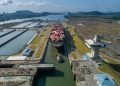
The measures also extend to Roxette Maritime Shipping and Trading S.A., a company based in Panama and Greece for which Karnakis and Karnakis served as corporate agent. OFAC sanctioned Roxette over its alleged activities in Iran’s petrochemical sector and designated seven vessels owned and managed by the company as blocked property.
The affected ships, all flying the Panama flag, are Anemos (IMO 9205952), Gloris (IMO 9449510), Pride (IMO 9487407), Destiny (IMO 9385491), Flamingo 1 (IMO 9474199), Harmony (IMO 9449522) and Prince (IMO 9548316).
OFAC has established limited temporary authorisations allowing companies that provide essential maritime services to wind down their business involving Roxette Maritime and the seven blocked vessels. The provisions cover services including vessel management, crewing, bunkering, piloting, registration, flagging, insurance, classification and salvage, where the transactions are necessary for the authorised wind-down.
Permitted activities include emergency repairs, measures to protect crew safety and actions to mitigate environmental risks. The authorisations also cover the safe docking, anchoring and departure of vessels from ports outside Iran and Russia. In addition, non-Iranian cargo may be delivered and offloaded, provided it was loaded on or before 21 October 2026 and is discharged outside Iran or Russia.
These exceptions are intended to address immediate operational, safety and environmental needs without removing the vessels from the sanctions framework.
Shipping agents accused of facilitating Iranian cargo movements
Washington has also targeted two shipping agents accused of helping move illicit Iranian cargo through ports around the world. The shipments concerned include oil, petroleum and other commodities, extending the crackdown beyond ship ownership and corporate registration to the intermediaries that facilitate maritime trade.
Singapore-based Amigoz Singapore Pte Ltd. is among the companies sanctioned. Treasury alleges that the firm acted as shipping agent for a light crude oil shipment overseen by Sepehr Energy Jahan Nama Pars Company. According to the US authorities, Sepehr Energy manages a network of front companies supporting the movement of billions of dollars’ worth of commodities supplied to the Iranian military.
Treasury has also linked Amigoz to a range of shadow-fleet operators, including actors associated with companies controlled by Mohammad Hossein Shamkhani. The Singapore-based firm is further accused of providing bunkering services to Zixuan (IMO 9317298), a vessel identified by the US authorities as part of Iran’s shadow fleet.
Dubai-based Whales Shipping Line LLC has also been designated. Treasury alleges that the company acted as shipping agent for Sparrow Trading FZE, a Dubai-based front company already under sanctions. Sparrow Trading allegedly arranged the purchase of tens of millions of dollars’ worth of Iranian petrochemicals in coordination with Persian Gulf Petrochemical Industry Commercial Co.
Together, the designations illustrate the breadth of Operation Economic Outcast: Washington is seeking to disrupt the corporate, legal and operational links that enable Iranian commodities to reach international markets. By targeting the service providers involved in establishing shipping companies, managing vessels, arranging port services and facilitating cargo movements, the administration is expanding sanctions pressure across the wider maritime supply chain.