



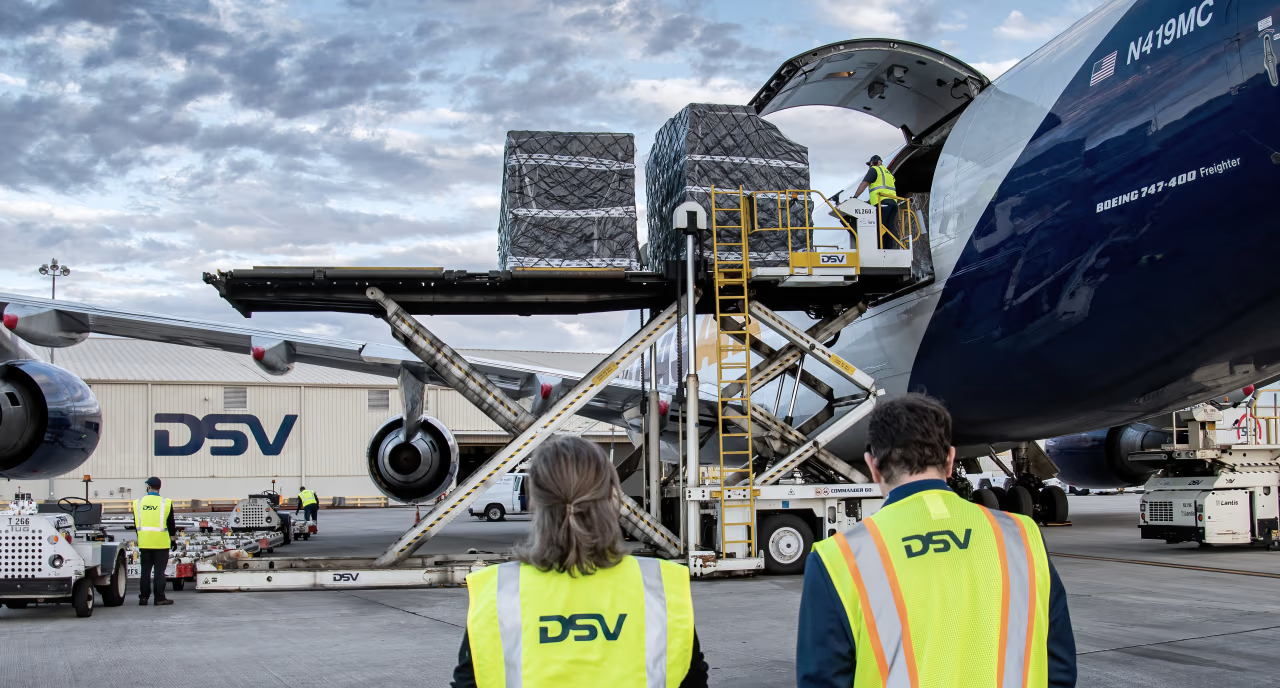
DSV’s air freight profitability improved in the third quarter of 2026, generating more gross profit from less cargo than a year ago. Higher yields per ton helped the Danish logistics group, while growth in shipments related to technology offset weaker volumes in other segments.
The gross profit in air freight was DKK 5.01 billion (€672 million), up 4% from DKK 4.74 billion (€636 million) in Q3 2025. Also the result was better than the DKK 4.87 billion (€653 million) in the second quarter of 2026.
Average gross profit per ton was DKK 8,936 (EUR 1,198) which is an increase of 8% compared to the same period last year (DKK 8,196/EUR 1,099) and a decrease of 3% compared to the previous quarter (DKK 8,722/EUR 1,169).
This came despite a 3% year on year drop in air freight volumes, which fell from 579,000 tons in Q3 2025 to 561,000 tons. Volumes sequentially grew to 558,000 tons from the previous quarter.
DSV attributed the year-on-year fall to its own yield management actions, a shift in some customers’ shipments from air to sea freight and weaker activity across Europe. Against this, there were pressures on available market capacity, which remained tight due to the continuing conflict in the Middle East and strong demand associated with technology and cloud infrastructure.
DSV’s air freight volumes grew 15% in the first nine months of 2026 compared with the same period in 2025, including acquisitions. Gross profit grew to DKK 14.14 billion (€1.90 billion) compared to DKK 12.10 billion (€1.62 billion) last year, an increase of 17.2%.
Air & Sea costs less to operate
The combined Air & Sea division registered better operating performance in Q3 2026. EBIT increased 18.9% year on year to DKK 4.28 billion (€573 million) from DKK 3.53 billion (€473 million) in the same quarter of 2025. The improvement was mainly due to a lower cost base, DSV said.
The conversion ratio increased to 45.8% from 38.6% in the year-ago quarter and 42.4% in Q2 2026. Operating margin was 9.4% compared to 9.1% in each of the comparison periods.
However, lower volumes in some European markets and the movement of some services to the new Global Products unit affected gross profit. “Excluding these transfers, gross profit was up 2.8%.
Road division struggles to integrate
DSV’s Road business continued to be under pressure due to the integration of Schenker’s European road network, which affected operations in the quarter.
Revenue decreased 1% to DKK 23.38 billion (€3.13 billion) year on year, and gross profit fell 11.2% to DKK 4.50 billion (€603 million).
EBIT fell 35.1% to DKK 526 million (€71 million) in Q3 2025 from DKK 798 million (€107 million). The most recent figure included DKK 195 million (€26 million) in gains on disposals of property.
The division’s operating margin decreased to 2.3% from 3.4% a year ago and its conversion ratio declined to 11.7% from 15.9%.

By the end of the third quarter, DSV said operational performance had returned to normal. The team strengthened divisional and country level management and deployed recovery plans to achieve service quality and operational efficiency.
There were signs of improvement in performance on the European road network. The percentage of shipments delivered in full and on time (DIFOT) rose to 93.4% in September from 92.4% in August, and was around 94% in early October.
The division is now focused on enhancing productivity and profitability while restoring customer volumes. However, DSV has delayed the remaining Road-related synergies until 2027, but its strategic priorities and financial targets are unchanged.
Contract Logistics delivers significant EBIT growth
Contract Logistics had a much stronger quarter on synergies, site consolidation and commercial expansion, especially in the technology area.
Revenue was up 7.3% year-on-year to DKK 14.28 billion (€1.91 billion). Gross profit climbed 1% to DKK 5.96 billion (€798 million).
EBIT increased by 50.3% to DKK 1.67 billion (€224 million) from DKK 1.10 billion (€147 million) in Q3 2025. The result included gains from the sale of property of DKK 105 million (€14 million).
The division’s operating margin increased to 11.7% from 8.4% a year earlier. DSV attributed the progress to the advantages of integration and consolidation and stronger commercial activity tied to technology clients, cloud infrastructure and hyperscalers.
Pre-tax return on invested capital (ROIC), for the last 12 months, increased to 10.9% from 6.9%.

Group revenue and operating earnings increase
At group level, DSV reported revenue of DKK 80.70 billion (€10.82 billion) for Q3 2026, representing annual growth of 10.5%. Gross profit advanced 2.3% to DKK 20.25 billion (€2.71 billion).
EBIT before special items rose 19.5% to DKK 6.61 billion (€886 million), compared with DKK 5.43 billion (€728 million) in the third quarter of 2025. The latest figure included DKK 300 million (€40 million) in gains from property disposals.
Diluted adjusted earnings per share for the last 12 months increased 11.5% to DKK 56.1 (€7.52).
Adjusted free cash flow amounted to DKK 6.44 billion (€863 million). However, net working capital remained elevated, reflecting the impact of higher freight rates and fuel prices.
Schenker integration advances, with synergies continuing to build
DSV said the integration of Schenker was broadly progressing according to plan. Almost all countries had either completed or begun the integration process, with the remaining countries scheduled to start in Q4 2026.
The integration has resulted in a net reduction of approximately 9,000 white-collar positions so far.
Quarterly synergies increased by around DKK 300 million (€40 million) during Q3, bringing the total to approximately DKK 1.4 billion (€188 million) per quarter compared with the position before the acquisition. DSV continues to target annual synergies of DKK 9 billion (€1.21 billion).
The company cautioned that inflation and the additional costs associated with expanding Contract Logistics activity would partly offset the savings. The remaining synergies related to Road and group functions have been deferred to 2027.
Total transaction and integration costs are still expected to reach approximately DKK 11 billion (€1.47 billion). Special items amounted to DKK 1.3 billion (€174 million) in Q3, taking cumulative costs recorded to approximately DKK 8.7 billion (€1.17 billion).
New Global Products unit consolidates specialised services
Alongside the Schenker integration, DSV is developing its Global Products organisation to bring several specialised services together under one structure.
The unit combines Global Customs, Parcels, Fairs & Events, supply chain services and fifth-party logistics (5PL). The objective is to strengthen the group’s service offering while improving productivity and operational coordination.
Approximately 450 white-collar employees transferred to the new unit during the third quarter, bringing its workforce to around 3,000. Further employee transfers are planned.
DSV said the unit’s impact on EBIT remains immaterial at this stage.
DSV narrows its 2026 earnings outlook
DSV revised its full-year 2026 guidance for EBIT before special items to a range of DKK 24.0 billion to DKK 25.0 billion (€3.22 billion–€3.35 billion). The previous range stood at DKK 23.5 billion to DKK 25.5 billion (€3.15 billion–€3.42 billion).
For comparison, EBIT before special items amounted to DKK 19.61 billion (€2.63 billion) in 2025.
The company also reduced its forecast for 2026 special items to DKK 5.5 billion (€737 million), down from DKK 6.5 billion (€871 million). The revision reflects the decision to recognise approximately DKK 1 billion (€134 million) in integration costs in 2027 rather than in 2026.
DSV expects to generate approximately DKK 4 billion (€536 million) in additional synergies compared with 2025. It also anticipates property disposal gains in Q4 broadly in line with those recorded in recent quarters.
The outlook remains subject to uncertainty arising from the conflict in the Middle East, which the group said is contributing to a more challenging economic environment characterised by rising inflation and interest rates.
For 2026, DSV expects the global air and sea freight markets it serves to expand at mid-single-digit rates. In the fourth quarter, Air & Sea volumes are expected to grow more slowly than the market, while average gross profit yields are forecast to be slightly below Q3 levels.
Road freight markets are expected to record flat to low-single-digit growth during the remainder of the year. Contract Logistics is forecast to grow at mid-single-digit rates.
The financial guidance assumes exchange rates remain at current levels, particularly the US dollar against the Danish krone.
Share buyback resumes following improvement in leverage
DSV has also launched a DKK 1.5 billion (€201 million) share buyback programme, its first since announcing the acquisition of Schenker.
The programme runs from 21 October 2026 to 1 February 2027. Of the total amount, DKK 1 billion (€134 million) is allocated to Q4 2026, with the remaining DKK 500 million (€67 million) scheduled for Q1 2027.
The company said the buyback had become possible after its gearing ratio declined to 2.5 times EBITDA. DSV aims to reduce net interest-bearing debt to below 2.0 times EBITDA during 2027.
The programme comes as the group continues to integrate Schenker, pursue cost synergies and manage uneven performance across its operating divisions. While air freight profitability and Contract Logistics delivered gains in the third quarter, the Road division’s recovery remains a key operational priority heading into 2027.