



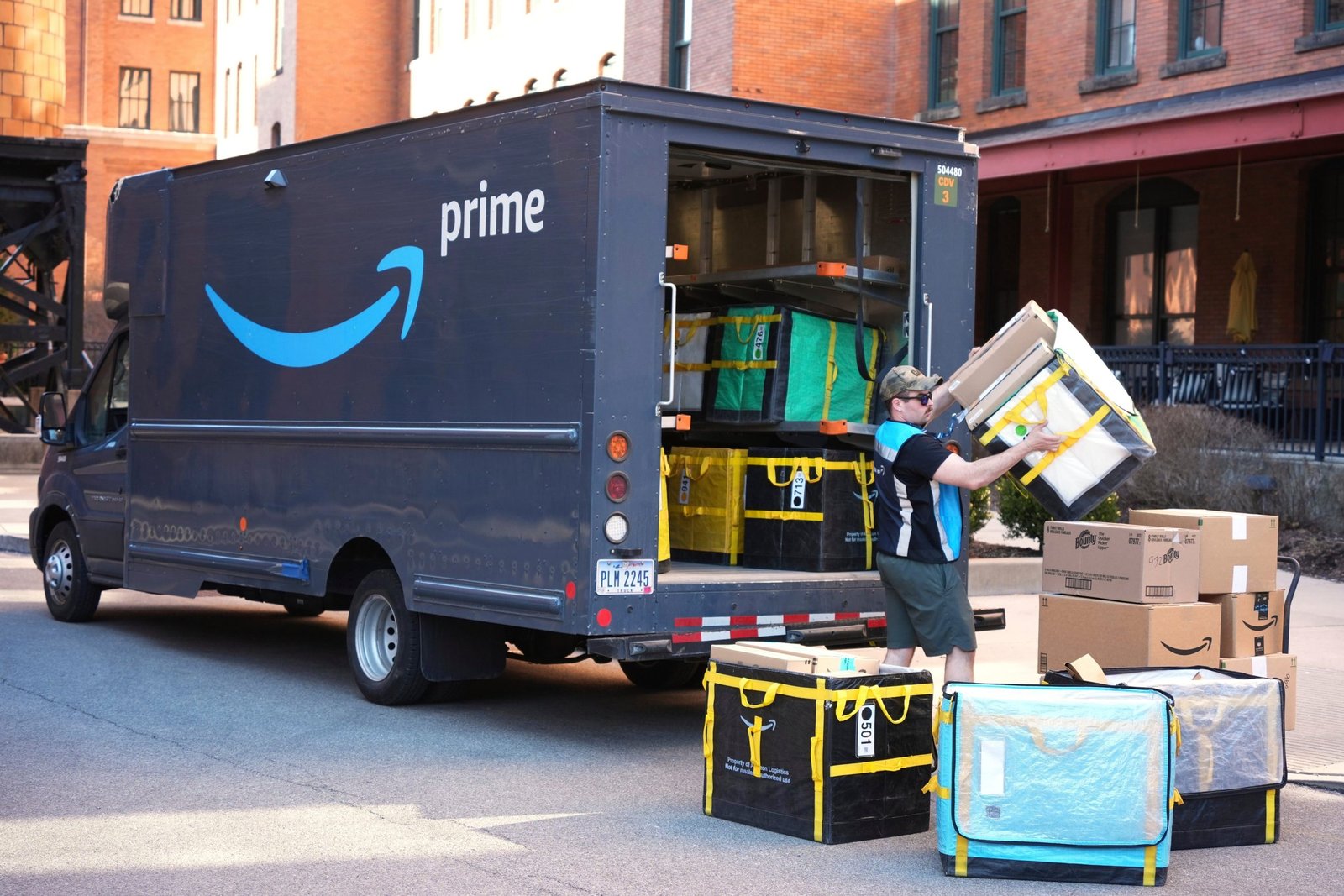
Amazon’s logistics business pressured its transportation costs, but the company still reported record operating profits in the third quarter of 2026. The e-commerce giant is still spending money on robotics to improve the efficiency of fulfilling orders amid rising fuel prices and linehaul rates, and as it builds out its delivery network.
“We’re building out same day fulfillment centers and ultra-fast delivery services and that’s important,” CEO Andy Jassy said Thursday following the company’s financial results. Those efforts are helping Amazon gain more customers and reduce the cost of fulfilling and shipping orders, he said.
“We’re on track to have our fourth consecutive year of reducing the cost to serve per unit,” Jassy told analysts on the earnings call.
The Seattle company posted revenue for the quarter of $201.9 billion, a 12% increase from $180.2 billion a year ago. Operating income jumped to $28.1 billion, up from $17.4 billion in Q3 2025, up roughly 61%.
Amazon, meanwhile, had a mixed bag of numbers relative to expectations. Revenue for the quarter was $202.3 billion, just shy of analysts’ expectations, and earnings per share were $1.89, below the expected $1.96.
Even with those misses, Amazon (Nasdaq: AMZN) still delivered an operating margin of 13.9%, its best ever. Higher operating costs were offset by its retail and cloud computing operations.
Increased transport costs are impacting logistics performance
Higher transportation costs remained a major headwind for Amazon’s fulfillment network in the quarter.
Logistics teams had to deal with more expensive fuel and higher linehaul rates, both of which pressured shipping costs, said Chief Financial Officer Brian Olsavsky.
This enabled the company to better position inventory, bring products closer to customers and consolidate packages, optimizing its cost to serve. These operational changes helped mitigate the financial impact of transportation inflation.
Globally, shipping costs climbed 11% from a year ago, compared to a 12% growth in units shipped. Excluding the effects of fuel and linehaul inflation, the cost to ship was up 8%, or about four points short of growth in units.
That difference means Amazon is taking on some of the extra transportation burden, through operational efficiency rather than costs rising in line with the number of shipments.
Amazon third-quarter earnings
Q3 2025 vs. Q3 2026 Financial and Operational Metrics
The company reported solid gains in operating profitability in its financial results, particularly in its North American operations and its cloud computing business. Here are the numbers that offer a snapshot of Amazon’s performance for the quarter.
Amazon Q3 2026: Key financial and operating metrics
Amazon Q3 2026: Key Financial and Operating Metrics
Financial comparison between Q3 2025 and Q3 2026
| Metric | Q3 2025 | Q3 2026 | YoY Change |
|---|---|---|---|
| Total revenue | $180.17B | $201.94B | +12.1% |
| Operating income | $17.42B | $28.08B | +61.2% |
| Operating margin | 9.7% | 13.9% | +4.2 pts |
| Net income | $21.19B | $20.69B | -2.4% |
| Diluted EPS | $1.95 | $1.89 | -3.1% |
| North America revenue | $106.27B | $112.85B | +6.2% |
| North America operating income | $4.79B | $8.72B | +82.1% |
| International revenue | $40.90B | $43.11B | +5.4% |
| AWS revenue | $33.01B | $45.98B | +39.3% |
| Worldwide shipping costs | $25.38B | $28.30B | +11.5% |
| Fulfillment expenses | $27.68B | $30.00B | +8.4% |
| Third-party seller services revenue | $42.49B | $46.49B | +9.4% |
| Online store revenue | $67.41B | $68.47B | +1.6% |
| Worldwide paid-unit growth | 11% | 12% | +1 pt |
Source: Amazon Q3 2026 earnings release.
Amazon (AMZN) Q3 2026 earnings release. Figures are as reported in the supplied financial data.
The numbers indicate a major improvement in Amazon’s operating performance. Operating income grew at a much faster pace than revenue and worldwide shipping expenses grew at a slower pace than units shipped.
Operating income growth led by North America
Amazon’s North America segment, which comprises its U.S. and Canadian retail business, posted sales of $112.9 billion in the third quarter. That was 6% higher than the comparable period in 2025 when the segment reported $106.3 billion.
Most importantly, the region’s operating income soared to $8.7 billion from $4.8 billion a year ago – an increase of about 81% to 82%, depending on which numbers you use. The division thus achieved an operating margin of 7.7%.
International operations were also a positive contributor. Revenue increased 5% to $43.1 billion and operating income rose to $1.6 billion from $1.2 billion a year ago.
Amazon also cited a key element in its year-over-year comparisons: the timing of Prime Day. The shopping event in most major markets was in the second quarter of 2026, versus the third quarter of 2025.
The company said the change in the calendar clipped its third-quarter revenue growth by about four percentage points.
Robotics and speedier deliveries change fulfillment operations
Besides the financial results, Amazon also unveiled major upgrades to delivery speed and warehouse automation.
The company said Prime members had their fastest-ever third quarter delivery speeds in the three months ending Sept. 30. Same day or overnight delivery was used for more than 1.5 billion items, showing the growing reach of its rapid fulfillment capabilities.
Automation continues to be a core aspect of this strategy. In its fulfillment network, Amazon has more than a million robots working, Jassy told analysts.
The CEO says the technologies have helped boost productivity, trim operating costs and reduce safety incidents in fulfillment operations to record lows.
Olsavsky also said Amazon doubled its fleet of robotic arms in 2026. That expansion includes its Cardinal and Sparrow systems used for various warehouse operations and package processing.
But the company is aiming to do more than automate traditional warehouses. Amazon is also working on robotics foundation models, which are designed to enable machines to do more complex physical tasks.
The investments are part of a wider effort to boost the efficiency of its logistics infrastructure to cope with increasing order volumes and increasingly exacting delivery expectations.
Q4 to see continued transportation cost pressures
Transportation inflation remains a headwind for Amazon in the back half of 2026, though it improved in Q3.
During Thursday’s earnings call, Jassy faced analysts’ questions about rising fuel prices and linehaul costs in the question-and-answer segment. “The effect of these cost increases would be a little bit more pronounced in the fourth quarter than in the third quarter,” he said.
Earlier this year Amazon began charging sellers using its Fulfillment by Amazon (FBA) service a fuel surcharge. The company can thus recover a part of the additional costs of fuel, incurred by the handling and delivery of the products of the sellers.
But Jassy acknowledged the surcharge doesn’t cover all the increased costs in transportation. Consequently, Amazon continues to incur higher costs in its inbound retail shipments and outbound customer deliveries.
The company is thus betting on operational improvements, automation and network optimization to mitigate the effect of these pressures on its profitability.
Amazon outlook for fourth quarter upbeat
Amazon projects net sales in the fourth quarter of 2026 to be between $240 billion and $247 billion. This forecast is approximately 12 to 16 percent year over year growth
Operating income is also expected to be between $28.5 billion and $33.5 billion, compared with $25 billion in the year-ago period.
These forecasts indicate that Amazon expects to continue its growth trajectory even in the tough transport climate.
Why this matters
That Amazon is able to increase shipping costs at a slower rate than shipped units is a textbook example of how logistics optimization, automation and strategic inventory placement can help protect margins in an inflationary environment. With rising fuel and linehaul costs, the company’s approach could provide key insight into the future economics of e-commerce fulfillment, parcel delivery and large-scale distribution networks.