



Venti Technologies is taking its autonomous container-handling technology beyond Singapore as it prepares to introduce driverless trucks at major US intermodal rail yards. The Boston-based company has spent nearly three years operating vehicles without drivers at PSA’s Singapore port, but expanding into the American market has required it to overcome a new set of operational challenges.
Unlike the Singapore terminal, where traffic follows a continuous loop and vehicles rarely need to reverse, US rail yards require trucks to perform more complex manoeuvres. According to Venti founder and CEO Heidi Wyle, the company has had to teach its vehicles to reverse articulated tractor-trailers and navigate railway crossings independently.
A Class I intermodal railroad is planning to deploy more than 130 Venti trucks across eight locations by 2027. Before that rollout can proceed, the vehicles must demonstrate that they can handle the specific conditions found in American yards.
Backing up an articulated truck is considered one of the more difficult manoeuvres in trucking. As reported when autonomous technology provider Outrider introduced trailer-backing capabilities for its distribution-yard tractors in 2022, this remains a significant technical challenge for driverless operations.
Wyle said Venti’s vehicles, which measure approximately 60 feet from tractor to trailer, have been trained to reverse with extremely limited clearance. The company has recorded demonstrations showing the trucks backing up with just four inches of space on either side.
Taking over trackside container movements
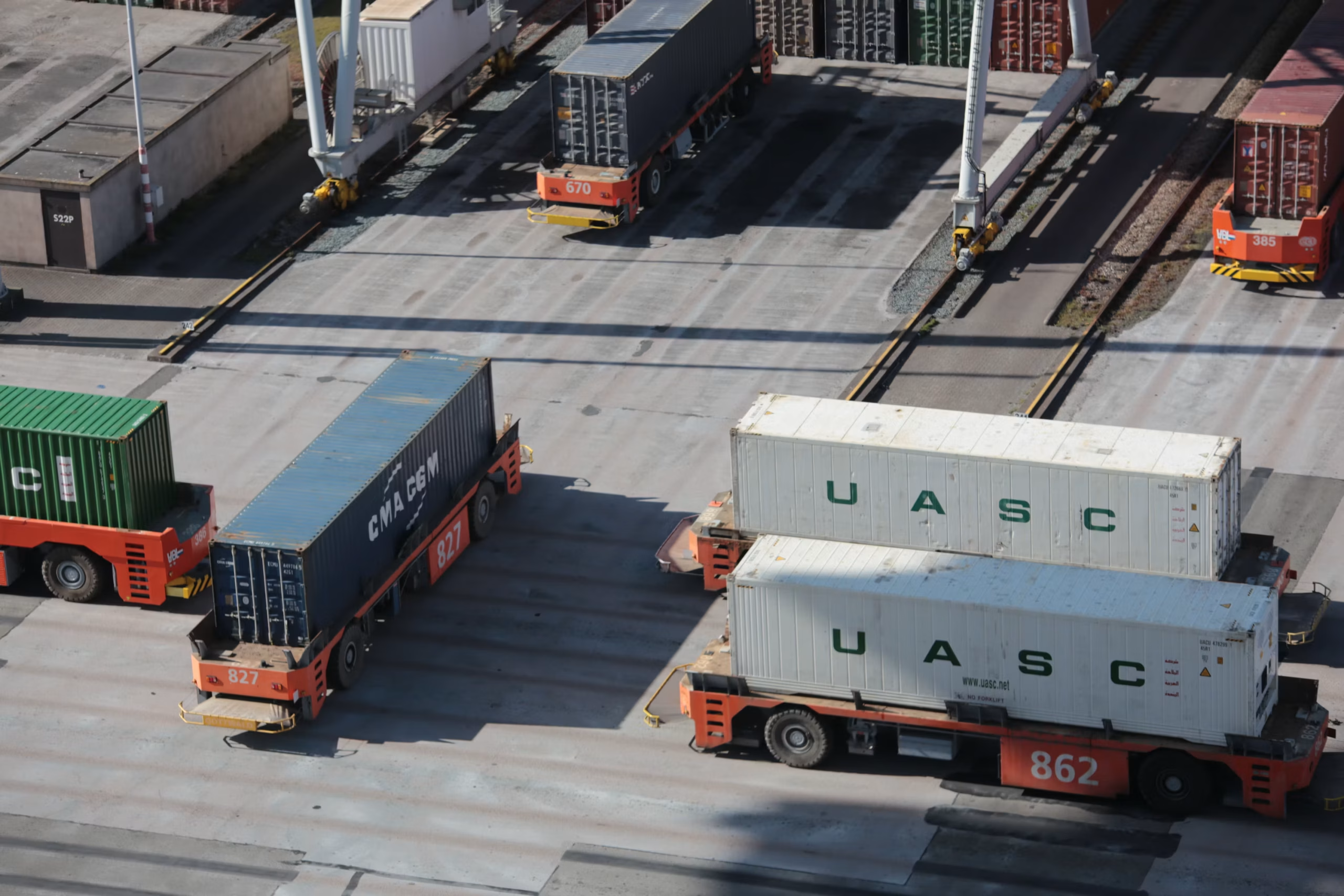
At an intermodal terminal, hostlers typically transport containers between storage areas and the railway tracks. Venti’s vehicles are being developed to take over these short-distance movements, positioning containers for onward transport by rail or other modes.
The proposed deployment also addresses persistent workforce difficulties at some facilities. Wyle estimates that monthly driver turnover can reach around 20% in certain locations. Working conditions are a particular concern in areas exposed to extreme temperatures, including Texas during the summer months.
The railroad’s objective is to have autonomous trucks operate alongside trains, handling container unloading and short-haul transfers before cargo continues its journey through the wider supply chain.
In a company announcement published on October 1, Venti said its vehicles would load, transport and unload containers during live yard operations without anyone inside the cab. The trucks are also expected to operate without dedicated lanes.
However, the announcement did not clarify whether human hostlers would continue working alongside the autonomous fleet at the US facilities.
Railway crossings represent another important part of the technology’s adaptation. Venti’s trucks must be able to detect approaching trains and respond to crossing signals without human intervention. Wyle explained that the vehicles recognise trains and interpret railway warning systems, including lowered barriers and red and green lights, in much the same way as a human operator.
[IMAGE TO INSERT HERE: Venti autonomous container truck operating in an intermodal railway yard]
A three-month pilot that met its targets ahead of schedule
The agreement with the US railroad followed a proof-of-concept programme initially planned to last three months. According to Wyle, the project had reached its six-week mark when the railroad informed Venti that the agreed performance targets had already been achieved.
The customer subsequently moved forward with two vehicles before deciding to pursue a broader deployment.
Venti signed a long-term commercial agreement with the unnamed railroad in July. The initial phase covers two of the operator’s busiest intermodal facilities in the United States, according to the company’s July 8 announcement.
At that time, Venti was targeting a fleet of more than 100 autonomous trucks by 2027. Its October 1 announcement raised that projection to over 130 vehicles operating across eight sites. The company also indicated that the fleet could exceed 600 trucks before the end of the decade.
Despite these plans, the US fleet has not yet begun commercial operations. Neither Venti nor the railroad has identified the rail operator publicly or disclosed the financial terms of the agreement.
Venti has previously secured external financing to support its development. In March 2023, the company announced a $28.8 million Series A funding round led by LG Technology Ventures.
From an early robotics concept to large-scale port operations
Venti was established in 2018 by Heidi Wyle and Daniela Rus, director of MIT’s Computer Science and Artificial Intelligence Laboratory.
The company’s initial concept focused on developing low-speed autonomous taxis for retirement and senior-living communities. Wyle said the idea was abandoned relatively quickly because the target market had limited financial resources and little willingness to spend on the proposed service.
The company’s direction changed around 2020, when PSA became involved in bringing Venti’s technology into logistics operations.
PSA, which operates more than 70 deepsea, rail and inland terminals according to its January announcement, worked with Venti to map its Singapore port and develop the autonomous vehicle system. The operation began with a single truck before expanding to two, four and then eight vehicles.
Venti now operates a driverless fleet of 30 trucks in Asia, Wyle said.
At PSA Singapore, these vehicles work alongside approximately 1,200 trucks operated by human drivers. According to Venti’s October 1 announcement, its autonomous fleet has accumulated more than 500,000 miles of driverless operation and transported over 360,000 containers.
The Singapore experience has therefore provided the company with an established operational base. The US expansion, however, requires the technology to adapt to different terminal layouts, more complex manoeuvres and the specific demands of rail infrastructure.
Autonomous operations could reshape the organisation of rail yards
Beyond reducing the need for drivers in repetitive yard movements, Wyle believes autonomous trucks could change how intermodal terminals are organised.
She pointed to the difficulties currently associated with locating chassis and equipment across busy facilities. In some yards, chassis are left wherever space is available, making it difficult for operators to track their precise locations. Some owners even use drones to search for equipment.
Autonomous vehicles could help address these inefficiencies by following predictable routes and arriving at designated locations at scheduled times.
Wyle said this level of operational precision could allow terminals to rethink their entire layout and improve the organisation of the wider supply chain. Rather than simply introducing driverless trucks into existing operations, the railroad wants to begin redesigning its yards to make them more structured and less chaotic.
The potential transformation is therefore not limited to replacing human-operated vehicles. It could also involve a more controlled allocation of space, equipment and container movements across intermodal facilities.
For Venti, the US project represents an important next step after nearly three years of driverless operations in Singapore. The planned deployment also places the company among a growing number of autonomous technology providers targeting logistics activities beyond traditional middle-mile and long-haul transport.