



The international freight forwarding industry has welcomed a landmark development in international trade law with the opening for signature of the United Nations Convention on Negotiable Cargo Documents, or the Accra Convention. FIATA, the International Federation of Freight Forwarders Associations, views the agreement as an important milestone for a more integrated, multimodal and digitally enabled global trading system.
The Convention establishes for the first time a harmonized and technology-neutral legal framework for negotiable cargo documents in all modes of transport. Its provisions cover both traditional paper documents and their electronic equivalents, filling a long-standing gap in the legal foundations of international freight movements.
This comes as supply chains around the world rely on more and more modes of transportation to move goods between countries. Road, rail, maritime and air services are often combined within the same shipment, crossing multiple borders and legal jurisdictions. Nevertheless, the legal recognition and use of negotiable cargo documents have been historically closely linked to maritime transport.
The Accra Convention aims to make these possibilities available to the wider transport sector, thus bringing legal arrangements more into line with modern commercial practice.
Its potential impact is particularly important for emerging markets, multimodal trade corridors and landlocked economies. In these regions, efficient connections between inland transport networks and international gateways are often a prerequisite for access to international markets. By facilitating smoother transitions between modes of transport and between borders, the Convention could increase flexibility along the logistics chain and legal certainty and access to trade finance. The new framework is also expected to create opportunities for small and medium-sized enterprises (SMEs).
The industry is ready to implement the agreement, FIATA says
“The signing of this Convention is a milestone for international commerce,” said Dr. Stéphane Graber, Director General of FIATA. “It reflects the reality of how goods travel through today’s global supply chains.
He also stressed the significance of the agreement for companies active in emerging and landlocked markets, where reliable multimodal links are crucial for international competitiveness.
FIATA had contributed the practical knowledge and operational experience of freight forwarders throughout the framework’s development, Graber said. The organization is now ready to work with governments, members and international partners to transform the agreement into concrete commercial benefits.
He mentioned in particular two existing instruments in the industry, the FIATA Multimodal Transport Bill of Lading (FBL) and its electronic version, the eFBL. These established solutions can support the practical implementation of the Convention from the outset, says FIATA.
The Convention was developed with the assistance of freight forwarders.
FIATA actively participated in the procedure of drafting, under the auspices of the United Nations Commission on International Trade Law (UNCITRAL), representing the operational requirements and commercial experience of freight forwarders.
The organization worked with other industry stakeholders such as the Global Shippers Forum (GSF) and the International Chamber of Commerce (ICC) Banking Commission. Their involvement helped to ensure that the legal framework proposed would reflect the realities of multimodal transport operations and could be translated into solutions that businesses could actually use.
The FBL has been firmly embedded in international freight forwarding for decades and provides the industry with a negotiable document for multimodal transport operations. Its electronic counterpart, the eFBL, takes this experience into the world of digital trade documentation.
Together, these instruments will provide immediate solutions for Negotiable Cargo Documents (NCDs) and electronic Negotiable Cargo Documents (e-NCDs) under the new Convention.
The existing infrastructure is of particular importance in that once the Convention has entered into force, freight forwarders will not have to wait for the creation of entirely new commercial instruments. They will have already established tools to support its implementation.
International transactions have already tested the framework
FIATA’s confidence in the practical application of the Convention is supported by real-world commercial experience.
The organisation has already led transactions designed to test the NCD framework using the eFBL on several international trade routes. These operations included:
-
Kazakhstan–China
-
China–Georgia
-
Turkmenistan–Romania
The transactions covered rail and multimodal transport arrangements and demonstrated how negotiable electronic documentation can operate within actual supply chains. They also explored its application in connection with trade financing.
These examples illustrate one of the Convention’s central strengths: rather than introducing an entirely theoretical system and requiring businesses to adapt their operations around it, the agreement builds on existing commercial practices and responds to needs already demonstrated by the market.
A milestone marking six decades of UNCITRAL work
The opening of the Accra Convention for signature also coincides with the 60th anniversary of the United Nations Commission on International Trade Law (UNCITRAL).
For six decades, UNCITRAL has worked to harmonise, modernise and unify international trade law. The Accra Convention extends this mission by addressing the changing requirements of global commerce, particularly the growing importance of multimodal transport and digital supply chains.
By establishing common legal principles for negotiable cargo documentation across different transport modes, the agreement seeks to provide businesses with a more consistent legal environment for international transactions.
26 countries sign the Accra Convention in Ghana
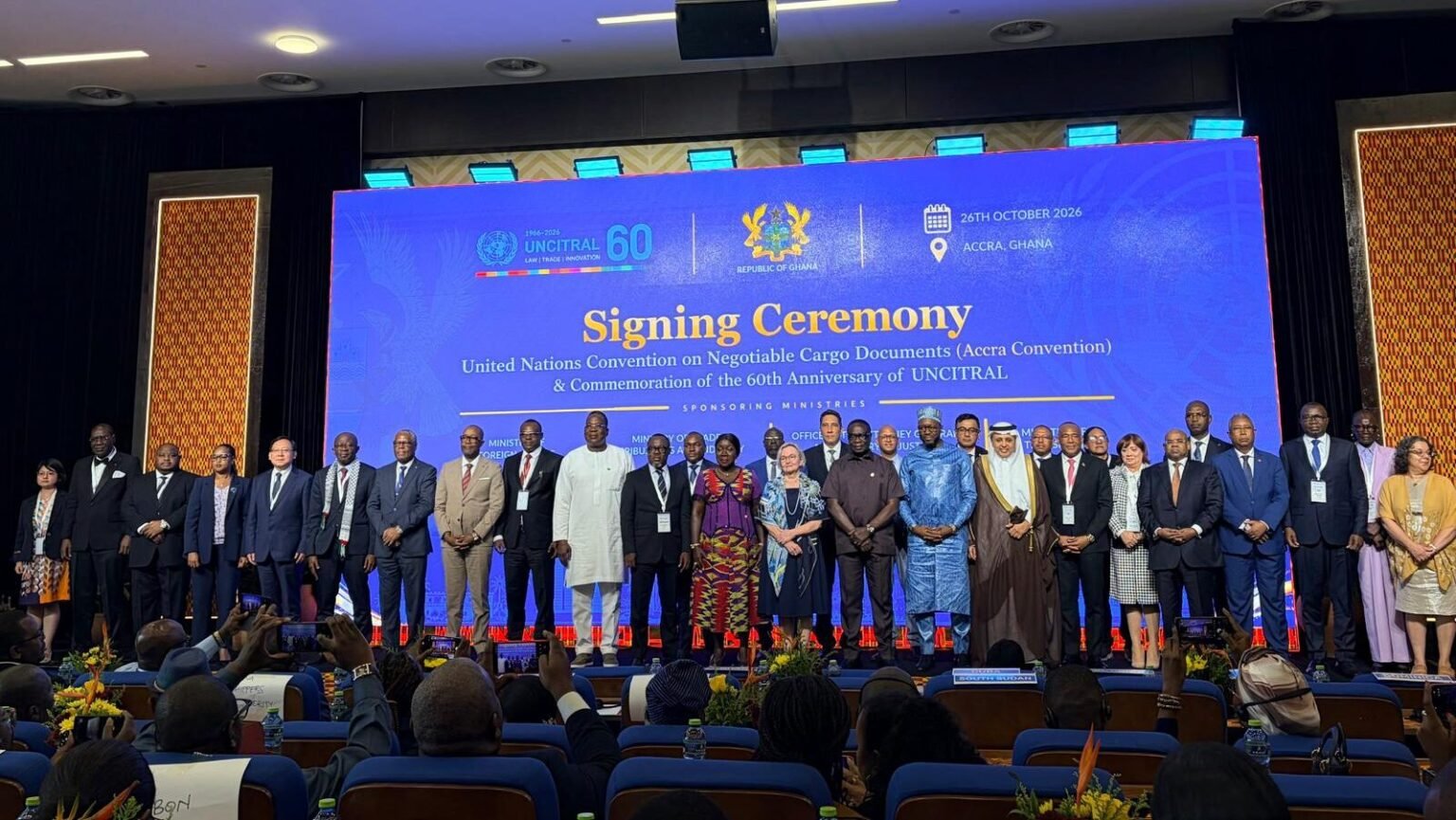
The official signing ceremony took place in Accra, Ghana, where 26 countries signed the Convention.
The signatory states are:
Burkina Faso, Guinea, Cabo Verde, Guinea-Bissau, China, Mauritania, Comoros, Nicaragua, Côte d’Ivoire, Nigeria, Cuba, Pakistan, the Democratic Republic of the Congo, Rwanda, Djibouti, Saudi Arabia, Dominica, Sierra Leone, the Dominican Republic, South Sudan, Gabon, Tanzania, The Gambia, Togo, Ghana and Venezuela.
Further countries are expected to sign in the near future, subject to the completion of the necessary diplomatic procedures.
For FIATA, the Accra Convention represents an opportunity to bring international trade documentation closer to the operational realities of modern logistics. By combining a common legal framework with existing paper-based and electronic industry solutions, the agreement could help strengthen multimodal connectivity, facilitate cross-border commerce and expand access to international trade finance.