




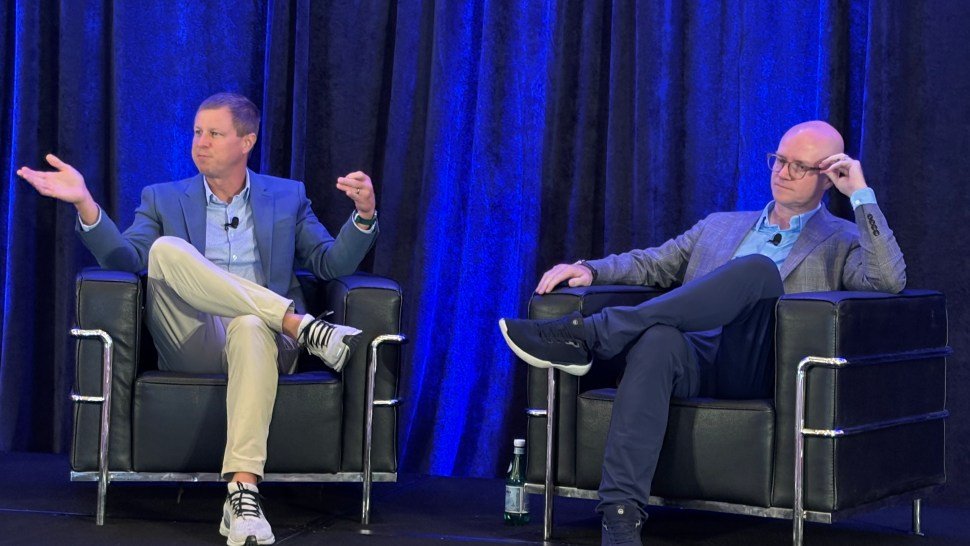
The monthly FreightWaves State of Freight webinar has moved to FreightWaves Today, but shippers attending a New York gathering on Tuesday still had an opportunity to hear from two of FreightWaves’ leading market analysts, Craig Fuller and Zach Strickland.
The event, organized by sister company SONAR and sponsored by Cass Information Systems along with SONAR, focused on a trucking market the analysts repeatedly described as “fragile.”
Unlike the first months of 2026, when discussions around the State of Freight webinars often centered on a market accelerating rapidly, Fuller, CEO of SONAR and FreightWaves, and Strickland, director of market intelligence, are now watching a market that is showing considerably more uneven movement.
The SONAR Tender Rejection Index (STRI), for example, has fallen from recent highs before making a sharp upward move in the days immediately ahead of the event, which was held at the TWA Hotel at JFK Airport.
Strickland pointed to tender rejections as one of the clearest indicators of market strength. These involve contracted freight that a carrier does not pick up within an existing contractual relationship, when such a rejection is permitted under the agreement.
“Rates have inflationary pressure on them,” Strickland said. “Tender rejections do not. So it’s a little bit more of an apples to apples comparison.”
Tender rejection levels have been rising since November 2025, but Strickland stressed that the recent increase in pricing remains far below the extraordinary surge seen during the COVID period.
He contrasted today’s environment with the sequence that unfolded during the pandemic: the initial “toilet paper” spike, the subsequent crash and then a slow, sustained recovery that eventually produced what became the strongest freight market in history, fueled by government stimulus and consumers’ renewed appetite to spend.
Fuller asked whether the recent decline in the STRI to below 14% after reaching more than 17% in June could represent “the pause before the storm.”
Strickland responded by looking back over the previous eight to 10 months. He said the initial increase in tender rejections reflected carriers acknowledging that conditions had become tighter than they could comfortably manage.
“Carriers finally saying, look, this market is tighter than we can manage. We’re going to start having to reject more freight to make it through,” he said.
Over time, the industry adjusted to that reality. But by mid-May, the market was hit by several disruptions, including Road Check week, the normal freight-market disruption around Memorial Day, and the fallout from Montgomery vs. Caribe Transport II.
The Supreme Court case introduced a range of new questions surrounding broker liability, carrier selection and the potential consequences for available capacity.
“This market is so fragile,” Strickland said, “even though we’re having these periods of stability.”
He also suggested that part of the recent decline in tender rejections may be linked to a shift toward intermodal rail services, as more freight moves away from trucking.
A new baseline but not necessarily a lasting one
Strickland described the current environment as a “new baseline,” although he cautioned that even this new level may prove temporary.
The warning sign is the renewed movement in the STRI. The index has climbed by roughly 75 basis points in just one week, a move Strickland described as evidence of a “bizarro world.”
“That tells me that this market is not in a stable position,” he said.
Fuller said he had recently spoken with Shelley Simpson, CEO of J.B. Hunt (NASDAQ: JBHT), who also characterizes the trucking market as fragile.
But Fuller emphasized that Simpson does not necessarily use the term in a negative sense.
“She was actually the opposite, which is that capacity is so tight that any disruption could cause a significant increase in rejections, a significant tightness in capacity, trucks not showing up,” Fuller said.
For Fuller, the meaning of “fragility” is therefore important. He noted that the word can usually suggest weakness or deterioration, whereas in this case it is being used to describe a market in which even a relatively small disruption could have an immediate impact on capacity.
Fuller also said contacts on Wall Street have raised concerns about a potentially “disorderly” supply chain similar to the conditions seen during COVID.
However, he does not expect the current market to develop into another pandemic-era supply chain crisis.
Container-ship data point to tighter market conditions, Fuller said, but he stressed that freight flows remain highly organized.
“The current market is very orderly. I don’t think anybody should be panicked about this is going to create a supply chain crisis,” he said.
Strickland agreed that the comparison with COVID has limits. The pandemic-era disruption was driven in part by an enormous surge in freight demand, something that is not currently evident in the [SONAR Tender Volume Index].
Demand faces several different pressures
Fuller also outlined several factors that could be contributing to weaker freight demand.
Among them, he cited reductions in immigration and deportations, arguing that fewer people in the country means fewer consumers available to purchase food and other goods.
He also pointed to the growing use of GLP drugs and their impact on food consumption.
“People consume a lot less beer, a lot less soda,” he said, adding that “there’s just a bunch of interesting sort of things happening today.”
These changes are creating a different demand backdrop from the one that drove the exceptional freight volumes during the COVID era.
FMCSA regulation adds another layer of pressure
Discussion about the trucking market inevitably turns to regulation, particularly as carriers and shippers continue to deal with the implications of Montgomery vs. Caribe.
Another major factor is the immigration and enforcement crackdown associated with the Federal Motor Carrier Safety Administration (FMCSA) and its administrator, Derek Barrs.
Fuller said he remains in frequent contact with Barrs, who has asked him a direct question: “How do I make sure rates always go up?”
According to Fuller, Barrs’ view is that profitable carriers are better positioned to invest in the areas necessary to maintain a safe and compliant operation.
The administrator believes that “carriers that make money spend more on maintenance, more on training, and hire proper and regulated drivers,” Fuller said.
Based on that approach, Fuller expects federal regulators to maintain pressure on the trucking sector.
“FMCSA and the regulators are going to continue to put pressure on the market, which is going to continue to force capacity out,” he said.