



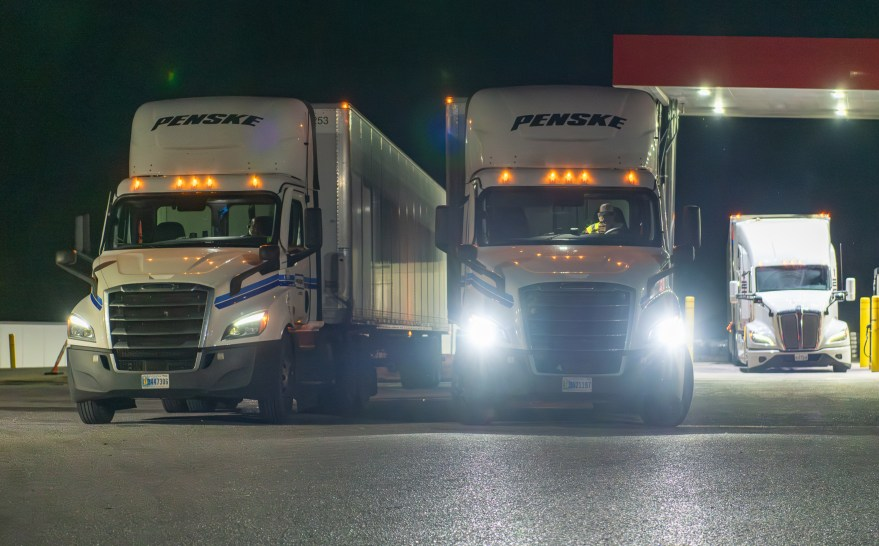
Two of the trucking industry’s leading trade associations are urging the U.S. Court of Appeals for the Fifth Circuit to reconsider a decision involving companies within the Penske network, warning that the ruling could have far-reaching consequences for carrier liability in brokered freight transactions.
The American Trucking Associations (ATA) and Truckload Carriers Association (TCA) last week filed a joint amicus brief requesting an en banc rehearing of an August 4 decision issued by a three-judge Fifth Circuit panel. The ruling sent the case back to the U.S. District Court for the Southern District of Texas.
Represented by trucking law firm Scopelitis, the two organizations argue that one aspect of the appellate ruling could fundamentally alter how liability is assigned throughout the trucking industry.
Focus shifts away from Montgomery and toward Penske Logistics
The Fifth Circuit’s August 4 ruling was influenced in part by the U.S. Supreme Court’s decision in Montgomery vs. Caribe Transport II. However, ATA and TCA’s request for a full rehearing is focused primarily on a separate issue involving Penske Logistics in its role as a motor carrier.
Penske Logistics is part of Penske Transportation Solutions, which includes several companies operating under the Penske name and is indirectly owned in part by Mitsui & Co.
In its August 4 decision, the Fifth Circuit reversed two lower-court rulings that had favored Penske Logistics and its brokerage affiliate, Penske Transportation Management (PTM).
The reversal involving PTM was based on the Supreme Court’s Montgomery precedent. At the district court level, PTM had been granted summary judgment and removed as a defendant under what had previously been a widely accepted interpretation of the Federal Aviation Administration Authorization Act (F4A).
However, the Supreme Court’s early-May Montgomery decision eliminated that F4A protection for brokers, leading the Fifth Circuit to overturn PTM’s summary judgment.
A complex freight chain at the center of the case
This is not background information; it is the movement of the freight which is in issue in the litigation, Crane vs. Liberty Lane.
There are a lot of plaintiffs and defendants in the case and the freight goes through a chain of transportation companies.
The seating manufacturer Adient has contracted Penske Logistics to transport its products. Penske Logistics was then connected to PTM. PTM then hired Liberty Lane, a motor carrier, to transport the freight physically.
Liberty Lane then double brokered the shipment to OK Trans without Penske Logistics or PTM’s knowledge.
Satnam Singh Lehal was driving a truck for OK Trans in December 2018 when the truck crashed into a pickup truck driven by Lyndon Dean Meyer in Bee County, Texas. Meyer died in the crash.
That series of events is now the subject of a legal dispute as to how far back liability can go through the chain of freight transportation.
Industry concerns over liability moving upstream
ATA and TCA’s request for an en banc rehearing is specifically directed at the potential liability imposed on Penske Logistics by the Fifth Circuit’s decision.
For several parts of the trucking industry, the possibility that Penske Logistics could be held liable under the circumstances described in the case has triggered serious concern.
In reversing the lower court’s ruling, the Fifth Circuit cited previous legal precedents that ATA and TCA are now challenging. The appellate judges concluded that Penske’s “assumption of control and responsibility of the vehicle made Penske Lehal’s statutory employer, regardless of whether Penske and Liberty Lane complied with the formal regulatory requirements.”
ATA and TCA acknowledge in their filing that motor carriers have historically been liable for accidents caused by their employee drivers.
“Since the earliest days of trucking, a motor carrier was liable for accidents caused by its employee drivers,” the associations said.
But the organizations argue that the Fifth Circuit’s ruling goes significantly further.
The dispute over statutory employment liability
According to ATA and TCA, the Fifth Circuit concluded that Penske had “statutory employment liability” because it hired a trucking company with motor carrier authority, which subsequently hired another carrier.
Under that interpretation, liability for the fatal accident could travel upstream through the transportation chain to the original carrier, Penske.
The associations argue that existing Fifth Circuit precedent has traditionally meant that a motor carrier leasing a specific vehicle from an owner-operator to operate under the carrier’s authority can be held liable for accidents involving that owner-operator.
ATA and TCA contend that this interpretation is fundamentally different from what occurred in the Penske case.
According to the Scopelitis-authored brief, the Fifth Circuit’s decision conflicts with the Federal Leasing Regulations (FLR).
“The (Fifth Circuit) imposed statutory employment liability on Penske Logistics under the FLRs for an accident caused by an employee driver (Lehal) for a separate, authorized carrier (OK Trans), which Penske Logistics knew nothing about,” the brief states.
Double brokering is part of the story, but not the legal argument
Although double brokering has become a major issue across the trucking industry, the ATA/TCA filing does not make the double brokering of the shipment to OK Trans a central legal issue.
According to the associations, the legal argument regarding statutory employment liability would remain essentially the same even if Liberty Lane had transported the freight itself and had been involved in the fatal crash.
ATA and TCA argue that because OK Trans was operating under its own motor carrier authority, its involvement in the accident should not extend liability back to Penske Logistics.
The Federal Leasing Regulations governing the responsibilities of a company such as Penske Logistics when another carrier operates under Penske’s motor carrier authority, the brief argues, “do not apply to agreements to have an authorized motor carrier provide delivery services under its own authority.”
The regulations were designed, according to the filing, to govern situations in which a carrier leases equipment from a company that does not have operating authority and then uses that equipment under the carrier’s own authority.
The ATA and TCA argument is summarized in one of the brief’s subheadings: “the FLRs do not apply when carriers transport goods on equipment under their own authority.”
The filing further argues that the Fifth Circuit effectively theorized the existence of an agreement between Penske Logistics and Liberty Lane or OK Trans to use the OK Trans vehicle driven by Lehal to transport the shipper’s freight.
“But there was no evidence in the record of a written or oral agreement of that kind,” the brief says.
Warning of consequences for the entire trucking model
ATA and TCA warn that allowing the Fifth Circuit precedent to stand could have consequences extending far beyond the Penske case.
According to the brief, the practical result would be that “the entire industry has been in violation of the FLRs for decades, because upstream carriers have not been executing FLR-compliant leases with downstream carriers.”
The associations believe the ruling could reshape long-standing capacity practices throughout the trucking sector.
Motor carriers have historically relied on other authorized carriers to supplement their capacity, whether because of equipment shortages, driver availability or the need to meet customer requirements efficiently and safely.
In their closing arguments, ATA and TCA warned that the appellate panel’s decision could discourage that long-established practice.
“Whether due to lack of available equipment or drivers, motor carriers have long turned to other motor carriers to supplement capacity to safely and efficiently meet a shipper’s needs,” the brief states.
According to the associations, allowing the ruling to remain in place would “chill that option, constrict the safe and timely flow of freight and increase costs as insurers account for a new, judicially-created liability regime.”
The outcome of the request for a full Fifth Circuit rehearing could therefore have implications not only for Penske Logistics and the parties involved in Crane vs. Liberty Lane, but also for how motor carriers across the United States manage capacity and assess liability when freight moves through multiple authorized carriers.








Comments 1