



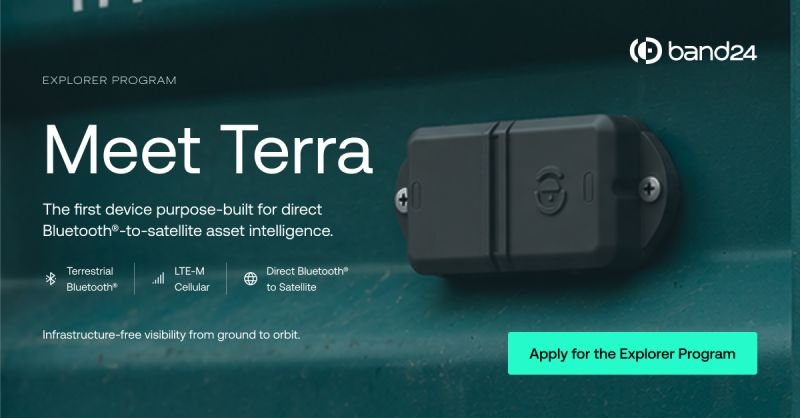
Band24 is inviting businesses to participate in an early-access program for Terra, its new asset-tracking device designed to maintain visibility over trailers, shipping containers and other equipment in areas with limited network coverage. Applications must be submitted by November 13, with selected participants expected to receive their devices in December. The company has not confirmed an exact delivery date, while broader commercial availability is planned for early 2027.
Announced on October 6, Terra is designed to monitor asset location and movement, dwell time, temperature, humidity and potential tampering. By combining three connectivity options in a single tracker, Band24 aims to address gaps in visibility that can arise when equipment moves between facilities or travels beyond the reach of conventional cellular networks.
“Every business with physical assets has felt this same pain you can see your equipment until the exact moment it matters most, and then it’s gone dark,” Band24 co-founder and CEO Patrick Patel said in the announcement.
The launch comes as cargo theft continues to create significant financial losses across North America. Verisk’s CargoNet recorded 2,646 confirmed cargo thefts across the United States and Canada in 2025, an 18% increase from 2024. Estimated losses approached $725 million, up 60%, while the average value of goods stolen per incident reached $273,990.
Three connectivity options in one device
Terra combines Bluetooth, LTE-M cellular connectivity and Hubble Network’s low-Earth-orbit satellite infrastructure. The system is designed to select the most suitable connection according to network availability and the information required for each update.
For routine tracking and location determination, the device can use a terrestrial Bluetooth network comprising more than 100 million crowdsourced access points. When cellular coverage is available, it can switch to LTE-M. If neither terrestrial option is accessible, Terra can rely on Hubble’s satellite network to transmit data.
Hubble’s technology enables Bluetooth Low Energy (BLE) devices to send small data packets directly to passing satellites using their existing Bluetooth radios. This approach removes the need for a dedicated satellite modem, potentially simplifying the hardware required to extend tracking into remote areas.
According to Band24, Terra can deliver an on-demand location update in approximately one minute when cellular or terrestrial Bluetooth connectivity is available. Satellite-based reporting works differently: when both terrestrial options are unavailable, the device must wait for a Hubble satellite to pass overhead. Consequently, updates depend on satellite availability rather than an immediate on-demand request.
Band24 expects satellite performance to improve as Hubble expands its constellation. As of September 23, 2026, Hubble reported having six satellites in low-Earth orbit.
Location data and satellite reliability remain key questions
Terra determines location using GPS, Wi-Fi localization and a terrestrial network of more than 100 million crowdsourced Bluetooth access points, Band24 said. When these methods cannot be used, Hubble’s satellite network supplies coarse location information.
The tracker determines when to report and which network to use based on several inputs, including LTE availability, nearby Bluetooth access points and sensor readings. This multi-network approach is intended to preserve asset visibility while managing power consumption.
However, the difference between an on-demand update and a satellite transmission tied to an overhead pass could prove important for fleet operators that need to locate equipment quickly in remote locations.
Band24 has not yet released figures on location accuracy or data demonstrating the reliability of satellite reporting. Without these measurements, it remains difficult to assess how consistently Terra will deliver timely location information in areas without terrestrial coverage.
Four-year battery life is still an estimate
Terra remains under development and testing as Band24 works toward completing the regulatory certification required before commercial shipments begin.
The company estimates that the device could deliver four years of battery life, although it stresses that measurements are ongoing and the figure remains a preliminary estimate rather than a confirmed performance result.
Band24 attributes the expected longevity to its approach to connectivity and power management. The tracker selects an energy-efficient network for each update, uses low-power wireless technology and can remain inactive between on-demand check-ins.
The enclosure carries an IP68 rating for dust and water resistance. Terra will also integrate with Band24’s existing Ranger dashboard and Events API, allowing users to incorporate the tracker into the company’s current asset-management tools.
Device activation and assignment will be possible through an NFC-enabled smartphone, offering an additional way to simplify deployment and device management.
Pricing model announced, costs still undisclosed
Band24 has not revealed Terra’s hardware price or subscription fees. The company plans to release pricing information closer to general availability.
The device will be licensed on a per-unit basis. Customers will not need to purchase additional hubs or build private networks to use the tracking system.
Band24 expects the combination of Bluetooth, cellular and satellite connectivity, together with multi-year battery life, to support competitive pricing. However, it has not provided figures that would allow businesses to compare Terra’s total cost of ownership with existing tracking solutions.
Until hardware prices, subscription charges and real-world operating costs are available, prospective customers will have limited information with which to evaluate the financial case for adopting the device.
Why it matters for logistics operators
Maintaining visibility over trailers, containers and other freight equipment remains challenging when assets move beyond cellular coverage or between logistics facilities. These gaps can complicate equipment management and make it harder for operators to locate assets when they are needed.
Terra is designed to address this problem by bringing Bluetooth, cellular and satellite connectivity together in a single battery-powered tracker. The approach could extend tracking capabilities into areas where conventional solutions provide limited coverage, without requiring customers to establish their own private networks.
Its practical value will ultimately depend on how frequently and reliably satellite updates are delivered, the accuracy of the resulting location information, the battery life achieved under real operating conditions and the total cost compared with competing devices.
Band24’s early-access program, which closes to applications on November 13, will give selected businesses an opportunity to test Terra ahead of its planned commercial rollout in early 2027. The results will help determine whether the technology can deliver the level of visibility, reliability and cost-effectiveness required by logistics operators managing assets across diverse operating environments.