



Mexican trucking organizations have reached an agreement with federal authorities to open negotiations over the security and economic challenges affecting the country’s freight transportation industry, following nationwide protests that disrupted traffic across multiple regions.
The agreement was reached Tuesday between Mexico’s Interior Ministry (Segob) and representatives of the trucking sector, including the National Chamber of Freight Transport (CANACAR). It provides for four high-level working sessions covering highway security, infrastructure, tax incentives, regulatory issues and other concerns affecting commercial transportation.
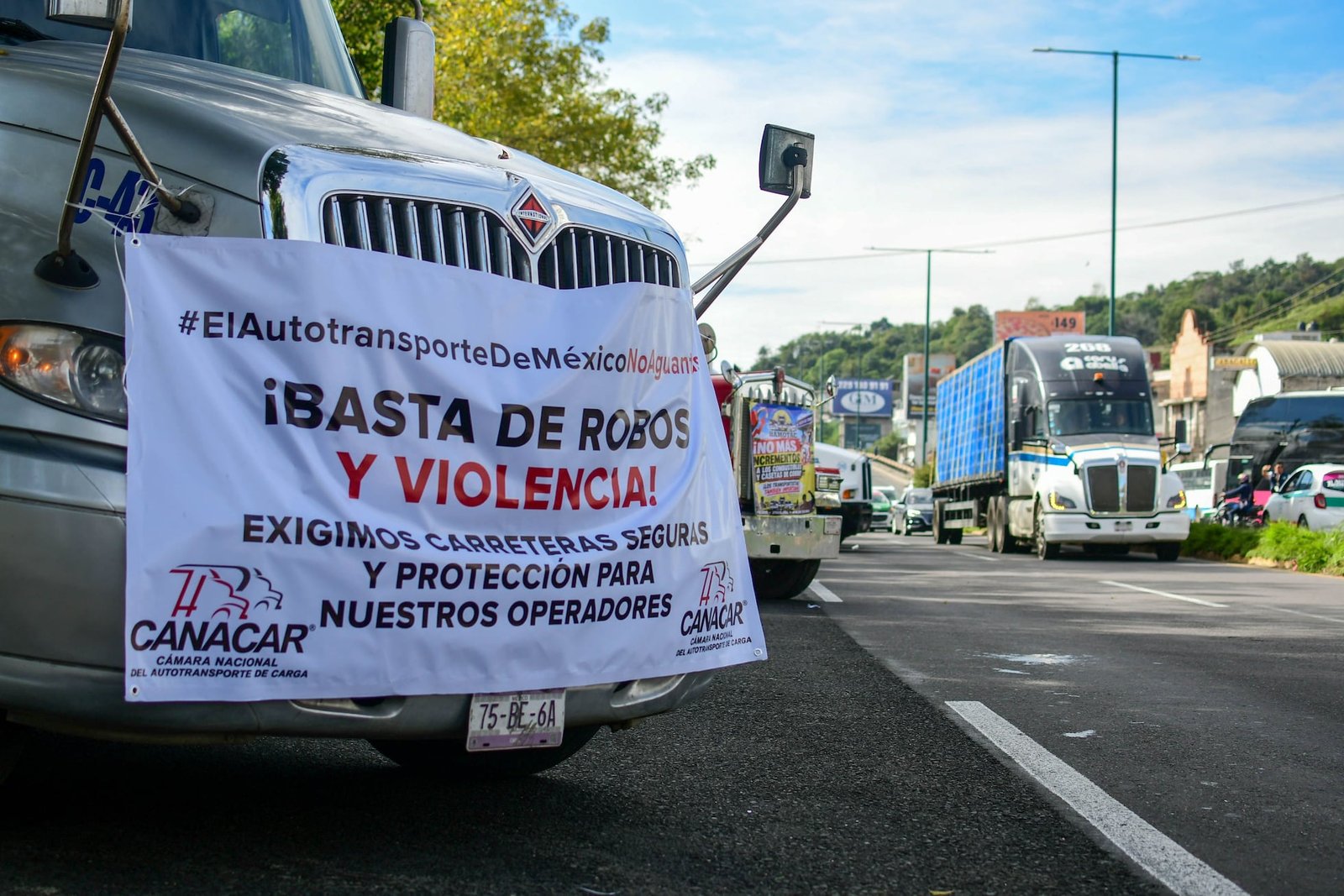
The negotiations follow a nationwide protest movement launched Monday, when truckers demanded stronger government action against cargo theft, violent highway robberies, extortion and rising operating expenses. The demonstrations affected major transportation routes and raised concerns about potential delays across Mexico’s domestic freight network and international supply chains.
According to reports from La Jornada, T21 and Revista Transportes y Turismo, the agreement came amid growing concerns among trade and transportation stakeholders about freight disruptions and delays throughout the country.
Disagreement over the scale of the demonstrations
Mexico’s Interior Ministry reported that Monday morning’s demonstrations had taken place at 38 locations across 19 states. Its figures indicated the participation of 691 vehicles and 858 people, with protests involving truck convoys, roadside gatherings and highway blockades.
CANACAR, however, challenged the government’s account of the geographical reach of the movement, maintaining that demonstrations extended across all 32 Mexican states.
On Tuesday, CANACAR President Augusto Ramos Melo met with Interior Ministry officials alongside Carlos García Álvarez, president of the Honorable Mexican Alliance of Transport Organizations (HAMOTAC), and Lauro Rincón Hernández, president of the Mexican-American Federation of Transporters (FEMATRAC).
Following the meeting, Ramos Melo announced that four negotiating sessions would be established to address the industry’s demands.
Despite the progress toward dialogue, the organizations had not confirmed that all demonstrations had ended. Earlier Tuesday, CANACAR and other trucking associations had urged participants to continue peaceful protests at strategic highway locations while arrangements for the negotiations were being finalized.
Security concerns and operating expenses remain central issues
The protests have brought renewed attention to persistent difficulties facing Mexican trucking companies, particularly cargo theft, attacks against drivers, extortion and the growing costs associated with operating commercial vehicles.
These challenges have consequences beyond individual carriers. Disruptions have affected major freight corridors linking Mexico’s industrial centers, manufacturing regions and international trade gateways.
Protest activity has been reported in Nuevo León, Tamaulipas, Veracruz, Guanajuato, Jalisco and the State of Mexico, among other areas.
In northern Mexico, demonstrations were reported near Nuevo Laredo and Reynosa in Tamaulipas, as well as on major highways serving Monterrey, Nuevo León. These routes are essential to cross-border trade between Mexico and the United States, carrying automotive components, manufactured products, agricultural goods and consumer merchandise.
Any prolonged disruption along these corridors can affect delivery schedules, freight capacity and the movement of goods between production facilities, distribution centers and international markets.
Repeated disruptions are adding pressure to North American supply chains
Supply chain specialists warn that recurring highway protests in Mexico are creating additional costs and uncertainty for manufacturers, importers and transportation providers that rely on cross-border freight movements.
Andrew Rader, managing director at supply chain consulting firm Maine Pointe, told FreightWaves in an emailed statement that the latest demonstrations represent the third major trucking protest in Mexico in approximately one year.
“This is the third major trucking protest in Mexico in about a year. At that frequency it stops being an event and becomes a cost of doing business,” Rader said.
He added that companies relying on a single corridor for cross-border transportation continue to absorb the consequences through expedited shipments and idle production lines.
The repeated disruptions could also force businesses to reconsider how they organize their North American supply chains, particularly where operations depend heavily on predictable transit times and uninterrupted access to border crossings.
Joseph Esteves, CEO of Charlotte, North Carolina-based Maine Pointe, argued that companies should reassess the assumptions underlying their regional logistics networks.
“For any company with cross border operations, the safe harbor assumption that anchored two decades of North American network design no longer holds,” Esteves said. “Products crossing the border in either direction need the math rerun.”
Negotiations could determine the next phase of freight operations
The agreement between federal authorities and trucking representatives creates an opportunity to address the industry’s longstanding concerns through formal discussions. The effectiveness of those talks, however, will depend on whether the parties can identify practical measures to improve road security, reduce operating pressures and address infrastructure and regulatory challenges.
For carriers, manufacturers and importers, the immediate uncertainty remains whether the dialogue will lead to a full end to the protests and prevent further interruptions along strategic freight routes.
Why it matters: Mexico’s nationwide trucking protests expose the vulnerability of critical freight corridors supporting U.S.-Mexico trade. The four planned negotiating sessions could play a decisive role in determining whether transportation operators face further disruptions, additional logistics costs and greater uncertainty in the days ahead.