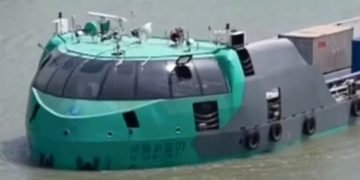




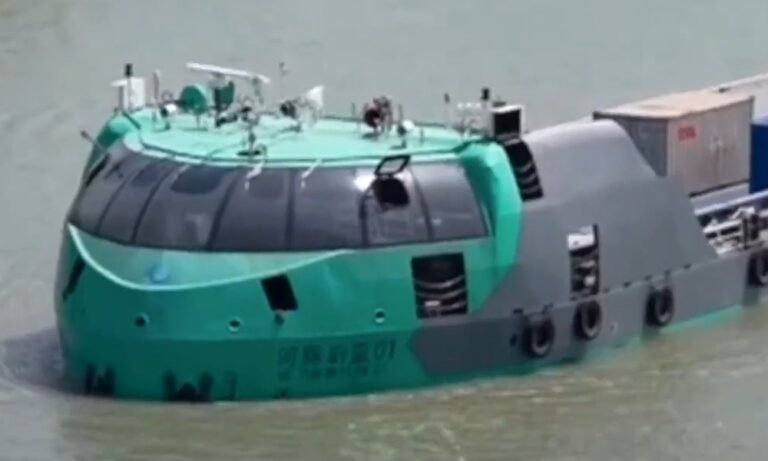
A very different kind of cargo vessel has just entered commercial service in China, and it doesn’t run on fuel in the traditional sense at all.
The ship, Hetun Weilan 01, has completed its first commercial voyage between Wuhu Port and Chaohu Port in Anhui province, carrying 49 standard containers. It left Wuhu and arrived safely in Chaohu, where it discharged its cargo after the short inland journey.
What makes it stand out is how it is powered. Instead of bunkering fuel, the vessel relies on a modular battery swapping system built around six removable batteries, each rated at 430 kWh.
The idea is simple but quite disruptive in practice: instead of waiting to recharge, the ship can physically swap out its batteries. Each battery can be replaced in about five minutes, and a full set can be exchanged in under 30 minutes. For short-haul inland shipping, that drastically reduces downtime.
The system has already been certified by the China Classification Society, and it has also received approval in principle from Bureau Veritas and DNV, which is an important step for wider industry acceptance.
Behind the concept is a modular energy platform designed to make batteries interchangeable across different uses. The same units can, in theory, be used not just on ships, but also in port vehicles, trucks, forklifts, and shore-based energy storage systems.
The owner of the vessel, Sandianshui New Energy Technology, is trying to push this idea further by building what it describes as a port centred energy ecosystem, where energy storage becomes shared infrastructure rather than equipment tied to a single machine.
The battery technology itself is protected by more than 370 patents, many of which draw on developments from the automotive industry, particularly around modular EV systems.
On board, Hetun Weilan 01 is also equipped with a range of modern systems, including an automotive-grade electric propulsion setup, integrated control and management systems, a 360-degree collision-avoidance view, and hardware prepared for future automated docking.
What this vessel really shows is a shift in thinking: instead of treating charging as a delay in operations, it turns energy replacement into a quick, standardised process almost like refuelling, but faster and fully electric.