



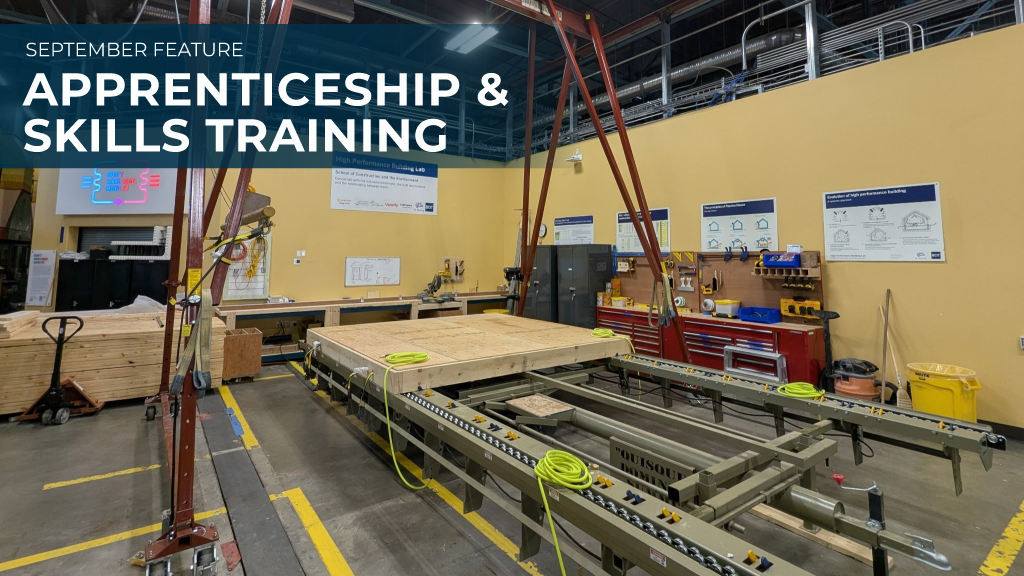
The British Columbia Institute of Technology (BCIT) is establishing a prefabrication teaching micro-factory at its Burnaby campus, creating a hands-on training environment focused on modern construction methods and, in particular, high-performance and low-carbon buildings.
Alex Hebert, director of the Zero Energy and Emissions Buildings (ZEB) Learning Centre, says the facility is designed to replicate a small-scale production environment. Students, industry partners and Indigenous communities will be able to learn practical manufacturing principles including lean production, quality assurance and repeatable construction processes.
The micro-factory will focus on producing prefabricated wall assemblies while bringing together building science, air-tightness, energy efficiency and Passive House best practices.
Beyond training, BCIT sees the project as a demonstration hub that can help accelerate the adoption of off-site construction methods across British Columbia.

“Our factory exists and is up and running,” says Hebert. “It is currently focused on teaching how to make prefab wall assemblies for net-zero homes. It is a first in B.C., and I have never heard of something like that elsewhere in the world, so perhaps it is a first globally, very likely a first in Canada.”
Hebert stresses that the objective is not to create a highly automated manufacturing facility.
Instead, BCIT wants to demonstrate a model that is small, affordable and capable of being replicated, while applying practical manufacturing principles to prefabricated construction.
“The model should be achievable by smaller builders and, importantly, by rural, remote and Indigenous communities that want greater control over how their housing is produced,” he says.
Starting with existing BCIT infrastructure
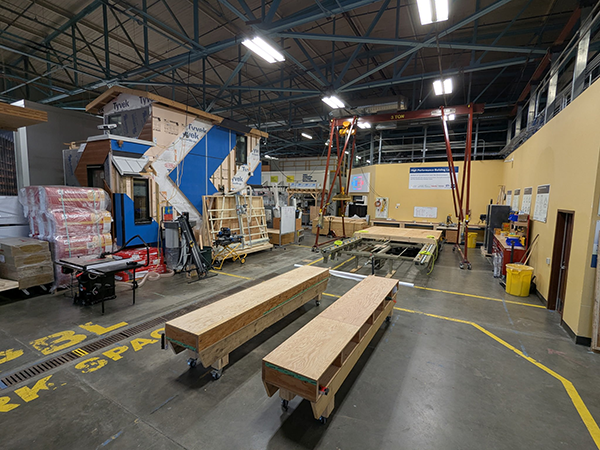
For now, the micro-factory is operating inside BCIT’s High Performance Building Lab.
Hebert describes the location as a temporary base that allows the institution to launch the initiative quickly by making use of infrastructure that already exists.
“This is its temporary home and provides an opportunity to get the concept operational quickly using existing BCIT infrastructure,” says Hebert.
“Rather than waiting for an ideal facility before teaching, BCIT can begin developing the factory workflow, testing equipment and processes, training instructors, delivering curriculum and working with our first students and client.”
The first demonstration project is already tied to a real housing need. BCIT is working with a First Nation client from a remote area of British Columbia.
According to Hebert, the idea for the micro-factory originally came from the First Nation itself. The concept was then turned into a working project through a collaboration between the community and BCIT.
“The project is an ideal opportunity to demonstrate what the micro-factory is intended to accomplish,” says Hebert. “It combines real construction with real training, while helping to build capacity within a remote Indigenous community.”
Three-course training program
The educational side of the initiative is being structured as a three-course micro-credential. Its working title is Prefabricated Construction Workforce Foundations.
The program is divided into three courses covering different stages of prefabricated construction.
The introductory course addresses the fundamentals of off-site construction, the principles of net-zero design, factory safety, quality assurance and collaborative production workflows.
The second course, Manufacturing of Panelized Building Components, is designed as a hands-on learning experience. Participants gain practical experience manufacturing prefabricated, high-performance wall panels inside a small-scale factory environment.
The final course, Site Assembly and Project Coordination for Prefabricated Buildings, focuses on the practical aspects of planning, coordination, site preparation and on-site assembly for prefabricated buildings.
Four First Nations students are part of the first intake.
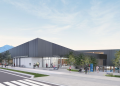
The next phase for BCIT will be moving the teaching micro-factory from its temporary location into a permanent facility on campus.
The proposed space would be a semi-outdoor facility covering approximately 2,500 square feet. It would include a wooden floor, a roof and a storage container.
Building skills beyond the walls of the factory
Hebert says the long-term vision is much broader than establishing a permanent facility at BCIT’s Burnaby campus.
“Our longer-term ambition extends beyond BCIT’s Burnaby campus,” says Hebert. “A fundamental part of the project is Indigenous community capacity building. As part of our commitments, BCIT will visit at least two remote Indigenous communities and bring this equipment knowledge closer to the places where the housing challenge actually exists.”
The intention is to help communities build the knowledge, technical skills, systems and confidence needed to take a larger role in determining their own housing future.
For Hebert, the success of the project cannot be measured solely by the number of wall panels produced.
“The micro-factory is therefore as much about people and capacity as it is about buildings and equipment,” he says. “A prefabricated wall panel coming out of the factory is valuable, but the greater outcome is someone understanding how and why that panel was designed and built, how to reproduce it consistently, and how those skills can contribute to future housing projects in their own community.”
The initiative is supported by Canadian Colleges for a Resilient Recovery (C2R2), through funding provided by Employment and Social Development Canada.
Cebert Adamson, C2R2 steering group co-chair, says rural and remote Indigenous communities should have access to housing that meets high standards without forcing them to compromise on cost or performance.
“People in rural and remote Indigenous communities deserve good houses,” says Adamson.
“They should not have to choose between affordability, durability, comfort, energy efficiency and quality. We want to demonstrate that homes can be affordable while also being comfortable, healthy, resilient, and capable of achieving net-zero or Passive House levels of performance.”