



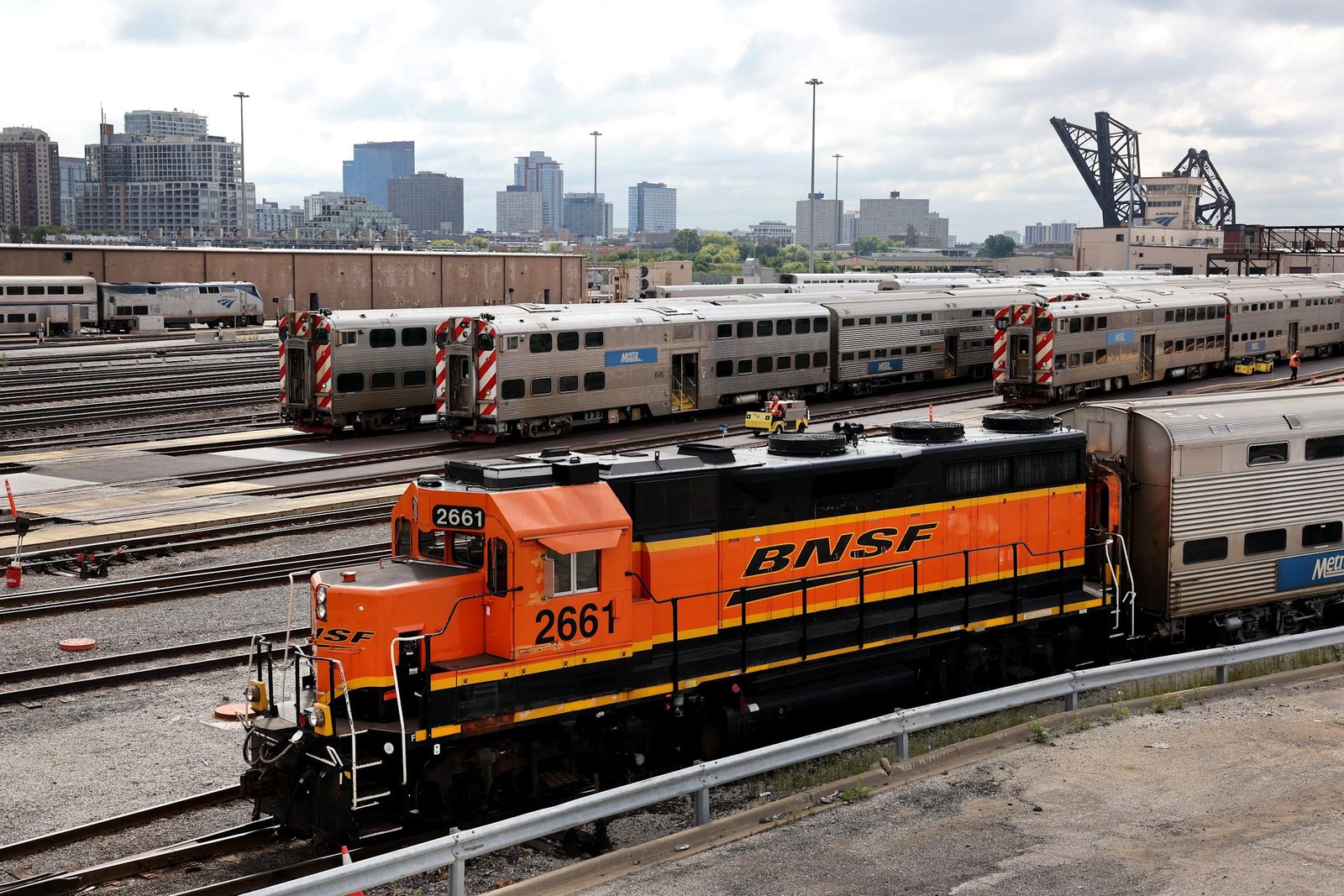
BNSF Railway chief executive Katie Farmer has renewed her opposition to the proposed merger between Union Pacific and Norfolk Southern, warning that the deal would hand a single railroad control of close to 50% of all U.S. rail freight volume.
Speaking during a keynote interview at the Association of American Short Line and Regional Railroad Association’s annual conference in Minneapolis, Farmer said the merger would be bad for the industry and ultimately harmful to customers.
She argued that consolidating such a large share of traffic under one network would reduce customer flexibility, limit routing options and lead to fewer interchange points. In her view, a railroad focused primarily on optimising its own network does not necessarily deliver better outcomes for shippers.
Farmer also cast doubt on the growth targets Union Pacific and Norfolk Southern have presented as part of their merger plan. The two railroads have said the combined company could increase volume by 12% within three years, but Farmer said historical evidence suggests that claim should be treated with caution.
She pointed to the Union Pacific-Southern Pacific merger as an example, noting that Union Pacific’s volumes have fallen 13% over the past 10 years while average revenue per unit has risen 37% above other Class I railroads. In her view, past consolidation has tended to mean fewer options and higher prices for customers.
Farmer said that if the promised growth fails to materialise, Union Pacific would likely respond by selling off underperforming parts of the combined network. She called for strong regulatory safeguards to protect local service, customer experience and broader growth opportunities.
She also said the tougher Surface Transportation Board merger rules introduced in 2001 after service disruptions from earlier rail consolidations were designed specifically to discourage future mega-mergers.
Under those rules, she said, a merger must both enhance competition for the customer and serve the public interest. Farmer argued that Union Pacific and Norfolk Southern are wrongly conflating the two by focusing on public-interest claims such as shifting freight from road to rail.
Union Pacific has said the transaction could take 2 million truckloads off U.S. highways. Farmer acknowledged that moving freight from road to rail is beneficial in the public interest, but said that is not the same as demonstrating enhanced competition for existing rail customers, which is what the 2001 rules were intended to protect.
She said the industry should push the STB to impose conditions that genuinely improve competition, service quality and traffic growth if the merger proceeds.
Farmer also criticised Union Pacific’s proposal for committed gateways — interchange points it says it will maintain on commercially reasonable terms to allow customers to hand off freight to other railroads rather than being forced into single-line service.
She noted that Union Pacific itself argued in 2022, when opposing the Canadian Pacific-Kansas City Southern merger, that open gateways would not necessarily preserve competition. She said BNSF’s own experience at the Laredo, Texas, gateway illustrates the problem: while the gateway remained operational following the CP-KCS merger, the economics changed so dramatically that BNSF’s monthly traffic there fell from 10,000 units to zero.
In her view, the issue is not simply lost volume for BNSF, but the loss of a real competitive option for customers.
She added that Union Pacific’s open-gateway proposal would apply to only around 0.4% of all rail freight and would exclude hazardous materials, unit trains and intermodal traffic. Even for the limited traffic that would qualify, she said, customers would still face rates in the top 30% of Union Pacific’s published pricing and would only be able to use those gateways during the STB oversight period.