



Bot Auto has announced that all of its remote assistance operators will be based exclusively in the United States, as the Houston-based autonomous trucking company seeks to reinforce its operational and safety framework.
The company’s remote assistants act as a human support layer between its driverless trucks and people interacting with the vehicles in the field. However, they do not participate in the actual driving process. Bot Auto’s trucks remain fully autonomous at all times.
Instead, remote assistants focus on communication and coordination. Their responsibilities include maintaining direct contact with first responders and law enforcement officers, providing operational information and carrying out limited vehicle actions when required during an incident.
“Remote assistants play a critical role in Bot Auto’s operations, providing a human layer of support and oversight for our autonomous fleet. We’re building out America’s 21st-century supply chain. It needs to be extremely resilient, and that’s why it’s critical that these roles are always kept within the United States,” said Brian Moore, Bot Auto’s chief policy officer.
Bot Auto operates a Level 4 autonomous fleet from Houston and offers transportation as a service, positioning its operations within what the company describes as the Texas trucking triangle.
Remote assistants play a key role at the roadside
The system is already being used in live operations. From Bot Auto’s mission control centers, remote assistants monitor vehicles, verify their operational status and relay information concerning cargo and routing.
They are also able to remotely activate certain functions, including hazard lights. Under specific circumstances, they can facilitate the shutdown of a vehicle at the direction of a law enforcement officer.
This capability becomes particularly important during a traffic stop involving an autonomous truck. With no driver present inside the cab, a request to stop or shut down the vehicle must be handled through another channel. Bot Auto’s approach is to ensure that a U.S.-based remote assistant is available to receive and coordinate that request.
A question already raised in the Senate
The location of remote assistance personnel became a political and regulatory issue in Washington earlier this year.
During a Senate hearing in February, Waymo Chief Safety Officer Mauricio Peña disclosed that part of the company’s robotaxi support workforce operates from outside the United States. Waymo maintains four remote assistance centers, including two in the Philippines and two others in Arizona and Michigan.
At any given time, approximately 70 agents may be on duty. Automotive World reported that these employees provide contextual guidance but cannot control the movement of vehicles, with the onboard autonomous system retaining real-time authority.
The disclosure prompted Sen. Ed Markey, D-Mass., to launch an investigation into the use of remote assistance operators by autonomous vehicle developers.
His office surveyed seven companies, including autonomous trucking developer Aurora, and published its findings on March 31.
Among the seven companies surveyed, Waymo was the only one using remote assistance operators based overseas. It was also the only company where a significant portion of the workforce did not hold a U.S. driver’s license.
The investigation also revealed differences in latency between autonomous vehicles and remote operators, with each company establishing its own threshold for determining when communication delays could become a safety concern. None of the companies agreed to disclose how frequently their remote operators intervene in vehicle operations.
Autonomous vehicle developers “have long boasted they can eliminate road fatalities caused by human error,” Markey said. “Now it is time they are honest about their technology’s reliance on human help.”
Bot Auto was not included among the seven companies examined by the Senate investigation. Its announcement comes as autonomous trucking gains wider adoption, allowing the company to establish its position on the issue before similar questions become more widespread across the sector.
“Every mission has a mission control”
During an emergency, response times can be measured in seconds. For a first responder arriving at an incident involving an autonomous truck, the ability to immediately reach a human operator, communicate clearly and initiate an appropriate vehicle response can be critical.
“Every one of our vehicles has a mission, and every mission has a mission control,” said Bart Teeter, Bot Auto’s director of fleet and operational safety.
“Our remote assistants aren’t driving the truck, but they are the voice on the other end of the line when an officer needs one, and they can act on the vehicle directly when it matters. Committing to U.S.-based remote assistants is about making sure that when a first responder needs us, there is no delay, no miscommunication, and no gap in accountability. We work hand-in-hand with law enforcement and emergency services, and this is a direct reflection of that responsibility.”
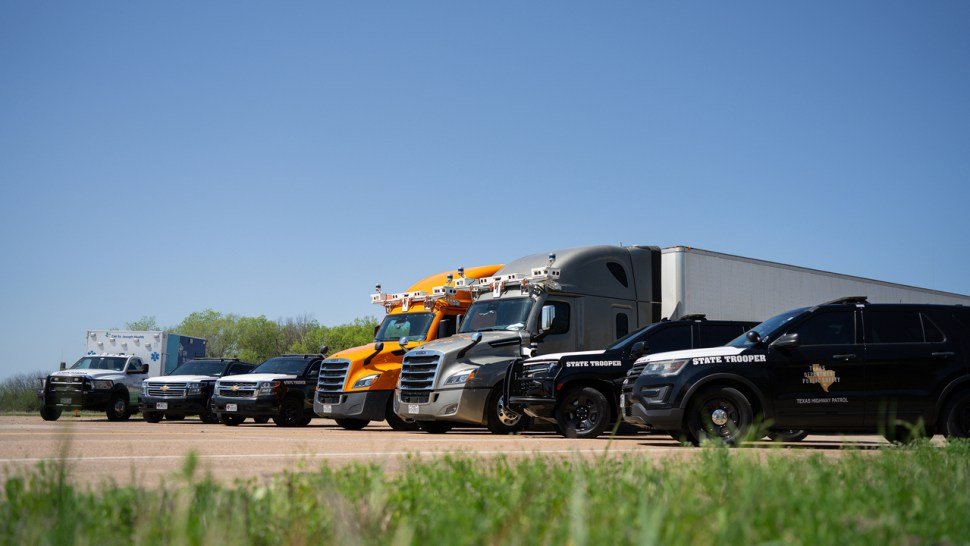
As its operations have expanded across Texas, Bot Auto has conducted ride-alongs and training sessions while coordinating incident response protocols specifically designed for autonomous trucks.
Federal regulators raise concerns over first-responder interactions
Bot Auto’s announcement also follows increasing attention from federal regulators regarding the interaction between autonomous vehicles and emergency personnel.
On July 8, the National Highway Traffic Safety Administration issued a call-to-action letter to autonomous vehicle developers, approximately seven weeks before Bot Auto made its announcement.
The agency, led by Administrator Jonathan Morrison, cited several safety concerns involving driverless vehicles. These included vehicles entering active emergency scenes, blocking the paths of ambulances and fire trucks, or failing to recognize flashing emergency lights, flares, smoke, fire and traffic cones.
NHTSA warned that an automated vehicle unable to safely interact with first responders represents a danger to the general public.
The agency scheduled meetings with autonomous vehicle developers before the end of July and emphasized that it retained the authority to take enforcement action where necessary.
For Bot Auto, the remote assistant model represents one component of a broader safety architecture that also includes validation testing and coordination with regulators and emergency services.
The company argues that keeping remote assistance personnel within the United States should represent a baseline expectation for autonomous vehicle operators serving the U.S. market.
“The ability to clearly and reliably communicate with a remote assistant during an emergency situation is critical to first responders,” said Maj. Omar Villarreal of the Texas Department of Public Safety.
“Miscommunication or poor connections can potentially cost valuable time in addressing emergency conditions. Autonomous vehicle operators committing to U.S.-based remote assistants convey that they are committed to their responsibility in engaging first responders by making effective communications a priority.”