



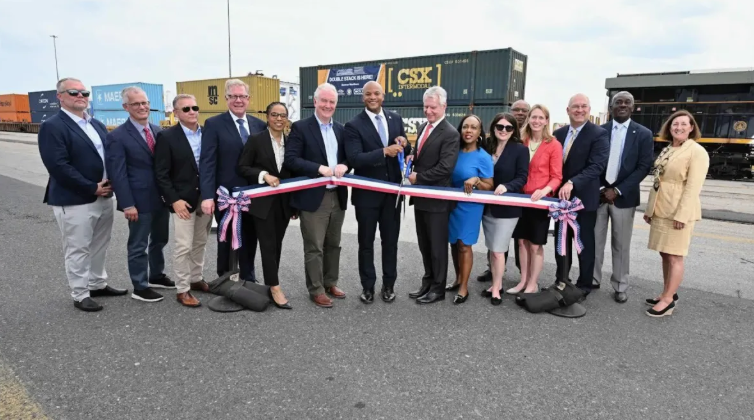
CSX Transportation has officially completed its long-awaited $495 million Howard Street Tunnel expansion project in Baltimore, a milestone expected to significantly improve freight rail efficiency and strengthen cargo connectivity between the Port of Baltimore and major inland markets.
The project enables full double-stack container train operations through the historic 1.7-mile tunnel, eliminating a long-standing infrastructure constraint that had limited the movement of containerized cargo to and from one of the United States’ most important ports.
According to an announcement from Maryland Governor Wes Moore’s office, the newly expanded tunnel will allow freight to move more efficiently between Baltimore and key destinations across the Midwest and the East Coast. The enhanced rail capacity is also expected to help reduce highway congestion along the busy I-95 corridor while contributing to lower transportation-related emissions.
The project involved increasing the tunnel’s clearance by 18 inches, a technically complex undertaking considering the structure has been in operation for 131 years. In addition to the tunnel modifications, clearance improvements were carried out at 21 other locations across Maryland, Delaware, and Pennsylvania to support uninterrupted double-stack rail service.
The Howard Street Tunnel reconstruction was made possible through a partnership involving CSX, the State of Maryland, the Federal Railroad Administration, and the U.S. Department of Transportation. The initiative has been years in the making and represents one of the most significant freight infrastructure investments in the region.
For decades, height restrictions within the tunnel prevented double-stacked containers from moving directly between the Port of Baltimore and other East Coast destinations, limiting operational efficiency and rail competitiveness.
The project’s path was not without setbacks. In 2017, CSX withdrew from the initiative, stating at the time that the proposal no longer justified the level of investment required from both the company and its public-sector partners. However, negotiations resumed, and CSX returned to the project two years later, allowing construction efforts to move forward.
The benefits of the investment were already beginning to emerge in 2024, when the Port of Baltimore launched double-stack rail services via a northern route while tunnel reconstruction remained underway. At that time, former Maryland Port Administrator Jonathan Daniels estimated that the completed project would increase the port’s annual cargo capacity by approximately 160,000 containers.
The Howard Street Tunnel officially reopened in September 2025, although several complementary infrastructure improvements remained under construction and were scheduled for completion in 2026.
Beyond operational advantages, the project is expected to generate substantial environmental benefits over the coming decades. According to project estimates, double-stack rail operations could reduce truck fuel consumption by approximately 137 million gallons and eliminate around 1.2 billion truck miles over a 30-year period.
Those reductions are expected to translate into cleaner air, improved road safety, and less congestion for communities located along major freight corridors.
For shippers, the expanded tunnel removes a major obstacle that had long complicated freight movements between the Port of Baltimore and inland distribution networks.
CSX Chief Executive Officer Steve Angel described the project as a transformational improvement for the company’s network.
“This strengthens a critical link in our network and enables us to move more freight on existing trains, giving customers greater access, capacity and flexibility across the East Coast,” Angel said.
With the completion of the Howard Street Tunnel expansion, the Port of Baltimore is now better positioned to handle growing cargo volumes, improve rail connectivity, and reinforce its role as a key gateway for U.S. trade in the years ahead.