




Diesel prices in the U.S. have retreated in recent weeks, but that decline has done little to ease the pressure on companies managing transportation budgets. Higher freight rates and lingering fuel-market uncertainty are leaving finance teams with limited room to absorb additional costs.
The national average for on-highway diesel stood at $6.20 per gallon on Oct. 5, down from $6.38 a week earlier, according to the U.S. Energy Information Administration. Freight rates, however, remain significantly above their longer-term seasonal averages.
Chevron CFO Eimear Bonner warned that energy prices are unlikely to normalize quickly. Speaking at a Wall Street Journal event on Sept. 22, she said prices could remain elevated until shipping through the Strait of Hormuz becomes more predictable and additional refining capacity comes back online. Conditions around Hormuz have shown some improvement, but uncertainty remains.
The fuel situation is also adding tension to an already difficult trucking market. Calls for truckers to stop work on Oct. 1 generated additional uncertainty, although the proposed action has largely been characterized as a social-media-driven campaign rather than an organized industry movement. Major trucking associations have said they are not participating, with one industry spokesperson describing the effort as “social media chatter at this point in time.”
Several states have meanwhile introduced measures aimed at reducing the impact of expensive diesel.
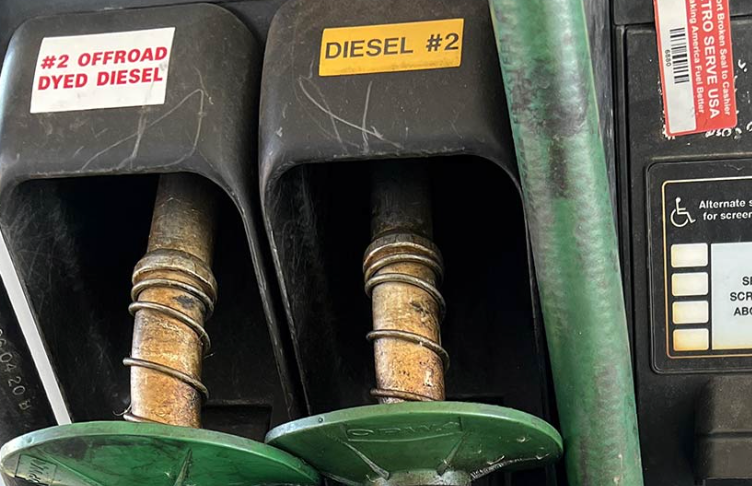
North Dakota Gov. Kelly Armstrong declared an emergency on Sept. 29, temporarily permitting vehicles associated with agricultural operations to use red-dyed diesel on public roads. Texas Gov. Greg Abbott has also relaxed restrictions on dyed diesel, a fuel normally intended for off-highway applications such as agriculture and taxed at a lower rate.
North Dakota’s order could save eligible users 19 cents per gallon in state taxes through Nov. 30, although the federal diesel tax remains applicable.
For shippers, however, the more consequential issue is the combination of high fuel costs, strengthening freight rates and carriers reassessing their economics ahead of new annual contract negotiations.
Trucking capacity is gaining pricing leverage
The diesel increase is occurring at a time when trucking carriers are already gaining greater leverage over freight pricing.
For the week beginning Sept. 13, national spot rates were 20% above the nine-year seasonal average for dry vans, 28% higher for refrigerated trailers and 25% higher for flatbeds, according to DAT data reported by Trucking Dive.
Weekly movements were less dramatic. Dry-van rates declined 3 cents to $2.17 per mile, while refrigerated rates increased 2 cents to $2.73 per mile. Flatbed rates fell 2 cents nationally to $2.60 per mile, although rates increased by 6 cents in the states DAT identifies as bellwethers for the flatbed market.
The post-Labor Day freight rebound also came faster than the return of available trucks.
Loads posted on DAT One increased 16% to 2.9 million during the week of Sept. 13, compared with an 8% increase in truck postings. Load-to-truck ratios increased across dry-van, refrigerated and flatbed freight. However, the preceding week had been shortened by the holiday, making it difficult to determine how much of the increase represents a sustained market shift.
Carrier investment provides another indication that operators see stronger conditions ahead. Trucking Dive, citing FTR data, reported that trailer orders reached 24,144 units in August, a 43% increase from July.
For shippers preparing new contracts, those figures matter because fuel costs are rising alongside a market in which carriers have more room to push for better rates.
Contract timing can leave carriers exposed
The effect of diesel prices is particularly visible when transportation contracts were negotiated before fuel costs began climbing.
Cherri Harris, CEO and owner of Swint Logistics Group, said the increase in diesel has had a significant impact on the company’s bottom line. Swint operates as a motor carrier, transporting freight across the continental U.S. and Canada through semi-trailer operations and local deliveries.
Harris told NewsNation on Sept. 27 that Swint had entered into many of its contracts before fuel prices increased. Customers have offered the company several additional hours of work each day in an effort to help offset the higher fuel expense.
But Harris made clear that the additional business does not fully solve the problem.
“It is a help, but it is not a solution,” she said.
The experience illustrates the exposure carriers can face when they commit to freight pricing before a significant fuel increase. Even when shippers attempt to compensate their transportation providers, the additional revenue may not completely offset the higher operating costs.
Fuel surcharges provide some protection, but they do not necessarily respond immediately to market movements.
Bob Costello, chief economist at the American Trucking Associations, told The Washington Post that fuel surcharges commonly adjust weekly based on the EIA’s diesel price. A carrier that purchases fuel following a sharp increase in the middle of the week may therefore have to absorb the additional expense until the next surcharge adjustment.
Eventually, that higher cost moves through to shippers when the revised surcharge appears on their freight bills.
That makes transportation increasingly relevant to corporate finance departments, particularly those already working closely with logistics and operations teams.
At online home furnishings retailer Wayfair, CFO Kate Gulliver said during a June CFO Leadership Council panel that finance and operations jointly assess shipping expenses and pricing through the company’s CastleGate fulfillment platform.
Gulliver also identified freight auditing as a potential artificial-intelligence application because of the enormous number of shipping transactions processed by Wayfair. Her comments predated the current diesel increase, but they demonstrate how closely transportation expenses can be connected to broader financial decision-making.
The fuel problem extends well beyond trucking
The diesel squeeze is not simply a consequence of shipping conditions around the Strait of Hormuz.
Ukrainian attacks on Russian refineries have also contributed to tighter fuel markets. President Trump publicly called on Ukraine to stop targeting Russian refineries, citing the broader effect on global fuel prices.
At the same time, refined-product exports from the Gulf have recovered faster than initially expected, according to The Wall Street Journal.
The U.S. has another potential source of supply in the Strategic Petroleum Reserve, although releasing crude does not immediately solve a diesel shortage. The oil still has to be processed by refineries before it can become diesel.
Much of the Strategic Petroleum Reserve is held in underground salt caverns, which provide a secure and relatively inexpensive way to store large quantities of crude. Water is pumped into the caverns to force oil to the surface, while the maximum withdrawal rate decreases as the inventory declines.
Refining economics are also critical. The commonly used 3-2-1 crack spread models three barrels of crude being processed into two barrels of gasoline and one barrel of diesel. The measure highlights why crude oil prices alone do not determine the price ultimately paid by truck operators for diesel.
The White House has also been considering restrictions on U.S. diesel exports. Trump said on Sept. 27 that he was “thinking very seriously” about a potential export ban.
Andy Lipow, president of Lipow Oil Associates, told Yahoo Finance that such a measure could reduce domestic diesel prices but could also force Gulf Coast refiners to reduce crude processing once storage capacity begins filling. That would have consequences beyond diesel, potentially reducing supplies of gasoline and other refined fuels as well.
The administration also offered on Sept. 27 to loan up to 40 million barrels of crude from the Strategic Petroleum Reserve. Reuters noted that routine drawdowns are restricted once reserve inventories fall below 252.4 million barrels.
Diesel could raise costs far beyond freight
The implications are becoming broader as the U.S. approaches colder weather.
Diesel and heating oil are closely related fuels, meaning competition for distillate supplies can affect both transportation and residential heating. The Energy Information Administration expects low U.S. distillate inventories to contribute to higher home-heating costs in the Northeast.
For businesses, transportation is another transmission channel. More expensive trucking can raise the cost of moving essential goods, including food and medicine, putting additional pressure on supply chains and ultimately on prices paid by consumers.
Earlier this year, governments including Malaysia and Pakistan introduced remote-work measures where possible in an effort to reduce fuel consumption during oil-market disruptions. Malaysia said government workers could work from home to save energy and costs, while Pakistan announced austerity measures aimed at reducing fuel use amid the conflict in the Middle East.
No comparable measure is currently being seriously considered in the United States.
For CFOs and logistics executives, the more immediate concern is therefore less about a single diesel-price spike than about how long elevated fuel costs remain embedded in transportation contracts.
With carriers facing higher operating expenses, freight rates already running above seasonal norms and annual contracts coming up for renewal, fuel is increasingly becoming a financial issue that extends well beyond the transportation department.