



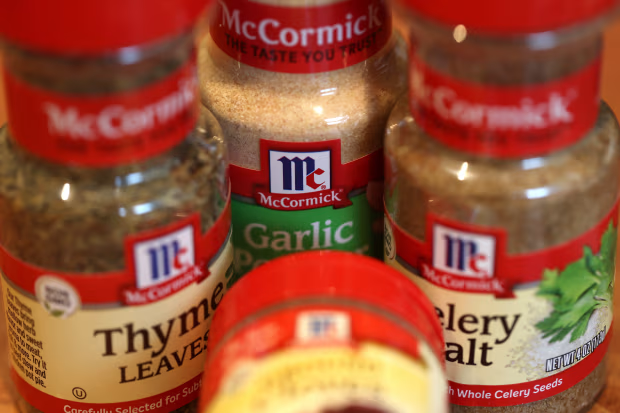
McCormick & Co. is preparing for a stronger inflationary impact than previously expected in fiscal 2026, with rising freight, logistics, packaging and other input costs prompting the spice and seasoning maker to raise its forecast.
The company now expects inflation to reach as much as 7% year over year, compared with its previous projection of a mid-single-digit increase. Executive Vice President and Chief Financial Officer Marcos Gabriel outlined the revised outlook during McCormick’s Oct. 1 earnings call.
Freight and logistics have become a particular source of pressure. Costs have increased amid the Iran war, while changes in U.S. federal regulations have contributed to tighter freight capacity. McCormick has nevertheless managed to absorb part of the additional expense through pricing actions and productivity improvements.
Gabriel pointed to the company’s long-running Comprehensive Continuous Improvement (CCI) program as one of the initiatives generating savings and helping counter higher operating costs.
The pressure is expected to remain in the company’s financial results over the next quarter. For the period ending Nov. 30, McCormick anticipates that higher commodity and freight expenses will contribute to year-over-year margin compression. Inflation is also expected to extend into fiscal 2027, which starts Dec. 1.
Food manufacturers face broader cost pressure
McCormick’s experience reflects a wider inflation challenge across the food manufacturing sector. The combination of the Iran war and other cost pressures has pushed several companies to revise or maintain elevated inflation expectations.
Conagra Brands said last month that its full-year inflation rate was expected to approach 6%. The frozen food manufacturer reported that logistics and transportation expenses were increasing at roughly twice the rate it had initially expected, with a shortage of truck drivers and higher oil prices contributing to the increase.
Lamb Weston has likewise continued to see inflationary pressure. For the quarter ended Aug. 30, the french fry manufacturer reported substantial increases in freight, edible oils, packaging and ingredient costs. CFO James Gray highlighted those pressures during the company’s Oct. 6 earnings call.
The transportation market is also dealing with tighter capacity. Stricter federal oversight of the industry has reduced capacity for over-the-road and long-haul trucking. In another sign of the strain on available carrier capacity, bulk lead times have increased from 24-72 hours to seven to 10 days.
Pricing and Mexico acquisition help protect margins
McCormick’s response has combined price increases with internal efficiency measures and the contribution of its Mexican operations.
During the third quarter ended Aug. 31, pricing, savings generated through the CCI program and the benefits of acquiring a controlling stake in McCormick de Mexico helped offset higher costs, according to Gabriel.
The company maintained strong profitability despite the increase in commodity and freight expenses. Adjusted profit margin expanded by 180 basis points from the same period a year earlier, reaching 39.3%.
Adjusted operating income also rose 22.1% to $358.5 million.
Procurement costs remain an issue for the business, but McCormick expects those expenses to generally decline during the three years following the completion of its planned $44.8 billion merger with Unilever.
The companies expect procurement-related savings to represent 40% of the $600 million in recurring annual expense reductions targeted from combining the two businesses.
McCormick and Unilever have previously indicated that the transaction is expected to close in mid-2027.