



The dry bulk sector’s decarbonization debate has moved beyond whether shipping will reach carbon neutrality and is now focused on how the transition can be achieved commercially in an uncertain world.
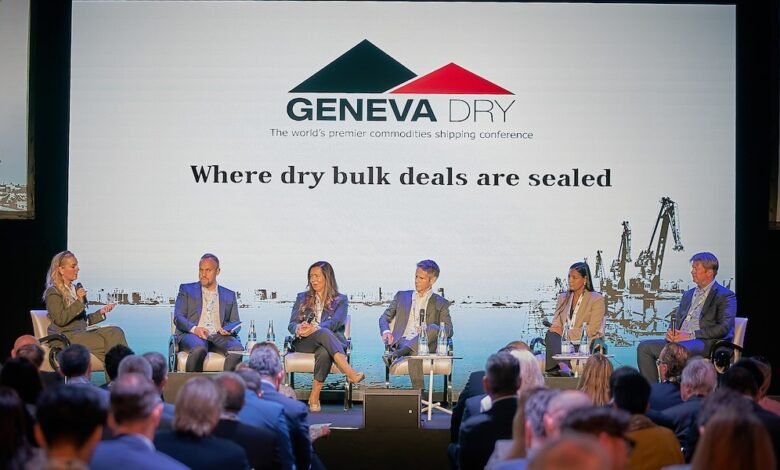
That was the central message from the dry decarbonization panel at Geneva Dry, where shipowners, charterers, analysts and operators discussed fuel choices, efficiency measures, carbon pricing, regulation and who ultimately pays for cleaner shipping.
Mette Asmussen of the World Economic Forum opened the session by stressing that decarbonization requires constant vigilance and agility.
Eman Abdalla, founder and CEO of Seathrew Marine, said the mindset has changed significantly since the previous Geneva Dry event. Two years ago, the industry was still debating whether decarbonization would happen. Today, the discussion is about how and when.
Speakers agreed that progress is being made through pilot projects, operational efficiency, energy-saving devices and dual-fuel newbuildings, but the sector must now scale up.
Dry bulk’s low-margin structure remains a major challenge. Alastair Stevenson of SSY said carbon costs have a proportionally larger impact on bulk shipping profitability than on tanker or container markets. EU emissions costs can represent 1% to 2% of cargo value in bulk trades.
Vale’s Michelle Gonzalez highlighted the company’s work on Scope 3 shipping emissions, including more than 15 years of testing hull coatings, propeller upgrades and wind-assisted propulsion. Vale aims to cut shipping emissions by 15% by 2035.
Several panelists described wind-assisted propulsion as one of the most promising near-term solutions for dry bulk. Engebret Dahm of Klaveness Combination Carriers said wind systems, AI-based weather routing and digital optimization tools can deliver practical emissions reductions at relatively low cost.
Fabian Kowatsch of Louis Dreyfus Company emphasized the need for collaboration between shipowners and charterers. The company expanded from one decarbonization project in 2022 to 14 collaborative projects last year.
Fuel choice remains uncertain. Vale has explored ethanol, while Louis Dreyfus has ordered methanol dual-fuel vessels. However, owners remain cautious about major fuel investments without predictable regulation and customer support.
The panel also returned to the question of who pays. Abdalla said shipping serves wider industrial supply chains and cannot finance decarbonization alone if cargo interests are unwilling to support it.
Despite the uncertainty, speakers agreed that implementation must accelerate.
“Decarbonization is a reality. There is no way back,” Gonzalez said.