




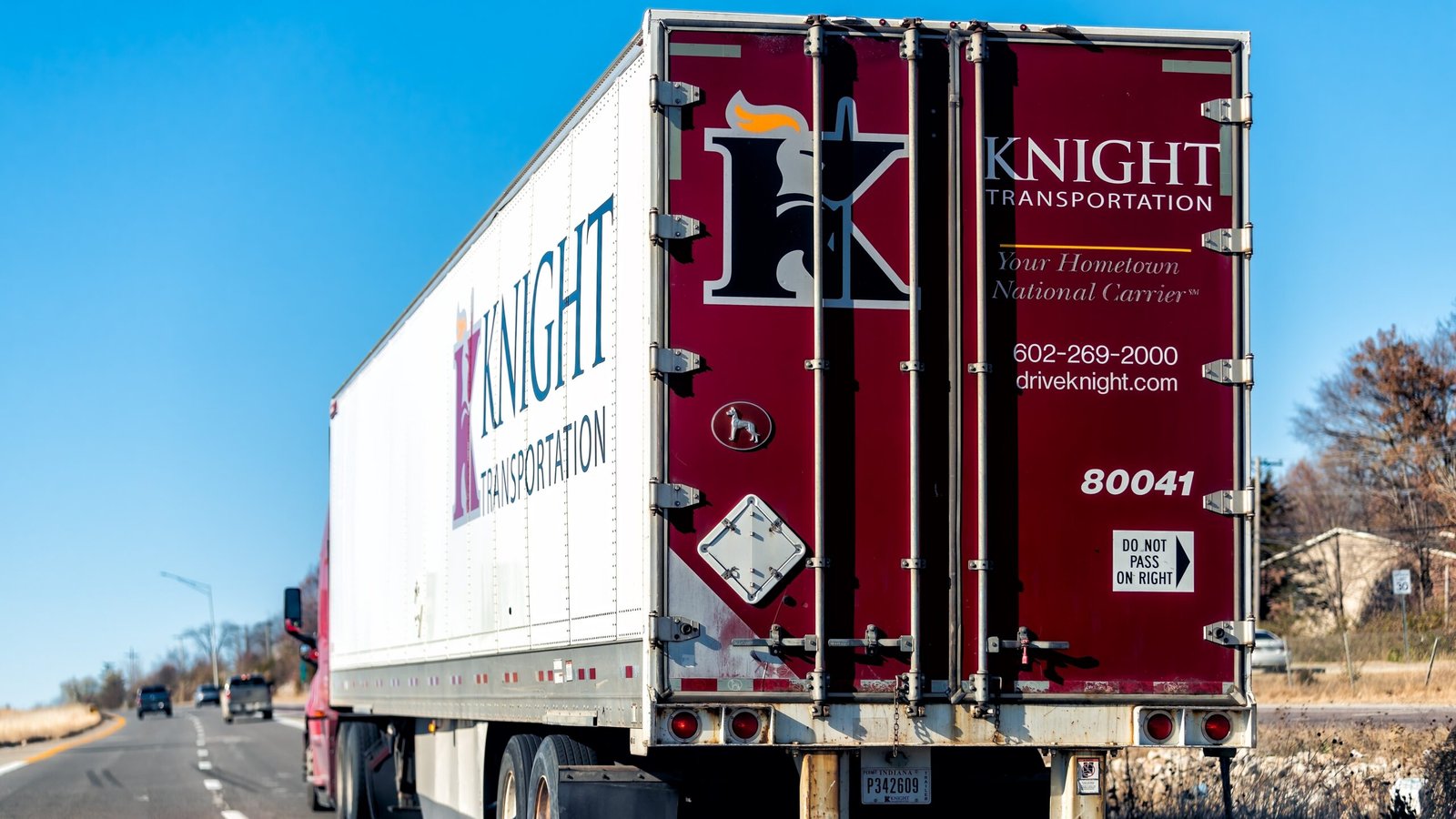
Knight-Swift Transportation says the freight market is showing signs of a meaningful shift, with tighter capacity already prompting shippers to secure peak-season coverage and setting the stage for stronger contract rate increases.
Speaking to analysts during the company’s first-quarter earnings call, chief executive Adam Miller said the market is emerging from a downturn that has lasted nearly four years. According to him, stricter regulatory enforcement and the recent spike in fuel costs are pushing non-compliant and underperforming operators out of the network.
Even without a major rebound in freight demand, those supply-side pressures are strong enough to make shippers rethink their routing strategies and lean more heavily toward asset-based carriers with real scale.
Miller said mini-bid activity is increasing as routing guides begin to fail, while some carriers are no longer honouring rates agreed only one or two months ago. He added that some customers are already trying to lock in peak-season capacity.
After securing mid-single-digit contract rate increases in its truckload business earlier this year, Knight-Swift is now targeting high-single-digit to low-double-digit increases on the remaining 70% of its contract book.
Miller said the market is facing an unusual kind of capacity pressure, driven more by regulatory factors than by normal economic cycles, and suggested that this could create a powerful catalyst for a strong bid season both this year and into next year.
For the first quarter, Knight-Swift reported a headline net loss of $1.3 million, or $0.01 per share. Adjusted earnings per share came in at $0.09, matching the downward revision the company issued last week but below the $0.25 analysts had been expecting before earnings season.
Adjusted EPS was affected by several nonrecurring factors, including an $0.08 per share headwind from negative LTL claims development, a $0.05 to $0.06 impact from weather and fuel costs, and a $0.02 hit tied to an adverse VAT ruling in Mexico. A roughly $8 million decline in net interest expense largely offset a similar drop in gains from equipment sales.
The company reiterated second-quarter adjusted EPS guidance of $0.45 to $0.49.
In truckload, revenue excluding fuel surcharges was flat year on year at $1.05 billion. A 4% increase in revenue per tractor offset a 4% drop in average tractors in service. Knight-Swift has been trimming fleet size over several quarters to improve utilisation, and loaded miles per tractor rose 2.3%, while revenue per loaded mile excluding fuel increased 1.6%.
The truckload segment posted a 96.3% adjusted operating ratio, 70 basis points worse than a year earlier, with bad weather and fuel inflation cited among the headwinds.
Much of the fleet reduction took place at U.S. Xpress, which Knight-Swift acquired in 2023. Annual revenue at U.S. Xpress is now roughly $1.7 billion, down from $2.2 billion in 2022, when the market was still benefiting from the end of the previous upcycle. Management said those actions were aimed at improving freight mix and margins, and that U.S. Xpress is closing the profitability gap with Knight and Swift, though it still lagged by 300 basis points in the quarter.
In the LTL business, Knight-Swift said margins remain under pressure from acquisition integration costs and rapid terminal growth, but improvement is underway. The segment reported a 99.6% adjusted operating ratio, 540 basis points worse year on year, although adverse claim development accounted for 570 basis points of that impact. Guidance points to a low-90s operating ratio in the second quarter, with potential to move below 90% later this year.
Revenue in LTL rose 3% to $313 million. A 1% drop in daily shipments was more than offset by a 4% rise in revenue per shipment excluding fuel. Tonnage growth accelerated through the quarter, increasing 1.6% in January, 2.6% in February and 6.9% in March. Management said rate renewals are continuing at a mid-single-digit pace.
Brokerage saw load count fall 19% year on year as the company tightened screening for non-compliant carriers and worked to reduce cargo theft risk. A 10% rise in revenue per load helped limit the revenue decline to 10%. The segment posted a 96.2% adjusted operating ratio, 70 basis points worse than last year, as higher purchased transportation costs reduced gross margin by 150 basis points to 16.6%.
Intermodal remained loss-making, posting a 101.5% adjusted operating ratio. That was 140 basis points worse sequentially but 50 basis points better than a year earlier. Revenue rose 3% as both load count and revenue per load improved steadily during the quarter. Management expects second-quarter intermodal volume to rise by a high-single-digit to low-double-digit percentage year on year, with the segment potentially reaching breakeven or better.
Other businesses, including support services for third parties, generated a combined operating loss of $7.1 million. A change in accounts receivable financing created a $5.2 million headwind, while startup costs for new warehousing contracts and delayed project activity also affected the quarter. Those units are expected to contribute between $14 million and $18 million in adjusted operating income during the second quarter.
By late morning on Thursday, Knight-Swift shares were up 3.9%, while the S&P 500 was flat.