



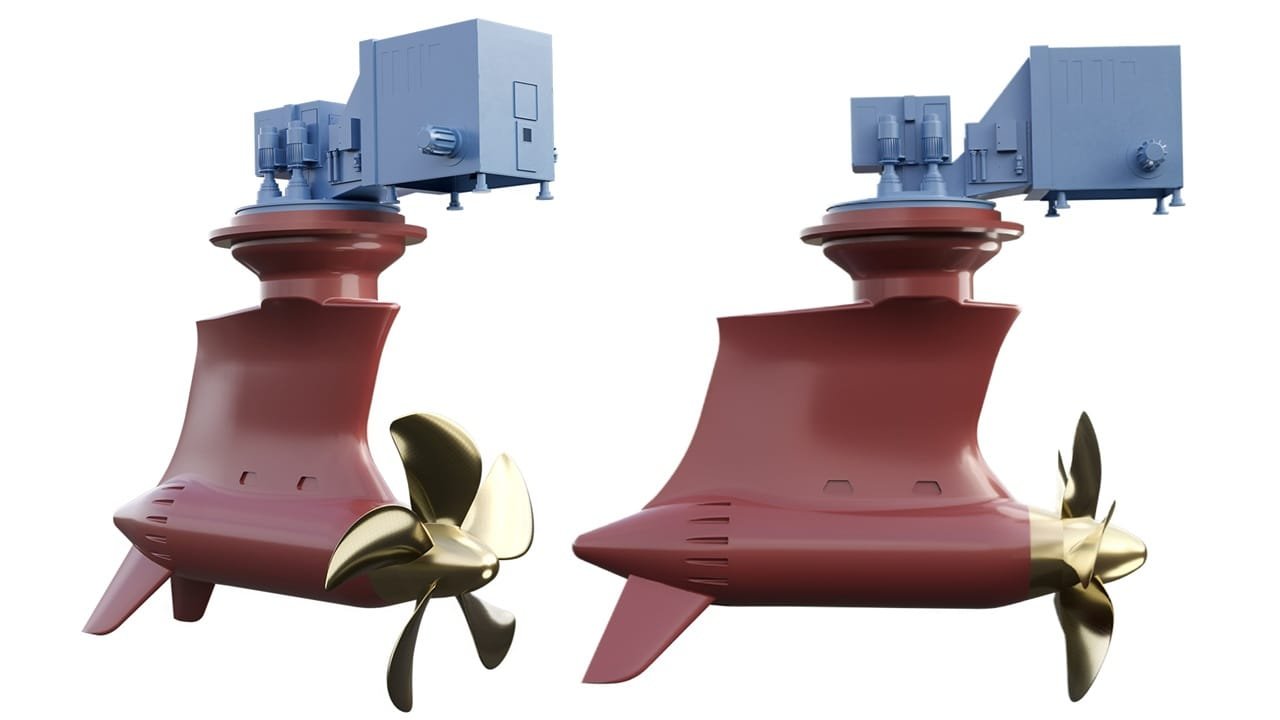
Kongsberg Maritime is expanding its Elegance Pod portfolio with a new range of larger podded propulsion systems, increasing the maximum available power from 7.5MW to 22MW.
The company unveiled details of the extended Elegance range at SMM in Hamburg, with the latest generation of large cruise ships clearly among the primary targets. However, Kongsberg also sees considerable potential beyond the cruise sector, particularly among commercial vessel owners and operators looking for practical ways to reduce emissions.
Per Nahnfeldt, Kongsberg’s General Manager of Products, Electric Propulsion, told Seatrade Maritime News that the larger pods have applications well beyond cruise vessels.
“Large ro-pax vessels are another excellent fit, particularly as operators look to balance energy efficiency, operational flexibility, and demanding port schedules,” he said.
According to Nahnfeldt, the combination of high propulsion efficiency, precise manoeuvrability and compatibility with hybrid propulsion architectures makes the expanded Elegance Pod range particularly suited to vessels where sustainability must go hand in hand with operational performance.
The design of the new range places a strong emphasis on both efficiency and lifecycle performance. Hydrodynamic optimisation has been a key element of the development, with the aim of reducing drag and improving thrust efficiency across a broad range of operating conditions.
Manoeuvrability is another central feature. Podded propulsion systems offer a significant advantage in this area, particularly for large ro-ro and ro-pax vessels operating longer-haul services across the Mediterranean and further north into the Baltic.
Such vessels frequently operate in ports where available manoeuvring space can be restricted, making precise propulsion control increasingly important.
Kongsberg said the Elegance range has also been developed to integrate relatively straightforwardly with different vessel configurations, including hybrid and fully electric propulsion systems.
The expansion comes as Kongsberg continues to highlight the economic potential of marine electrification. Earlier this year, an analysis by Kongsberg Maritime identified operating cost savings of between 20% and 27% from electrification on certain ferry routes.
The strongest results were recorded on longer routes, particularly in the Baltic.
The analysis followed the earlier spin-off of Kongsberg Maritime from Kongsberg Gruppen, with the company now separately listed on the Oslo stock exchange.
At the time, Oskar Levander, VP of Business Development for Kongsberg Maritime’s Emerging Solutions business unit, told Seatrade that the increasingly stringent regulatory environment in Europe was becoming a major factor in the business case for electrification.
Among the key drivers are the European Union Emissions Trading System and FuelEU Maritime.
As these regulatory requirements become progressively stricter, Levander said, the economic case for electrification is becoming increasingly attractive for vessel operators.