



Maersk is taking its first step into wind-assisted propulsion for its ocean fleet with plans to equip one of its container ships with a high-tech rotor sail.
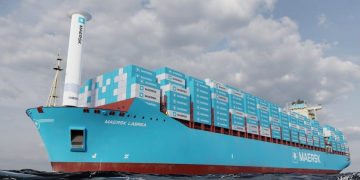
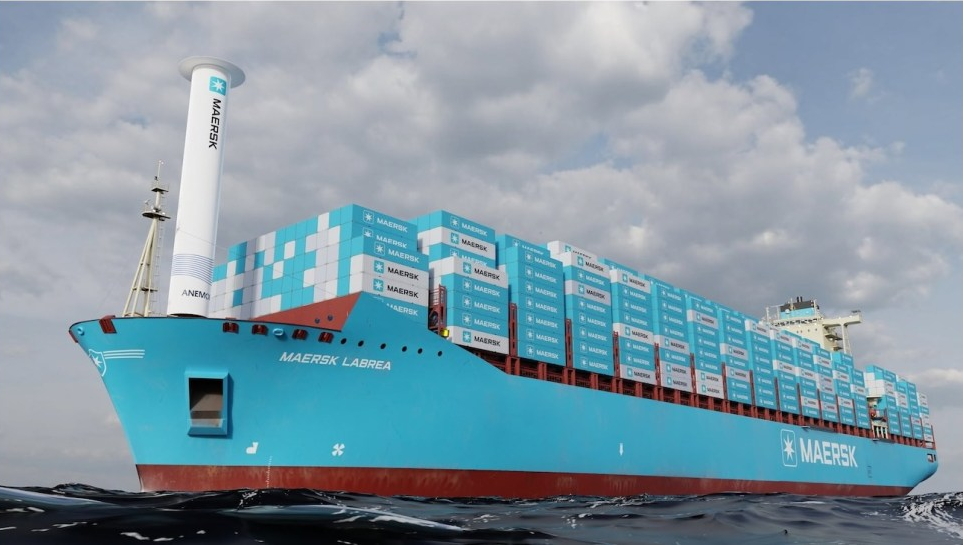
The Danish shipping giant has signed an agreement with London-based Anemoi Marine Technologies to retrofit a 115-foot-tall rotor sail onto a 984-foot, 8,700-TEU Lima-class container vessel. Installation is scheduled for mid-2027, after which the technology will be tested during the ship’s regular commercial operations.
During the pilot phase, the vessel is expected to operate on Maersk’s North and South Atlantic routes. The company will then assess the system’s performance in commercial service.
Anemoi’s technology is typically deployed in configurations of three to five rotor sails per vessel. According to the company’s specifications, each unit can save approximately one ton of fuel per day while reducing CO₂ emissions by around three tons.
For Maersk, the project forms part of a broader, fuel-agnostic strategy aimed at reducing greenhouse gas emissions across its ocean operations. The company’s current decarbonization efforts focus on scaling lower-GHG-emission fuels, including bio- and e-methanol, expanding its dual-fuel fleet and improving both network and vessel efficiency.
The move comes as other major shipping companies also explore wind-assisted propulsion. Earlier this year, CMA CGM began rotations of the sail-assisted Neoliner Origin, a ro-ro vessel that calls at the Port of Baltimore.
Maersk has also continued to invest heavily in other fuel-saving and lower-emission technologies. In 2025, the company added 10 dual-fuel methanol vessels to its fleet and completed fuel-saving retrofits on 230 owned ships and 150 time-chartered vessels.
Those measures helped bring Maersk’s ocean Energy Efficiency Operational Indicator (EEOI) to a record-low 10.8 gCO₂e per ton-nautical mile.
The company expects to have 25 dual-fuel ships in service by 2027. In the longer term, Maersk aims for 25% of its fleet to be capable of operating on lower-emission fuels.
The rotor sail initiative adds another technology to that wider transition, giving Maersk an additional way to reduce fuel consumption and emissions without relying on a single alternative-fuel pathway.
Maersk has set a target of achieving net-zero emissions by 2040.