



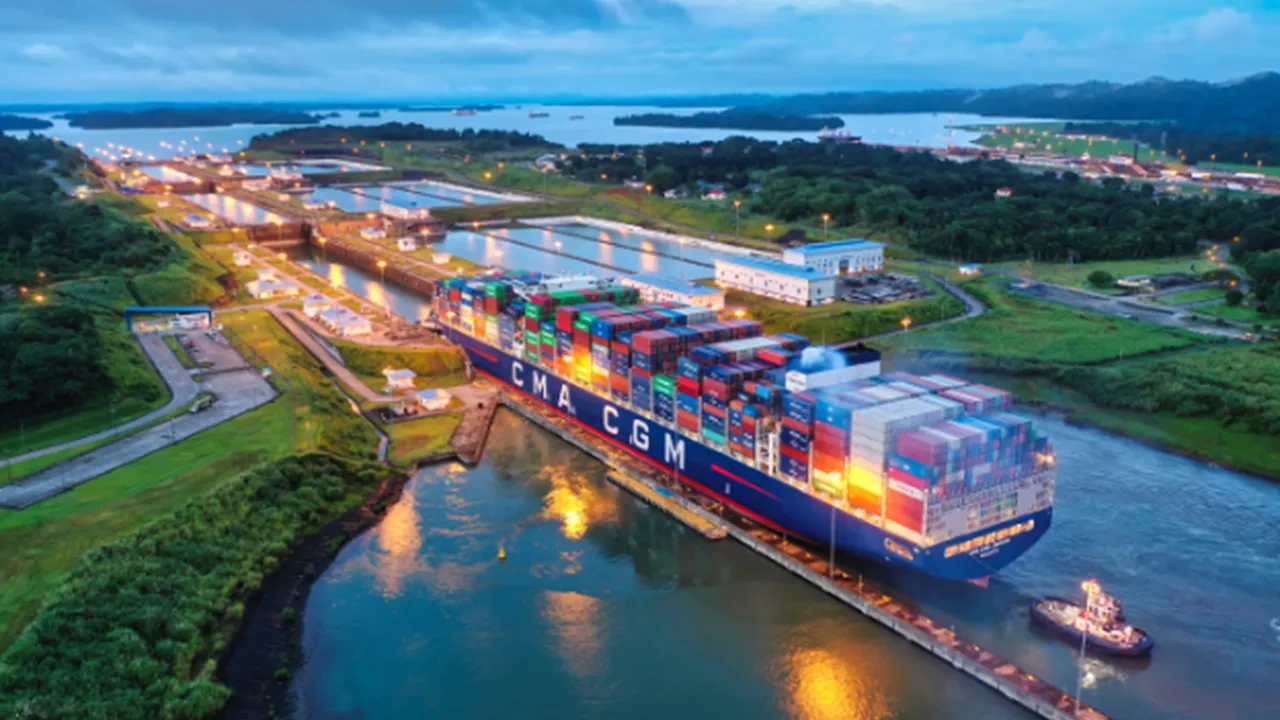
The Panama Canal Authority (ACP) has introduced temporary changes to its transit reservation system for Neo-Panamax vessels as demand for canal capacity continues to rise amid the ongoing situation in the Strait of Hormuz and restrictions linked to drought conditions.
The adjustments affect the Transit Reservation (Booking) System and are intended to give customers greater flexibility while distributing available capacity more efficiently between market segments and supporting more effective use of the canal’s water resources.
Under the revised system, a single customer will be able to secure more than one booking slot on the same date. Customers will also be allowed to reserve slots across two or more consecutive dates.
The ACP will make 63 booking slots available each week for Neo-Panamax vessels. This includes full-container ships, for which at least five slots will be offered on each booking date. Allocation will be based on the vessels’ Transit Teu Allowance (TTA).
For the LPG and LNG sectors, a minimum of three slots per booking date will be available for each segment, with allocations determined according to customer classification.
Car carriers and ro-ro vessels, bulk carriers and other vessel segments will also have access to a minimum of three weekly slots, again allocated according to customer classification.
The revised arrangements came into effect on 30 August, covering booking dates beginning on 13 September.
However, the greater flexibility does not remove the canal’s existing operational restrictions. Limits on vessel draught and the number of daily transits remain in place.
Daily transit capacity is expected to decrease from 36 vessels to 34 on 3 September, before falling further to 32 from 15 September. Additional changes could follow.
The pressure on available capacity has also been reflected in the canal’s daily auction system, where vessels without booking slots have recently paid record amounts to secure transit opportunities.
A vessel carrying LPG paid $5.3 million to obtain a faster transit through the Panama Canal on 1 September, marking the highest auction payment recorded so far. Earlier in August, the 10,100 teu container ship Seaspan Benefactor paid $4.6 million in a daily auction. In April, the gas carrier Gas Virgo secured a slot through an auction for $4 million.
The ACP said the surge in demand is closely linked to developments around the Strait of Hormuz.
“Demand to transit the Panama Canal has increased in recent months due to restrictions and tensions in the Strait of Hormuz, which have led to changes in transport routes for energy products such as oil, LPG and LNG. The value of time — particularly for energy cargoes tied to contractual delivery windows — can far exceed the auction price itself,” an ACP spokesperson told Seatrade Maritime News.
The spokesperson also stressed that the auction system does not allow vessels to simply bypass other ships waiting in line.
“The daily auction is not to skip the queue. But only to obtain a booking slot,” he said.
As of 30 August, 118 vessels were waiting to transit the canal. Of these, 107 had bookings while 11 did not. Thirty vessels were waiting for the Neo-Panamax locks, while 87 were waiting for the Panamax locks.
The current queue represents approximately three days of canal transits and remains broadly typical of the high season. During the 2023 El Niño event, however, the number of vessels waiting to cross the waterway climbed as high as 150 when daily transit capacity was restricted.
The ACP said the average auction price between October 2025 and February 2026 was approximately $55,000. Recent auction results have therefore been around three times higher than that average.
Draught restrictions remain another important constraint on canal capacity. Since 15 August, the Neo-Panamax locks have been operating with a maximum draught of 14.78 metres.
This represents the third adjustment to the previously announced schedule. The permitted draught was initially reduced to 15.09 metres on 3 July and then to 14.94 metres on 24 July.
Further reductions are scheduled. The maximum draught will fall to 14.63 metres on 2 September and then to 14.48 metres on 1 October.
The combination of tighter transit limits, lower permitted draughts and stronger demand from vessels seeking alternative routes for energy cargoes continues to put pressure on available Panama Canal capacity.