



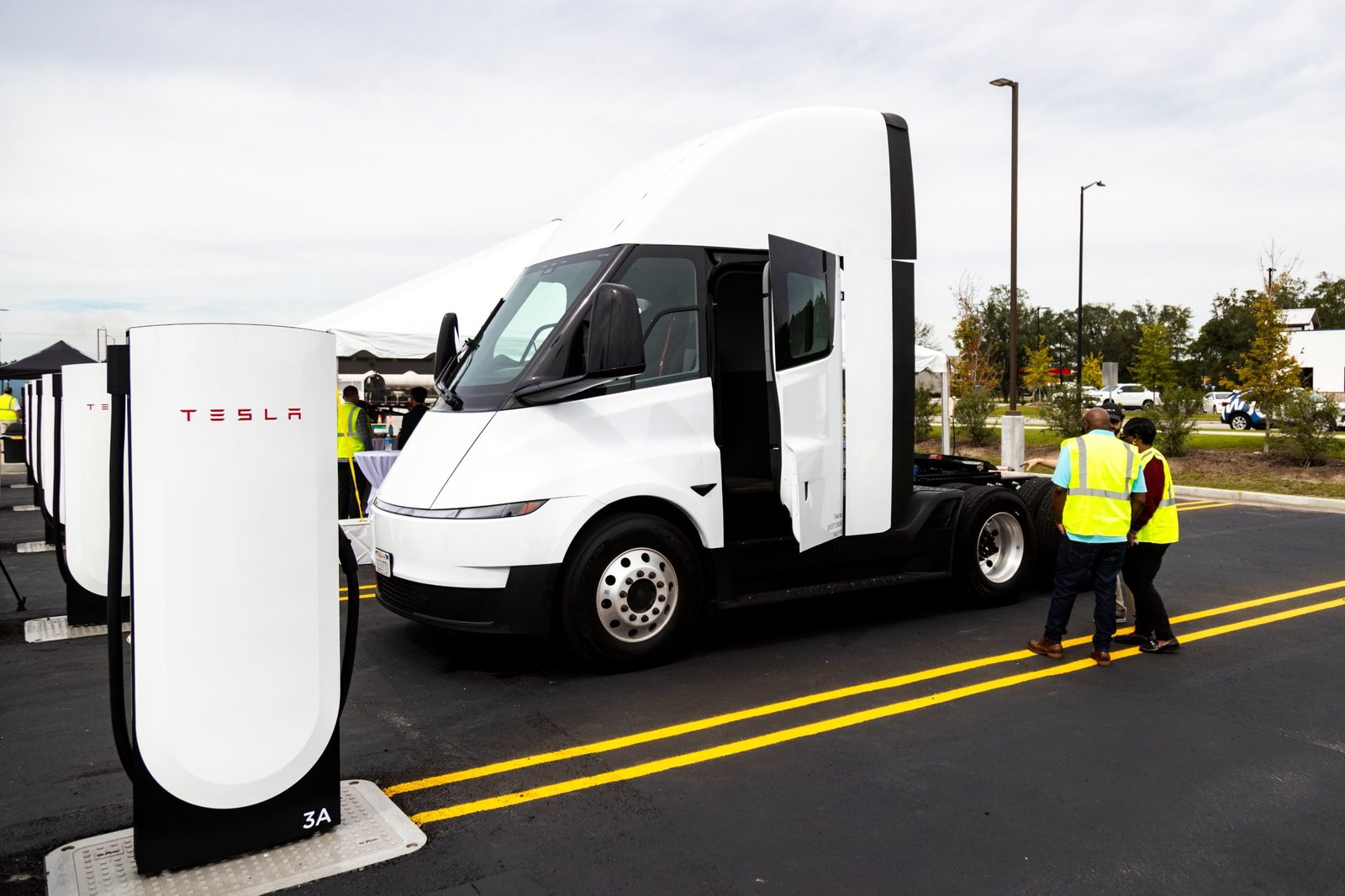
Pilot Travel Centers and Tesla have opened their first Megacharger location dedicated to heavy-duty electric trucks, marking a milestone in efforts to expand charging infrastructure for long-haul freight operations. Announced by Pilot on October 8, the facility is located at a Pilot travel center in Ellabell, Georgia, and features six charging stalls.
The opening is part of a broader rollout that includes 12 additional heavy-duty charging sites currently under construction. Three of these locations are nearing completion: a Flying J travel center in Tulare, California, which was scheduled to open on October 9; another Flying J in Fort Stockton, Texas; and a Pilot location in North Las Vegas, Nevada.
Each facility will be equipped with between four and eight charging stalls powered by Tesla’s V4 cabinet technology. Tesla says each stall can deliver up to 1.2 megawatts of power, enabling a Tesla Semi to replenish 60% of its battery charge in approximately 30 minutes.
A charging network focused on major freight corridors
The planned network will cover selected Pilot locations along Interstate 5, Interstate 10 and other major freight routes. Initial deployment is focused on California, Georgia, Indiana, Nevada and Texas, providing charging access at strategic points for commercial fleets operating across the United States.
Pilot, a subsidiary of Berkshire Hathaway headquartered in Knoxville, Tennessee, operates more than 900 locations across 43 U.S. states and five Canadian provinces. The company intends to build on its existing passenger electric-vehicle charging network while expanding its alternative-fuel services for the commercial transportation sector.
“Pilot is proud to bring heavy-duty charging directly to key trucking routes and pair it with the services and amenities drivers rely on,” said Shannon Sturgil, senior vice president of alternative fuels at Pilot.
The Ellabell opening, however, came later than initially anticipated. When the companies announced their partnership in January, Pilot indicated that construction would begin during the first half of 2026, with the first charging locations expected to open in the summer.
The initial announcement also included New Mexico among the states targeted for the rollout. The October update no longer lists New Mexico and instead identifies Indiana as part of the planned network.
Tesla Semi production accelerates alongside infrastructure expansion
The expansion of the Megacharger network coincides with Tesla’s move toward high-volume production of its Semi electric truck. Production began at the company’s factory in Sparks, Nevada, on September 24.
Tesla expects to have more than 30 charging stations and over 200 megawatt-capable charging posts in operation by the end of 2026. The planned total includes the facilities being developed with Pilot. The Sparks plant is designed to support annual production of 50,000 trucks.
The charging infrastructure is a critical component of the wider deployment strategy for the Semi, particularly for fleets operating on long-distance routes where charging speed and access to strategically located facilities can influence vehicle utilization and operating schedules.
Pilot said the heavy-duty charging initiative complements its existing passenger EV charging infrastructure and its renewable diesel and biodiesel offerings, extending its alternative-fuel portfolio to a broader range of transportation customers.
“With these initial locations, we’re making fleet electrification a more accessible option for long-haul transportation,” Sturgil said.
As more sites approach completion, the partnership aims to provide freight operators with additional charging options along major U.S. trucking corridors while Tesla scales production of its heavy-duty electric truck.