




Parcel shipping costs are expected to reach record levels in 2026 as carriers continue to hike prices and add new fees, adding to the pressure on businesses ahead of the peak holiday shipping season. The latest market analysis by investment bank TD Cowen and AFS Logistics says this year could be the most expensive parcel shipping year on record, with high rates and frequent price swings continuing to impact the industry.
The rising load is also leading shippers to diversify their carrier networks. Big players are always tweaking their pricing models, so there is room for other providers to take some of the market share from companies who want to control their transportation costs.
Fuel surcharges are a rising part of shipping costs
Fuel surcharges are one of the most important cost drivers for parcel shippers in 2027. Diesel prices have risen since the start of the war in Iran in February, which has disrupted shipments of crude oil and refined fuels through the Strait of Hormuz. But TD Cowen and AFS Logistics said ongoing adjustments that carriers have made to their surcharge formulas have pushed prices up even more than the increase in the price of fuel alone.
According to the TD Cowen/AFS Freight Index published Tuesday, carriers have been revising their surcharge tables regularly since 2021. These changes have allowed them to lock in more revenue when fuel prices go up and to keep surcharges high even as actual fuel costs go down.
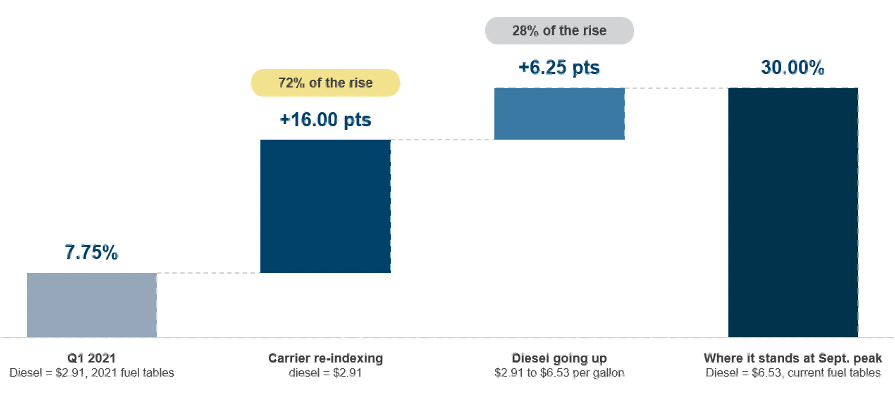
The figures show the degree of change. The average diesel price for the first quarter of 2021 was $2.91 per gallon and fuel surcharges were 7.75 percent of the transportation rate. By September 2026 the surcharge had climbed to 30% and diesel was selling for $6.53 a gallon.
The report said almost three-quarters of that increase was due to a change in the surcharge tables by the carriers, not any change in the price at the pump.
Even if diesel prices returned to 2021 levels, the fuel surcharge would still be 23.75% of the transportation rate, or about three times the level five years ago. The index has been consistently indicating that changes in the fuel surcharge mechanism are the main driver of parcel shipping inflation this year.
“Fuel surcharges are much more than a way to recoup operating expenses,” said Mingshu Bates, chief analytics officer and president, parcel, AFS Logistics.
“While diesel and jet fuel are major costs for ground and express parcel, the fuel surcharge has become a revenue lever for carriers as well as a pass through mechanism to cover the cost of doing business,” said Bates in a news release accompanying the report.
“Even if crude oil prices stabilize and fuel cost eases, the effective surcharge is unlikely to come down materially,” she added.
AFS Logistics uses transactional data to assist companies in managing their expenditures across parcel, less-than-truckload and truckload transportation.
FedEx expands delivery-area charges and other fees
Fuel is only one part of the pricing pressure affecting parcel shippers. Major carriers are increasingly replacing predictable annual increases with more frequent, targeted adjustments designed to protect margins as overall demand growth slows.
Industry practitioners say this approach can face limited resistance because many shippers continue to plan their transportation budgets annually, leaving them less prepared for changes introduced throughout the year.
Between the beginning of 2025 and mid-summer, FedEx implemented or announced more than 50 pricing changes, according to parcel spend management firm LJM. The adjustments covered general rate increases, delivery-area surcharges, customs fees and demand-related charges.
For the fourth consecutive year, FedEx (NYSE: FDX) announced an average general rate increase of 5.9% last month, effective January 4, 2027.
The new pricing structure also includes a significant revision to delivery-area classifications. A total of 2,533 ZIP codes will move from the extended delivery-area surcharge category to the remote delivery-area surcharge, the most expensive tier.
The change is substantially broader than a previous adjustment that added 102 ZIP codes to the standard delivery-area surcharge category, moved 74 from standard to extended and transferred 63 from extended to remote.
For shipments going to ZIP codes reclassified from extended to remote, the delivery-area surcharge will rise to $17.75. According to the TD Cowen/AFS report, this will roughly double the fee for residential deliveries and more than triple it for commercial destinations.
Charles Moore, vice president of parcel solutions at Transportation Insight, warned on LinkedIn that some shippers could experience effective increases well above the headline 5.9% rate adjustment.
Businesses with a high proportion of residential deliveries, rural destinations, lightweight packages or shipments subject to substantial accessorial charges are particularly exposed.
FedEx’s ground pricing increases are also becoming more uniform across zones rather than being concentrated on longer-distance routes. Lightweight e-commerce shipments are among the most affected, with packages weighing between one and five pounds facing increases of nearly 6.5%.
The minimum FedEx Ground charge is scheduled to rise to $12.70, representing a compounded increase of more than 12% over two years. Additional handling fees are also increasing, by between 7% and 7.6%, Moore noted.
FedEx is introducing two additional documentation charges as part of its push toward fully electronic shipping and trade processes: a $25 paper document fee and a $5 paper air waybill fee.
Peak-season surcharges spread across the parcel market
The pricing pressure extends beyond FedEx. DHL eCommerce has published its peak-season surcharges, while UPS (NYSE: UPS) has increased a broad range of fees in recent years, including the introduction of new cubic-volume rules. Amazon, the U.S. Postal Service and other independent carriers have also moved toward additional seasonal charges.
So far, DHL eCommerce, Amazon Shipping, OnTrac, FedEx, UPS and the USPS have announced peak-season surcharges.
DHL eCommerce’s program is divided into three pricing windows beginning in late October. Its highest charges will apply from November 22 through December 26, when parcel volumes typically reach their seasonal peak. Fees also vary according to shipping distance.
Consultancy LJM recommends that DHL customers calculate their expected peak-season costs by shipping week, product, package weight and zone. Using a single average surcharge per package is no longer sufficient to produce an accurate forecast, the firm said on its website.
Josh Dunham, co-founder and CEO of shipping intelligence platform Reveel, said the growing frequency of accessorial charges reflects a broader shift in carrier strategy.
Introduced frequently and sometimes with little advance notice, these fees have become an increasingly important way for carriers to raise revenue per package. Dunham argued that the industry’s priorities have changed: instead of pursuing market share through a broad range of shipments, carriers are increasingly targeting freight that offers the strongest profitability within their networks.
He recommended that shippers expand the number of parcel carriers they use to improve their ability to respond to pricing changes.
Ground, express parcel rates inch closer to new highs
The TD Cowen/AFS Freight Index shows the ground parcel rate-per-package index 43.3% higher than its January 2018 baseline in Q4 2026. That would mark a 5.8% year-over-year increase and a 3.2% increase from the prior quarter.
Also, the price of express parcels is projected to set a record for the fifth quarter in a row. The index should be 20.3% above its baseline in January 2018, an increase of 13.8% year-over-year.
The cost per package for express parcels was up 1.1% in the third quarter compared with the preceding quarter. The increase was driven by higher billed weights, increased share of premium services and additional accessorial charges.
Average billed package weight continued to increase, a result of a decreasing proportion of lightweight shipments and changes to carrier rating rules that increase the weight used to compute fees.
There’s more pressure on pricing overall, but the authors said FedEx and UPS have more capacity to offer deeper discounts to specific customers this year. Network restructuring and efficiency programs are reducing operating costs and supporting margins with more focused pricing incentives.
UPS’s rate increases have been more targeted at small and medium-sized businesses, while FedEx’s discounting strategy is more targeted at large customers.
UPS has always seen small and medium-sized businesses as a strategic target market. These companies often lack the internal resources to manage all aspects of their logistics operations and may require carriers that can provide additional services.
Lower ground costs provide some relief
TD Cowen/AFS Freight Index reported that costs per package for ground parcels decreased 2% sequentially. Lower fuel surcharges, less accessorial charges, and deeper discounts offset some of the ongoing pressure of higher rates.
Shippers paid an average effective fuel surcharge that was 4.7% lower during the period. Diesel prices fell in the first two months of the quarter before rising to a record high in September.
But the lower effective ground costs don’t remove the broader risk for shippers. FedEx & UPS targeted their discounts to large customers, leaving small and medium sized businesses without the same pricing benefits.
With diesel prices hitting record highs last month, the Freight Index predicted that carriers may need to make further fuel-based changes to generate additional revenue.
For companies setting transportation budgets for the final quarter and beyond, elevated surcharges, new delivery area classifications, higher handling fees and seasonal pricing mean that the headline annual rate increase may only tell part of the story in terms of actual shipping costs. With parcel pricing becoming more complex, the importance of diversifying carrier relationships and forecasting costs at the shipment level is growing.