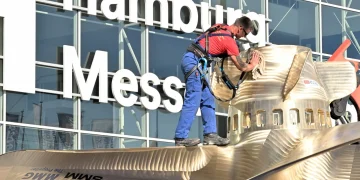





The opening conference at SMM put two major issues facing the maritime industry firmly on the agenda: escalating security risks in the Middle East and growing uncertainty surrounding the IMO Net Zero Framework. Yet as senior industry and policy figures debated the challenges confronting shipping, the deeper causes behind the current geopolitical turmoil largely remained off the table.
The subject surfaced most clearly at the end of a discussion focused on security and the protection of maritime assets. When Emma Salisbury, senior fellow at the Foreign Policy Research Institute and associate fellow at the Royal Navy Strategic Studies Centre, was asked to sum up the issue, her answer was blunt: “Trump.”
Moderator Andrea Thilo immediately attempted to steer the discussion elsewhere, saying: “Let’s not talk about Trump.” But the US president’s policies had already featured prominently throughout the morning and would continue to shape the discussion, particularly in relation to the war in Iran and US intervention in the IMO’s vote on the Net Zero Framework in October last year.
On the question of maritime security, International Chamber of Shipping (ICS) chairman John Denholm argued that the world’s three major powers are pursuing territorial ambitions, a point further developed by Salisbury.
Removing Trump’s name from the equation, Salisbury described a broader shift in international relations.
“I think we are moving into a world where the great powers…don’t recognise the value of rules-based order anymore, and they realise that they do get what they want through hard power, and they don’t have to co-operate in the same way that they used to.”
For Salisbury, restoring a rules-based international order would require persuading those same major powers that cooperation serves their own interests. Without a clear benefit, she argued, countries will have little incentive to participate and may instead continue to act according to their own interests.
Denholm pointed to the Middle East as a clear illustration of the limits of military power when it comes to achieving geopolitical objectives or restoring normality.
“Unfortunately, the war in the Middle East has shown that even the might of the US Navy cannot protect a relatively narrow passage of water, and that’s because of asymmetric warfare. I don’t think military force will create stability. It’s actually a peaceful endeavour and working together as nations that will restore security for the shipping industry,” he said.
For shipping companies, however, the immediate reality is that vessels will continue to be rerouted away from conflict zones. Denholm said the industry would continue delivering goods around the world, even if doing so comes at a higher cost.
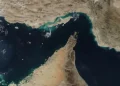
The Strait of Hormuz remains effectively closed, with vessels that attempt to transit the waterway frequently coming under attack from Iranian forces. At the same time, the United States is maintaining its own blockade of Iranian ports.
IMO secretary general Arsenio Dominguez once again urged the industry not to expose seafarers to such high-risk areas. Denholm added that responsible shipowners would not deliberately send their vessels into danger.
Standing alongside the IMO secretary general, Denholm also connected the current geopolitical crisis with the regulatory challenges facing international shipping.
“If we don’t obey the rules of the seas, we’ll have terrible access, and we don’t want nation states interfering in the role of the IMO and undermining it. Regulation can’t solve these problems. We just need countries to respect the rule of law and the way things work, and have a rules-based system. We need to get back to that, and it’s quite broken.”
The debate over security is closely linked to another major uncertainty for shipping: the future of the IMO’s Net Zero Framework.
The US delegation to the IMO played a key role in derailing the framework last year, threatening member states with reprisals if they voted in favour of the green policy.
Despite decarbonisation receiving considerably less attention in shipping headlines recently, Dominguez was keen to stress that the work at the IMO has continued.
Just one hour before his statement, the IMO Intersessional Working Group on Greenhouse Gas Emissions (ISWG-GHG 22) had opened in London to resume negotiations on the Net Zero Framework.
For Dr. Uwe Lauber, CEO of Everllence, the uncertainty surrounding the regulatory framework has direct consequences for investment decisions.
“Without the regulatory framework, I will not invest any more in the development of a new engine type for alternative fuels,” he said.
Everllence has already made what Lauber described as “tremendous” investments in alternative fuel technologies. The company’s main lesson from that experience, he explained, is that decarbonisation rules and regulations must ultimately be global rather than being driven solely by Europe.
“We can only pay the bill as a whole society, that means the global countries have to work together,” said Lauber.
The message emerging from SMM was therefore twofold. Maritime security cannot be separated from the wider breakdown of international cooperation, while shipping’s decarbonisation ambitions remain dependent on a stable and genuinely global regulatory framework.
For an industry operating across borders by definition, both challenges point to the same underlying requirement: countries must once again find a way to cooperate.