



A US-sanctioned tanker has unexpectedly reversed course after what initially appeared to be a successful transit of the Strait of Hormuz, adding weight to indications that the United States is actively enforcing its blockade of Iranian ports.
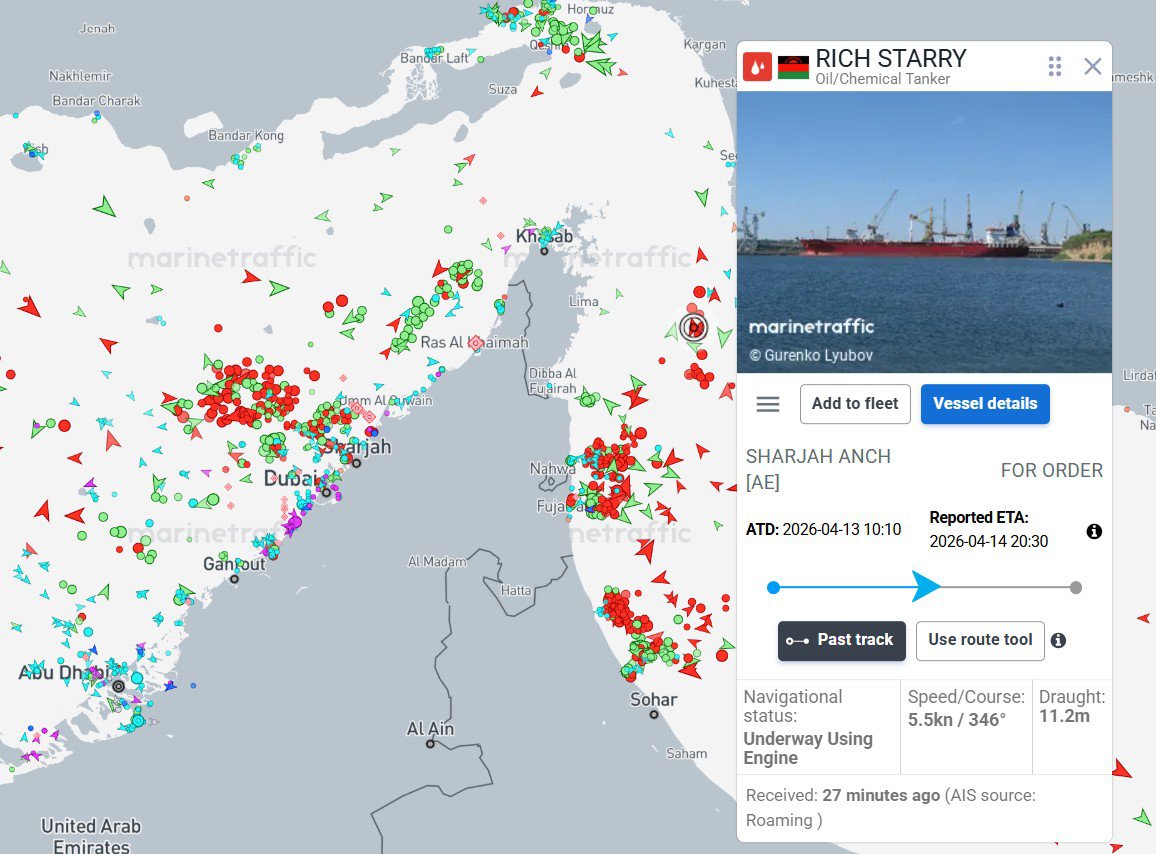
AIS data from Pole Star Global shows that the tanker Rich Starry, which is falsely flying the Malawi flag, abruptly turned north after exiting the Strait instead of continuing into the Arabian Sea.
The vessel’s movements appear to support the view that the US blockade is being enforced outside the Arabian Gulf, allowing US naval forces to intercept merchant ships further away from the immediate threat of Iranian retaliation.
Martin Kelly, head of advisory at EOS Marine, said in a social media post that the US blockade now appeared to be in force.
Rich Starry had been signalling China as its destination and was shown as laden after loading in the UAE, although security specialists noted that the vessel has a history of falsifying its AIS information.
The tanker is one of two ships being closely monitored as an early test of the blockade. The second vessel, Elpis, slowed to a halt at the entrance to the Arabian Sea after completing its own transit of the Strait of Hormuz.
The apparent change in behaviour comes as an audio recording circulates within maritime circles, reportedly featuring a US Navy warning to ships not to breach the blockade of Iran’s ports. According to the recording, vessels travelling to or from Iranian ports could face interdiction and seizure, with force threatened if they do not comply.
Rich Starry was added to OFAC’s sanctions list under its previous name, Full Star, in early 2023 because of links to Shanghai Xuanrun Shipping Co. and alleged involvement in moving petrochemical cargoes from Iran.
Elpis, previously known as Chamtang, was sanctioned in February 2025 over links to Malaysia-based IMS Ltd. and its alleged role in transporting Iranian petroleum. The vessel is currently shown as falsely flying the flag of Comoros.