



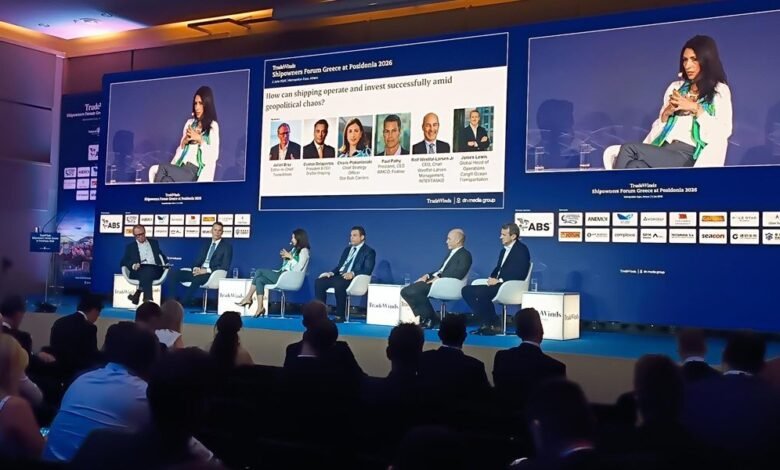
Shipping leaders gathered at the TradeWinds Shipowners Forum during Posidonia painted a clear picture of an industry no longer driven solely by cycles and fundamentals, but increasingly shaped by geopolitics that is actively redrawing global trade flows, fleet deployment strategies, financing decisions and asset values.
A central message from the panel was that geopolitical developments are no longer temporary disruptions but structural forces reshaping entire shipping markets.
“Nowadays, we see that geopolitics is not simply creating operational disruptions. Geopolitics are redefining entire markets across segments,” said Charis Plakantonaki, chief strategy officer at Star Bulk Carriers.
She pointed to a series of major global shocks—including the US-China trade war, Covid-19, the Ukraine conflict, Red Sea attacks and tensions in the Persian Gulf—as key drivers that have already reshaped global trade patterns.
“From the US-China trade war, we saw China shifting trade from US to Brazil. We saw Europe shifting trade from Russia to other countries,” she said.
The latest Middle East tensions are also having a direct operational impact, with Plakantonaki noting that more than 200 vessels are currently “trapped in the Gulf”, while higher oil prices have pushed average dry bulk vessel speeds to below 11 knots.
Despite these disruptions, she described a “net positive effect” for the dry bulk sector from developments in the Persian Gulf, while warning that rising insurance costs, sanctions exposure and security risks remain significant challenges.
From a chartering and trading perspective, James Lewis, vice president at Cargill Ocean Transportation, said the speed of change has reached unprecedented levels.
“I think we’d summarise it that it’s definitely structurally more difficult,” he said. “The biggest difference is the speed of change.”
He added that he has not witnessed this level of volatility in two decades, with operators increasingly relying on flexibility, technology and collaboration to adapt to rapidly shifting conditions.
“What enabled us to kind of navigate around that quickly was the collaboration with our partners, flexibility in our charters,” he said.
Fednav chief executive and BIMCO president Paul Pathy argued that shipping has always been adaptable, but the intensity and pace of disruption has increased significantly.
“Shipping companies generally are actually quite flexible and adaptable in changing strategy,” he said. “Things hit fast now. Things are more ferocious, very quick happening. So the strategy has to evolve more quickly.”
The discussion also focused on whether shipping could be forced into geopolitical alignment amid growing US-China tensions.
Lewis described how rapidly shifting trade signals have complicated fleet strategy decisions.
“We’d spent years in Cargill trying to build up a fleet of modern eco ships, particularly Japanese built. We felt very good. Suddenly the next day we didn’t want them. We wanted Chinese ships. Suddenly the next week we wanted Japanese ships,” he said.
Pathy, however, argued that commercial logic will ultimately prevail.
“China is business focused. The United States is business focused,” he said. “Ultimately, money talks.” He added: “No, I don’t think it will,” when asked if shipping would have to choose sides.
The panel also highlighted rising concerns around the “weaponisation” of shipping.
Intertanko chair Rolf Westfal-Larsen Jr warned that vessels are increasingly being used as geopolitical tools.
“Shipping and especially tankers are being used actively as a political weapon and shipping is being weaponized,” he said.
He pointed to ongoing attacks on vessels, calling the situation a potential turning point.
“Several seafarers have been killed in the process and attacks are ongoing. That’s maybe the game changer,” he said.
He added that certain routes can no longer be assessed purely commercially.
“When it comes to such significant risk as that, at Intertanko we just have to advise our members to stay away from, especially Hormuz, Strait of Hormuz.”
He also highlighted the expansion of the “dark fleet”, estimating around 1,500 tankers operating outside regulatory frameworks.
“They’re completely doing their own thing outside of regulations at great risks to international safety,” he said, warning that weak enforcement could accelerate its growth.
“You really just want a level playing field,” added Pathy. “If you have a portion of the world’s fleet that is kind of not following the rules, that is highly detrimental to the rest of the world’s fleet.”
DryDel Shipping CEO Costas Delaportas highlighted how fast-changing sanctions regimes are complicating compliance.
“You can easily carry legitimate cargo, but in one day can rapidly change these rules,” he said. “You can end up with the sanctions of cargo despite you have done everything perfect.” He also noted bunker delays of 10–12 days in some regions.
Across the discussion, speakers consistently returned to the same conclusion: shipping strategies must increasingly prioritise flexibility, diversification and financial discipline.
Pathy stressed the need to “match the risk to the reward”, Lewis highlighted “building flexibility into your model”, and Westfal-Larsen warned against concentration risk while stressing contractual protections such as force majeure clauses.
Plakantonaki concluded with a focus on financial resilience.
“My advice to shipping company is a strong balance sheet,” she said. “Cash is king once again.”
As geopolitical pressures intensify, the message from Posidonia was clear: resilience, liquidity and adaptability are now core competitive requirements for global shipping.