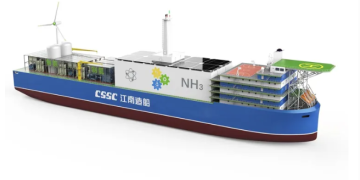




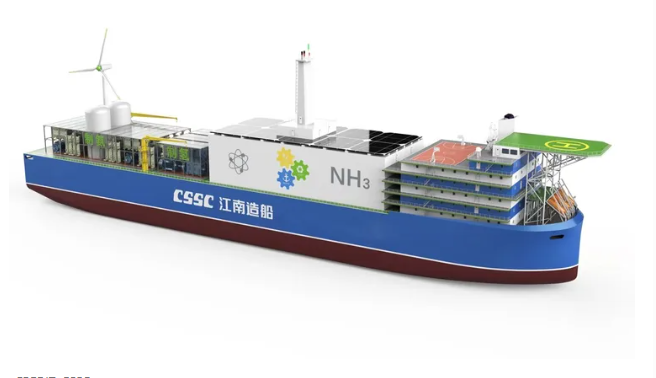
Jiangnan Shipyard has introduced a new Molten Salt Reactor (MSR)-based container shipping concept that places fourth-generation nuclear energy at the centre of what it describes as a fully integrated, zero-emission maritime logistics ecosystem.
The Chinese shipbuilder’s proposal goes beyond conventional vessel design, outlining a connected operational model that links ships, ports, energy production and cargo handling into a unified system aimed at reshaping long-term container shipping architecture.
At the heart of the concept is a closed-loop, zero-carbon transport network built around multiple operational layers. This includes MSR-powered deepsea container vessels, nuclear-powered tugs, all-electric feeder ships, as well as supporting infrastructure such as nuclear energy generation platforms and green fuel production units.
A key feature of the system is a nuclear-powered container transshipment terminal designed to support ocean trunk routes, coastal feeder operations and cargo handling activities within a single coordinated framework.
Nuclear energy integrated across maritime operations
According to Jiangnan Shipyard, the energy platform within the system would use molten salt reactors combined with power generation units to deliver electricity for floating offshore terminals. It would also support charging infrastructure for all-electric feeder vessels while they are docked.
Beyond electricity supply, the system is designed to produce green ammonia and other zero-carbon fuels at scale, enabling refuelling of coastal vessels and expanding the operational range of low-emission maritime transport solutions.
The concept integrates nuclear energy with electric propulsion systems and introduces a set of operational frameworks focused on navigation efficiency, fleet coordination, lifecycle management and emissions elimination across the entire shipping chain.
A central argument behind the design is the inherent safety advantages associated with molten salt reactor technology, which Jiangnan Shipyard positions as a key enabler for scalable nuclear-powered maritime operations.
A modular vision for global shipping decarbonisation
The proposed system is designed as a modular and replicable architecture that could be adapted to different port configurations and major global shipping lanes. Jiangnan Shipbuilding underscores its value-chain solution potential to speed the transition of the maritime industry to net-zero operations.
The aim is to integrate green fuel production into the energy infrastructure to facilitate wider decarbonization of container shipping and associated coastal logistics operations.
Jiangnan Shipbuilding Industry Group has been developing nuclear-powered ship concepts for several years. In 2023, the company unveiled earlier designs for ultra-large nuclear-powered container ships that obtained Approval in Principle (AiP) from the major international classification societies, a signal of early-stage endorsement of the technical direction.
- Latest
- Trending
ADVERTISEMENT