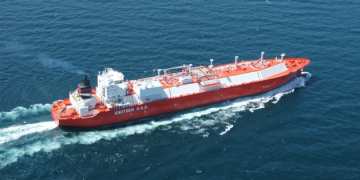




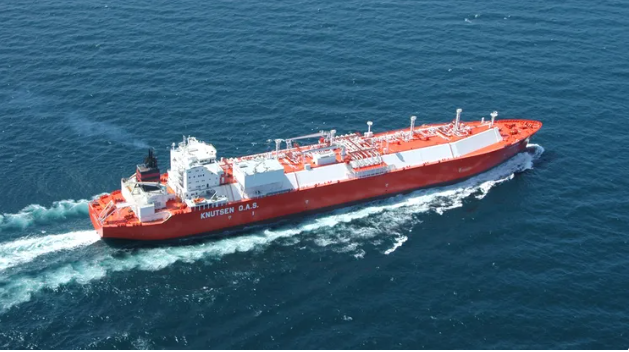
The maritime industry’s search for zero-emission propulsion may be entering a new era as Norwegian tanker operator Knutsen joins a pioneering project exploring the use of nuclear energy at sea.
Knutsen has agreed to participate in a trial designed to assess the feasibility of installing a maritime nuclear reactor aboard its 77,200 dwt LNG carrier Cadiz Knutsen. The initiative brings together several major players from Norway’s maritime and technological ecosystem, including the Norwegian University of Science and Technology (NTNU), Tesser Atomics, and nuclear technology developer Kairos Power.
The project reflects Norway’s long-standing culture of collaboration within its maritime clusters and could represent a major milestone in the decarbonisation of global shipping.
The proposed solution relies on the next-generation Kairos Power’s KP-FHR (fluoride salt-cooled high-temperature reactor), a nuclear reactor technology employing molten fluoride salt as a coolant and operating at low pressure. The reactor would be powered by TRISO fuel, a highly advanced form of nuclear fuel known for its exceptional safety and durability characteristics.
Speaking at the Nuclear Propulsion for Shipping conference held at NTNU in Ålesund, Norway, Kairos Power founder and Chief Nuclear Officer Per Peterson argued that many of today’s alternative marine fuels struggle to provide a practical long-term solution for shipping. He also noted that the increasing reliance on slow steaming is reducing operational efficiency across the sector.
According to Peterson, the combination of TRISO fuel and molten-salt reactor technology could create a realistic pathway toward large-scale maritime decarbonisation.
TRISO fuel consists of uranium enriched to 19.75%, encapsulated within ceramic spheres and protected by multiple layers of pyrolytic carbon. Peterson highlighted not only its strong safety credentials but also its environmental advantages, particularly its remarkable durability in seawater environments.
“The key thing that we’re doing is leveraging TRISO fuel,” Peterson explained. “It has tremendous safety attributes because it’s a fully ceramic fuel, but it also offers significant environmental benefits thanks to its durability in marine conditions.”
Under the current concept, the Cadiz Knutsen would be fitted with two KP-FHR reactors. The vessel already operates with a steam turbine propulsion system supported by two Mitsubishi Heavy Industries boilers capable of producing 65,000 kg of steam per hour. This existing configuration is expected to simplify the transition from conventional propulsion to nuclear power compared with vessels using traditional diesel engines.
The project is still awaiting a series of regulatory and safety approvals but Peterson said he believes the conversion could become a reality by 2031.
If successful, the initiative could lead to dedicated nuclear-powered shipping corridors. Peterson envisions an initial deployment on LNG routes linking Texas and Europe, supported by a fleet of approximately 40 to 50 nuclear-powered LNG carriers.
Such a network would serve as a proof of concept for wider adoption across global trade routes.
“We would establish nuclear corridors for ships to operate on,” Peterson said. “Once successful, similar corridors could be developed across the Pacific, followed by other cargo sectors. Ultimately, nuclear-powered vessels could become a standard solution for cargo transportation worldwide.”
As pressure mounts on the shipping industry to achieve ambitious decarbonisation targets, projects like the Cadiz Knutsen trial are attracting increasing attention. While significant technical, regulatory and public acceptance challenges remain, supporters argue that nuclear propulsion could offer something few alternative fuels can: virtually unlimited range combined with zero operational emissions.
For an industry seeking long-term solutions to its carbon footprint, the next decade could determine whether nuclear energy moves from concept to commercial reality on the world’s oceans