




The Islamabad Memorandum of Understanding signed by the United States and Iran on 17 June 2026 does not make Iran a more powerful regional power overnight. But it does usher in a more complicated and arguably more important change: the re-entry of Iran into global trade and finance after a time of war, sanctions and maritime disruption.
Iran emerges from the 2026 conflict with damaged energy infrastructure, limited oil export capacity and an unresolved nuclear program status. Its regional influence has also weakened, particularly in the Levant. Yet the real significance of the agreement lies not in Iran’s immediate condition, but in the trajectory it opens—one where sanctions are lifted, maritime corridors are reopened, and capital begins to flow again.
At the centre of this framework is a phased lifting of the naval blockade on the Strait of Hormuz, the removal of sanctions on Iranian crude and related financial services, the release of frozen assets, and the potential creation of a reconstruction fund estimated at around $300 billion. Taken together, these measures do not simply restore Iran’s position—they re-legitimise its participation in global trade.
A weaker Iran, but back in the system
The deal’s immediate mechanics are designed around de-escalation. A 60-day negotiation window is established for unresolved political and security issues, while commercial shipping through Hormuz is progressively restored. Crucially, oil export waivers take effect immediately, and financial unfreezing begins reintegrating Iran into formal banking and insurance systems.
The distinction is important: this is not a resurgence of Iranian strength, but a reintegration into global trade architecture. And that reintegration, more than military or political power, is what reshapes maritime flows.
Hormuz: from disruption to normalization
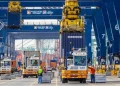
The reopening of the Strait of Hormuz has immediate consequences for global shipping. As a chokepoint for roughly one-fifth of global oil and gas flows, its normalisation reduces war-risk premiums, restores transit efficiency, and reverses costly rerouting and slow-steaming strategies adopted during the blockade period.
More structurally, Iranian crude exits the shadow economy. Previously dependent on ship-to-ship transfers and re-labelling through intermediary countries, exports now return to declared, insurable, and financeable channels. This shifts over a million barrels per day back into visible global supply, tightening competition among Gulf producers and narrowing Iran’s discount pricing.
Iran’s reintegration also creates a three-front competition dynamic with Saudi Arabia, the UAE, and Iraq: crude market share, reconstruction capital, and logistics corridor influence. At the same time, reconstruction demand triggers significant inbound flows of steel, cement, machinery, and project cargo, benefiting suppliers across the Gulf, Turkey, and China.
China: positioned, but not fully committed
China sits at the centre of the emerging equilibrium—but not unambiguously as the winner.
On one hand, stable access to Hormuz secures a critical energy route for an economy sourcing around half of its seaborne oil from the Gulf. China is also structurally well placed for reconstruction contracts, given its engineering capacity and long-standing infrastructure engagement in the region.
On the other hand, Beijing’s historical behaviour suggests caution rather than acceleration. Despite political alignment with Tehran, Chinese investment has consistently flowed toward Saudi Arabia, Iraq, Egypt, and Central Asia rather than Iran. Iranian trade represents less than 4% of China’s total exchange with Russia combined, and oil flows to China declined sharply in late 2025.
Legalisation of Iranian crude also removes the discount advantage that previously benefited Chinese refiners operating under sanction constraints. While China gains stability of supply, it loses pricing arbitrage. At the same time, Iran regaining legitimacy also regains the ability to diversify partnerships away from Beijing, reducing China’s leverage.
In effect, China emerges less as an investor of first resort and more as a strategic free rider: benefiting from US-enforced maritime security while selectively engaging in commercially viable reconstruction opportunities.
Bab-el-Mandeb: the unresolved chokepoint
If Hormuz stabilises, Bab-el-Mandeb does not follow the same trajectory.
The Red Sea remains governed by a separate conflict dynamic tied to Gaza and regional proxy alignments. The Houthis, operating in Yemen, continue to represent an independent escalation vector, even as Iran’s formal status improves under the MoU framework.
A reintegrated Iran may regain the financial capacity to support regional partners, including the Houthis, potentially increasing their operational resilience at a time when other Axis-aligned groups have weakened. This introduces a structural asymmetry: one chokepoint stabilises while another remains exposed.
The implications for global trade are significant. Around 12% of global trade passes through Bab-el-Mandeb, and disruptions previously halved oil transit through the corridor. Diversions via the Cape of Good Hope add approximately two weeks to Asia–Europe routes, increasing costs and reducing efficiency across global supply chains.
Insurance markets reflect this split reality: risk premiums compress in Hormuz while remaining elevated in the Red Sea, where targeting logic has expanded beyond vessels to include ownership structures and commercial affiliations.
A bifurcated maritime risk map
The result is a fragmented global risk geography. One corridor reopens and normalises; another remains structurally unstable. Even within the same trade routes, risk is no longer linear but conditional—dependent on identity, affiliation, and geopolitical signalling.
At the same time, reconstruction flows into Iran create a secondary layer of competition. Frozen assets, potentially diverted through Gulf intermediaries, underscore regional financial interdependence. Ports, industrial corridors and logistics hubs throughout the region are vying for capital inflows associated with reconstruction efforts.
The longer horizon: corridor reactivation
Beyond immediate stabilisation, the agreement opens the possibility of longer-term structural shifts in global trade routes.
Projects such as the International North-South Transport Corridor via Chabahar and potential Belt and Road land bridges linking Asia to the Mediterranean could reposition Iran as a land–sea connector between major trade blocs. While weakened regional influence limits immediate execution, the strategic logic remains intact: Iran as a transit node rather than a sanctioned periphery.
Conclusion: a map being redrawn, not simplified
The Islamabad MoU does not reduce global trade risk—it redistributes it.
Hormuz is reopened, Iranian exports return to formal markets, and reconstruction creates new commercial flows. China is positioned to benefit, though not without constraints or hesitation. Meanwhile, Bab-el-Mandeb remains a persistent instability point, ensuring that global maritime risk does not decline uniformly.
The central variable going forward is not whether Iran is stronger or weaker, but how it chooses to use reintegration: as a stabilising force to secure economic normalisation, or as a renewed channel of regional leverage. Shipping lines, insurers, and traders will not be pricing Iran’s strength—they will be pricing its restraint.
- Latest
- Trending
ADVERTISEMENT