




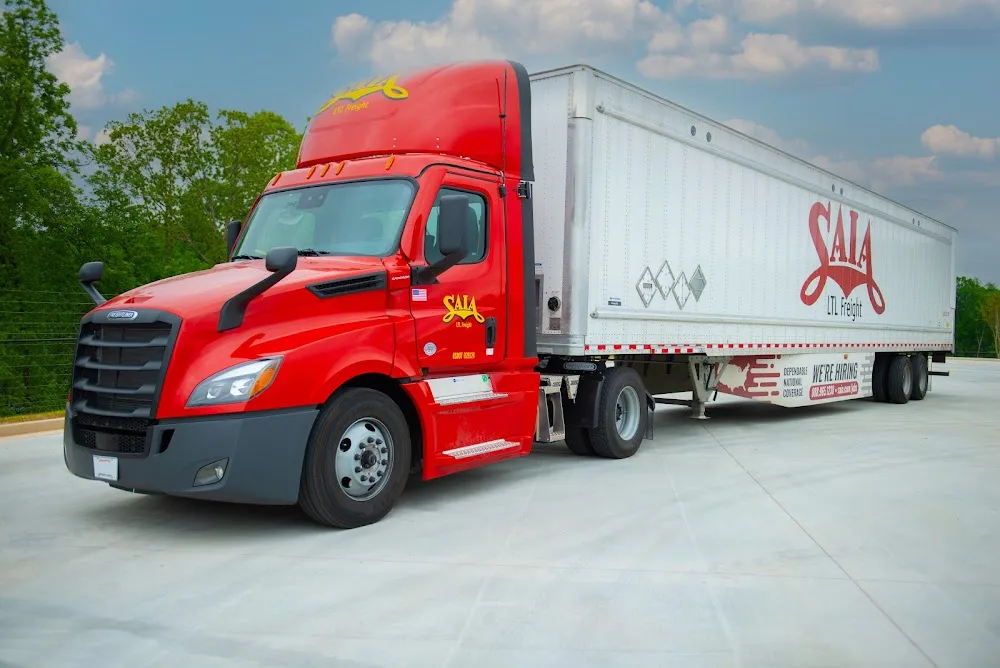
Saia saw its shares decline nearly 12% in Thursday’s midday trading after issuing a third-quarter margin outlook that fell short of investor expectations, overshadowing an otherwise strong second-quarter financial performance.
The company also revised its full-year margin expectations, indicating it now expects results to land at the lower end of its previously announced guidance of 100 to 200 basis points of year-over-year improvement.
Despite the cautious outlook, President and CEO Fritz Holzgrefe highlighted the company’s operational progress, pointing to record revenue, tonnage and shipment volumes during the second quarter, supported by continued expansion of Saia’s national service network.
For the quarter, Saia reported earnings of $3.51 per share, exceeding analyst expectations by 12 cents and improving 84 cents compared with the same period last year. Lower tax expenses contributed approximately 2 cents per share, while reduced net interest expense added another 8 cents.
Revenue increased 17% year over year to $957 million, broadly matching market expectations. Both shipment tonnage and overall yield rose 8% compared with the prior year, although yield excluding fuel surcharges declined 2%.
Growth in freight volumes was driven by a 4% increase in both shipment counts and average shipment weight. Monthly tonnage growth accelerated throughout the quarter, rising 6.9% in April, 8.4% in May and 9.9% in June, while July volumes remained strong with a 7.5% year-over-year increase.
On July 6, Saia implemented a 7.1% general rate increase (GRI), introducing the pricing adjustment three months earlier than in the previous year and at a level 120 basis points higher. Management noted that general rate increases can temporarily affect shipment volumes as customers evaluate alternative transportation options.
Using a two-year comparison to smooth year-over-year fluctuations, the company said tonnage growth has remained consistently between 8% and 9% over the past three months.
Management also addressed the 2% decline in yield excluding fuel surcharges, explaining that heavier shipments and a 1% reduction in average haul length reduced revenue per hundredweight. Excluding those factors, along with softer freight activity in the Los Angeles market, the company estimated that underlying yield increased by approximately 3%.
Contract renewals remained particularly strong, averaging 10.7% during the second quarter, or 15.8% on a two-year comparison. Company executives noted that Saia’s pricing remains competitive relative to the level of service it provides.
Saia reported an operating ratio of 86.9%, a 90 basis point improvement over the prior year and the company’s first year-over-year improvement in operating ratio since the first quarter of 2024.
Management is forecasting a softer operating margin for the third quarter. Saia usually sees a sequential decline of 150 to 200 basis points between the second and third quarters, but now expects a decline of about 100 basis points. Even so, the projected 87.9% operating ratio for the third quarter would still represent a slight year-over-year deterioration after adjusting for a one-time real estate gain recorded during the third quarter of 2025.
Executives attributed part of the expected margin pressure to the earlier timing of employee wage increases.
The company also continues to absorb the costs of its significant network expansion. Since 2022, Saia has added 33 new service centers and expanded or relocated 25 additional terminals, increasing its total door capacity by approximately 25% and improving its nationwide coverage.
Profitability at these newer facilities improved by about 300 basis points in the second quarter, but they still operate at an operating ratio in the low-90% range and are less profitable than Saia’s existing network.
Saia reaffirmed its 2026 net capital expenditure guidance of $350 million to $400 million. By comparison, net capital expenditures totaled $544 million in 2025 and $1.05 billion in 2024.
In midday trading after the earnings release, Saia’s stock was down 11.7% while the S&P 500 was up 1.3%.